Views of Vietnam

Source: https://c1.staticflickr.com/9/8376/8525983904_2377fabcd0_b.jpg

By Felicia Teba

Target Students: 8th grade US History

Skills: Sourcing and Contextualization

Topic: The Vietnam War

Essential Question: How did the various  aspects of the war in Vietnam impact opinions on the war?

Description: The questions in this set of documents help students to understand that war doesn’t just impact a nation, but that it impacts individuals, and the Vietnam War was one of the most contentious.


Source 1: A Letter Home

August 27, 1967

Dear all,

Surprise! Charlton Heston visited our company for a few minutes, and I shook hands with him! He looked like an old farmer the way he was dressed in old drab green jungle fatigues. He said “almost everybody is backing us over here” and “I’d like a beer.”

Can’t think of anything else to say. The new library opened up– air conditioned and quiet.

Well, cheerio

Rick

Source: Dear America: Letters Home from Vietnam, edited by Bernard Edelman, p.158.

Questions

  1. Why do you think Rick wrote this letter?
  2. Who is Charlton Heston, and why was he visiting Rick’s company?
  3. Who do you think Rick was writing to in this letter?
  4. What do you think the war was like at this point in 1967?
  5. Did Rick write his letter before or after the Tet offensive? Would that have impacted what he wrote about?

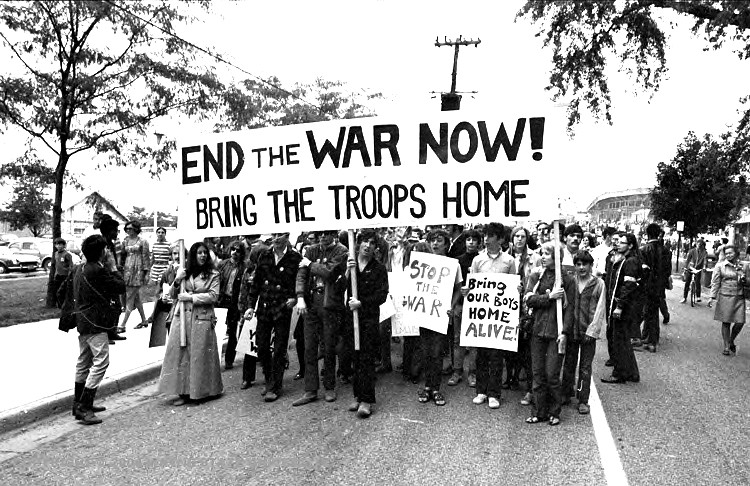
Source 2 & 3: Different Views of Support
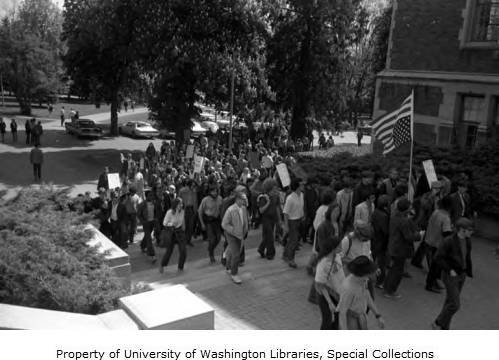
Protestors_carrying_an_American_flag_at_a_rally_on_the_University_of_Washington_campus_May_7_1970
Protestors carrying an American flag at a rally on the University of Washington campus May 7 1970


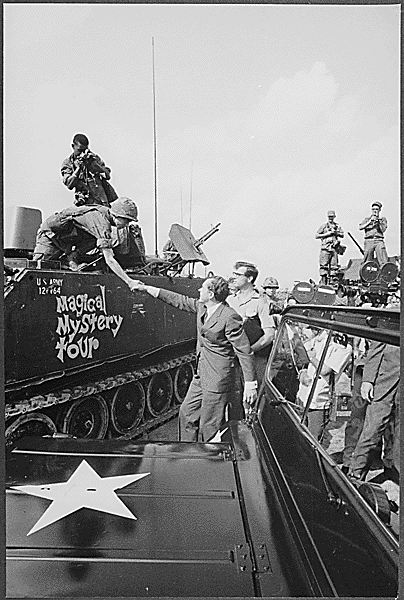
Richard M. Nixon shaking hands with armed forces in Vietnam 1969

Protestors carrying an American flag at a rally on the University of Washington campus, May 7, 1970  Source
Richard M. Nixon shaking hands with armed forces in Vietnam 1969 Source

Questions

  1. Who is in this picture?
  2. What is going on?
  3. Digging Deeper Questions
  4. Why would it be important to take a picture like this?
  5. What audience would like this picture? Which audience would dislike this picture?
  6. On the picture on the right, why is the American flag upside down?

Source 4: “A Day in Vietnam”

Questions

  1. Who do you think made this video?
  2. Who is the audience?
  3. Why was this video made?
  4. What reason could there be for a video like this?
  5. If you were an American civilian at this time, how might this video impact your opinion of the war?

Reflections: In this assignment, I think I could have done better at providing a context for when I would teach these particular unit. To use this lesson, I would add a lecture that gives background to each of the sources, so that students are not left confuse about what I am asking them to look for. With this lesson, I think it would also be good to stick with just one type of source, like just soldiers letters, so that my set of sources is not too broad.


Learning about Primary Sources

Bruce_Crandall's_UH-1D

Hello! I am working with a group 8th grade students in a 90 minute Language Arts/Social Studies  block. Which is what I had in for this lesson study.

Content: Students will read a letter from the book Dear America: Letters Home from Vietnam.                                                                                                                                                                         This lesson has the following elements:

  1. Examining and analyzing primary sources.
  2. Understanding the role of written letters in peoples’ lives
  3. Applying knowledge of the Vietnam war to primary sources
  4. Understanding the changing perspective of the war in Vietnam
  5. Learning how to work in groups and discuss

Process: In this lesson, students will choose a letter from a small selection of letters (3-4) from Dear America. After they have picked their letter they will read it and highlight what they believe to be important. Students will then share with each other and discuss what they learned from their letter (what was something new that they learned, or what surprised them about the letter). Then as a class we will discuss what the letters are about and how it reflects what we will have learned/read in class. The students will then do a short 1/2 page write up summarizing what they learned about soldiers’ lives during the Vietnam War.

Product: The end product will be a short write up that would include the letter they examined. The letter should show signs that they highlighted and some notes on what they felt to be important.

Evaluation: Learning will be assessed via a rubric, which will be used to grade their short paper and letter examination. This evaluation will show them how well they did at writing and understanding the process that we were going through. Some informal assessment will also come from student participation in both group and class discussion.

What kinds of thinking will students need to do to participate in the lesson?          The students will need to do higher order thinking through analysis and evaluation of primary sources. Students will have to do some kind of reflection on what they think is important when learning about a complicated historical event like the Vietnam War

To what extent do students have options or choices regarding these lesson components?                                                                                                                                                         This activity allows for students to have a choice in the primary source that they analyze. It also allows them to draw their own connections to history.

Reflection: After having gone through the peer review process with this assignment, I made some changes that are reflected in this post. Before these changes, I don’t think my lesson would have worked very well with eighth graders. In my initial lesson study the activities would have been better done with high schoolers. I think with the changes that I have in this post, I would make this an engaging activity for middle schoolers.

Image Credit: Bruce Crandall’s UH-1D