
Rubber Atrocities

Background Information: Men of the Nsongo District (ABIR concession) with hands of two of their countrymen Lingomo and Bolenge murdered by rubber sentries of ABIR Anglo-Belgian India Rubber Company in May 1904. The two European men are Mr. Stannard and Mr. Harris of the Congo Balolo Mission at Baringa. This image formed part of the Harris Lantern Slide Collection. Under King Leopold II the Congo Free State used mass forced labour to extract rubber from the jungle for the European market. As consumer demand grew King Leopold II’s private army – the Force Publique – used violent means to coerce the population into meeting quotas, including murder, mutilation, rape, village burning, starvation and hostage taking. Alice Seeley Harris and her husband Reverend John H. Harris were missionaries in the Congo Free State from the late 1890s.
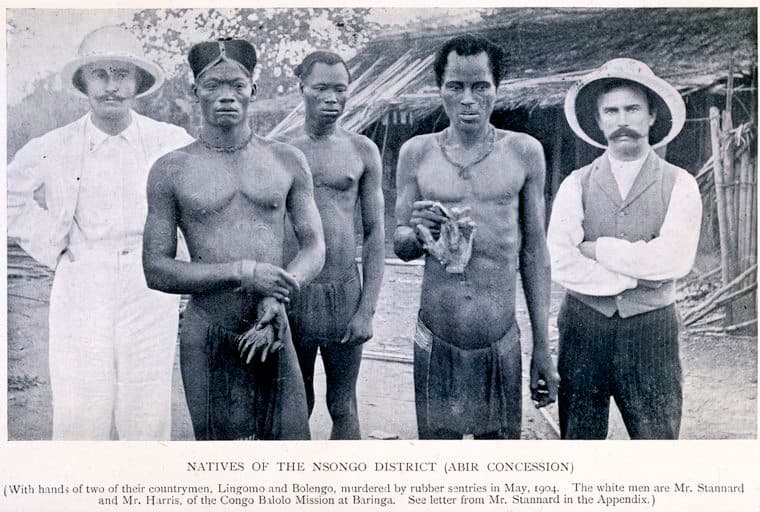
Image courtesy of NYPL Digital Collections

Background Information: This 1904 photograph is by Alice Seeley Harris, the man’s name is Nsala. Here is part of her account (from the book “Don’t Call Me Lady: The Journey of Lady Alice Seeley Harris”): He hadn’t made his rubber quota for the day so the Belgian-appointed overseers had cut off his daughter’s hand and foot. Her name was Boali. She was five years old. Then they killed her. But they weren’t finished. Then they killed his wife too.

And because that didn’t seem quite cruel enough, quite strong enough to make their case, they cannibalized both Boali and her mother. And they presented Nsala with the tokens, the leftovers from the once living body of his darling child whom he so loved. His life was destroyed.

They had partially destroyed it anyway by forcing his servitude but this act finished it for him. All of this filth had occurred because one man, one man who lived thousands of miles across the sea, one man who couldn’t get rich enough, had decreed that this land was his and that these people should serve his own greed. Leopold had not given any thought to the idea that these African children, these men, and women, were our fully human brothers, created equally by the same Hand that had created his own lineage of European Royalty.

Image courtesy of NYPL Digital Collections

Questions:

  1. What do you think was Alice Seeley Harris’ intention in taking these images? How do you think she gained access to take and share these photos?
  2. Imagine you were alive during this time. How might you respond to each of these images? Would your perspective change if you were Belgian?
  3. What do you think the posing of the subjects in the images shows us about the interactions between the photographer and the subjects?

Instructional Goals and Model Answers:

The learners will evaluate the photographs along with their understanding of the time and place they were taken. The learner will explain their perspective on the intentions of the photographer and their access to the subjects.

  1. Alice Seeley Harris was a missionary in the Belgian Congo. Her position as a missionary might have helped her gain access to take these photos. I believe her intention in taking these photographs was to show the inhumanity happening at that time. What was happening must have seemed very far away from Europe at that time, so her intention may have been to show that this evilness was occurring and was real.
  2. It might have been difficult at the time for someone to believe that these images were real, especially someone who was Belgian. They may not have wanted to face or accept the fact that the rubber industry was this horrible.
  3. It’s difficult to imagine the circumstances in which these photographs were taken. Alice Seeley Harris had to have been standing in front of these people. I wonder what she said to them in order for them to let her take their picture, especially the guards, and how they must have compartmentalized and dehumanized the Congolese people in order to do what they did. The second photograph is incredibly powerful, made even more so by the framing. Nsala’s devastation and emptiness is felt by the viewer.

Bolshevik Propaganda Corner

Image courtesy of Picryl

Context: This cartoon from 1919 depicts Lenin and Trotsky, two of the most prominent figures of the October Revolution in Russia in 1917. The two men are shown here as lizards in a room with aristocrats. It was published in the New York Herald.

Icebreaker Prompt: Analyze the image. Brainstorm a list of questions. Are the questions closed, or open? Rank the questions in terms of your curiosity and discuss your rankings.

Student Response:

  1. Both men are drawn as lizards. What is the artist’s purpose in doing this? Are they meant to not look trustworthy?
  2. There is a picture on the wall of an eagle. Are they in Germany or Russia? What is significant about both of those countries at this time, and the presence of Lenin and Trotsky in them?
  3. Lenin and Trotsky are up on a stage and all the people in the room are looking at them. What is this meant to represent? Is the artist trying to say that wealthy people are being tricked by these revolutionaries?
  4. This cartoon appeared in an American publication and has text in English. Knowing the context of the time, what was the publication trying to say about Lenin and Trotsky? How would someone in the US react differently to this cartoon than someone in Russia would have at the time? How does the meaning of the cartoon changed based on who is viewing it?
Image courtesy of Picryl

Context: This poster is from 1937 and depicts Trotsky, a political rival of Stalin, being picked up and about to be beaten by a large figure meant to depict the Russian proletariat. Trotsky is grabbing for many papers and his hands are covered in blood. He is wearing one Nazi boot and one cowboy boot with a spur.

Icebreaker Prompt: Analyze the image. Are there any symbols? In what context do they fit, and how are they confusing?

Student Response:

  1. Proletariat in red: How does the size of this man show his power, in contrast with Trotsky’s size? What does the red suit symbolize in Russia at this point in time? Is there anything important about this man’s mustache? Which other important Russian figure had a big, beautiful mustache at this time?
  2. Papers: What do all of these papers represent? Was Trotsky more of an intellectual than the majority of the Russian people? Was this seen as a positive or a negative? How can we tell from this cartoon?
  3. Blood on Trotsky’s hands: Trotsky’s hands are depicted as claws covered in blood, how does this influence how the viewer is supposed to see him?
  4. Trotsky’s boots: With one western cowboy boot and one Nazi boot, what does this say about how the audience is meant to view Trotsky’s political alignments?
Image courtesy of Picryl

Context: Polish government anti-communist poster to counter Bolshevik propaganda from Russia during the Polish-Russian war, in 1920, showing People’s Commissar for the Army Leon Trotsky. Large caption reads: “Bolshevik freedom.”

Small caption on the right-hand-side reads: The Bolsheviks promised: We’ll give you peace. We’ll give you freedom. We’ll give you land. Work and bread. Despicably they cheated. They started a war with Poland. Instead of freedom they brought: The fist. Instead of land: Confiscation. Instead of work: Misery. Instead of bread: Famine.

Icebreaker Prompt: Drawing analysis. Quickly sketch the image: where did you start? What important parts did you focus on? Discuss with a partner and compare.

Student Response: The first things a student may notice:

  1. Trotsky as the devil, all red and pointy.
  2. All the skulls, standing on top of a massacre.
  3. Death on his shoulder, giving him advice?
  4. Gun and knife, dripping in blood.
  5. Fire in the background, showing more devastation on the horizon.

Codependent criminals

Image courtesy of Picryl
Bonnie and Clyde both grew up in impoverished West Dallas during the Dust Bowl and Great Depression. Their rebellion against the law and society also included dressing in their best clothes. This is an example of stylish and expensive clothing from the time period.
A small slice of one of the many vehicles stolen by the Barrow Gang is seen in the background of this image. Vehicles did not require keys to start the engine until 1949, so stealing vehicles was sometimes more simple. I wonder how many cars were stolen by the Barrow Gang?

Image courtesy of Picryl

This comic appeared just days before Bonnie and Clyde were fatally shot by police on May 23, 1934.

This comic shows the popular method of execution at the time, the electric chair. Public opinion of Bonnie and Clyde at this point was shifting away from enamor and toward hatred. This cartoon also shows the feelings of the general public about capital punishment at the time.

Image courtesy of Pictyl
Some interesting insight into the time, Bonnie is known by pseudonyms but also by “Mrs.” and then the full name of the man she is married to or connected to. This is common for how women were often treated as property of or tied to the men in their lives throughout history.

The National Motor Vehicle Theft Act was enacted in 1919, also known as the Dyer Act. It made the theft of vehicles and their movement across state lines a federal crime. The prominence of the law listed on this wanted poster might tell us something about how terrible a crime vehicle theft was considered by the public at this time.

J. Edgar Hoover was the Director of the FBI at this time. His name issued on this poster is important because at this time the Bureau, under his direction, was cracking down on mobsters and bank robbers who had been evading capture with the help of people who saw banks as the enemy during the Great Depression.

Our history

In most educational settings, history is often taught in a stale, immovable way. This was my experience until my junior and senior years of high school, when I was lucky enough to have several teachers who valued making history feel tangible and valuable to the lives of students. The main way my teachers created this feeling was by viewing the same historical event through multiple lenses. 

Prior to this point in my education, I had been taught that there was one true story of history, the only story. In my junior year History of the Americas class, my world was opened up to the truth and validity of multiple points of view for the same subject. This was introduced by analyzing the same historical events, such as Columbus’ conquest, banana republics, the Mexican-American War, etc. from perspectives of multiple sides. We analyzed first- and second-person accounts, historical texts and timelines, and even incorporated examination of magical realism literature to strive to reach a fuller picture of how history can mold the experiences of many different people in varying ways. History did not feel dry or perfunctory, but instead took on so much emotion and connectedness.

My teachers never discouraged us from sharing our own perspectives as well, allowing us to partake in history and therefore making it more important to our own lives. This was particularly important during the subjects of the 9/11 attacks and the Arab-Israeli conflict. We would often have discussions before a unit, where we would discuss what we knew about a subject, maybe with an introductory overview taking place first to help aid the discussion. This also allowed my teachers some form of assessment in order to scaffold knowledge into the class based on what was already known about the subjects. Discussion or debate often led to a lot of emotion over the topics, and I appreciate that my teachers never shied away from facilitating difficult conversations. 

For me, what was most impactful from those classes were the reviews at the end, which were often written assessments of what we had learned, what affected us the most, and what questions we still had. From seeing many perspectives on a historical event, it made me feel the validity of my own point of view and those of my peers, knowing that history did not exist in some untouchable place in the world. The amount of freedom we were afforded really bolstered our autonomy in terms of Self-Determination Theory, and made us value ourselves and our place in history. 

Featured image by Shelagh Murphy on Unsplash