
Depictions of Japan’s Warrior Past

Akugenda Becomes a Thunderbolt

The topic of my document-based lesson project is Japanese warrior identity as shown by Medieval era (1185-1868) depictions of warriors. In the lesson students are asked scaffolding questions that help them look at the underlying biases that go into the varied depictions that we are looking at. By doing this students will be interacting with the sourcing of documents, while forming a contextualization of the time period and society that had its top class  dominated by warriors.

Using the sources that I chose, students will be able to engage in the question of how groups of people are depicted and why these depictions and the truth may not actually match up. I intentional choose semi-historical depictions of the Samurai to showcase how depictions reflect the identity of the time period that they were created in.

From the first step in creating this document based lesson I knew that I wanted to do something with Medieval Japan. My mind instantly thought about the many woodblock prints (Ukiyo-E) that became massively popular during the Edo Period of Japanese History (1615-1868). By paring these more recent images of warriors and events, that were popularized by the war tale genre, with the war tales and their definition of valor and bravery, I felt that students would become engaged with this material readily. I knew that I would have to include a source from the war tales themselves to be able to tie all the images together so I picked the ending scene from the Hogen Monogatari. While the inclusion of more documents would help, I think that the  depictions that I chose give students the chance to question why these documents were made and why these documents became so well known within Japanese society.

Medieval Japan is a secondary topic of study for most World History classes. The time devoted to Japan is either at the very end of the year, when teachers are looking to fill time, or as an aside to exploration of China. As this document based lesson shows, Japan’s Medieval period is filled with a gold mine of historical inquiry. Japan’s Medieval period is filled with a great many questions that reverberate across the entire world during the Medieval period. The one that this lesson focuses on is, What does it mean to be a warrior. by looking at this question students will have the opportunity to see how extremely different cultures view the same topics  and begin to see how different cultures and groups respond to challenges. By engaging in these questions, students will have the opportunity to be junior historians and engage in the material the same way that a historian would.

At the end of the lesson I would have one of two activities. The first activity would be a standard argumentative essay that asks students to show me whether or not the depictions of Samurai offered up by the documents are justified or are they hiding the villainy of an entire group of people behind a facade of fiction. Another activity that could end out this unit would be for groups of students to create a movie poster for a fictional film that depicts Samurai. In doing this students would be asked to show whether or not their film would promote the Samurai or vilify them using the documents and depictions as a base. These two activities allow students to engage with the generative question of these lessons which is, what does it mean to be a warrior? In addition, the second activity allows students to display their understanding of the documents by depicting how the documents only show a side of the warrior class.


Image Credit: Ukiyo-E.org

Title: During the Visit of Kiyomori to the Nunobiki Waterfall, the Ghost of Akugenda Yoshihira Strikes down Namba Jirô.

Artist: Utagawa Kuniyoshi.

Date Created/Published: 1825.
 

Document-Based Lessons and Historical Thinking Skills

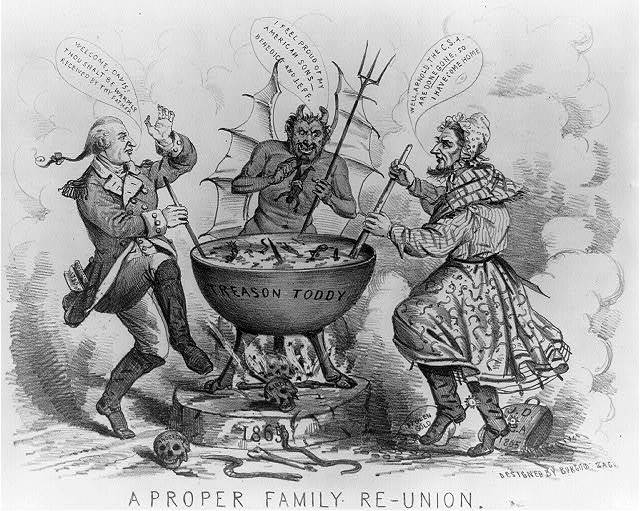
A Proper Family ReunionThe topic of my document-based lesson project was the period of Reconstruction as viewed through political cartoons published in the time period from 1865-1877.  In the lesson, students are asked scaffolding questions which help them engage with the historical thinking skills of contextualization and sourcing. Using the images I chose, students will be able to develop an understanding of how Americans in different parts of the country may have felt about policies enacted during Reconstruction, and about the period as a whole. I intentionally chose certain cartoons that depicted vivid images and which reflected various opinions of Reconstruction.

In the initial stages of developing this lesson, I had the idea that I might want to focus primarily on political cartoons for this lesson. There are so many available from this time period, and so many with such vivid imagery that allow students to engage in analysis with very little background knowledge. As I began to collect documents for this lesson, I was a bit worried that I did not have enough content, and that I might need to include other types of documents. However, because Reconstruction is such a large topic, and because there are so many different lenses through which it can be understood, I found that it was easier to stick with the medium of political cartoons, and engage with them more deeply. In this way, students get the opportunity to engage with the controversy of how to rebuild after a terrible and destructive war that changed multiple aspects of society.

In secondary history classes, topics such as Reconstruction are rarely discussed; if they are, very little time is spent uncovering the controversy and complexity of the time period. However, Reconstruction is a period in America’s history that began the current stream of history. By understanding the period following the Civil War, students can begin to see how America’s history has shaped its present. For instance, certain racial policies enacted during Reconstruction played a major role in Americans’ later perceptions of race and racial constructs. It isn’t an easy time period to untangle, certainly another reason why it rarely is at the secondary level. However, giving students primary sources to discuss and explore give them an effective entry point into the time period and the topics surrounding some difficult issues of Reconstruction.

At the end of this particular lesson, numerous different activities could be assigned. In the creation of this lesson, I wanted to leave the final product/assignment open because there are so many creative ways to assess understanding of the cartoons and the ideas and values they present. When I discussed possible options for closing assignments for this lesson, various suggestions were given. My favorite assignment idea was to have students create their own political cartoon using similar themes and imagery from the cartoons that they explored in the lesson. This could be done either about Reconstruction issues or even current events. This would allow students to make connections across topics and time periods.


Image Credit: Library of Congress

Title: A proper family re-union

Creator: Oscar Henry Harpel

Date Created/Published: 1865.

Summary: A biting cartoon showing Confederate president Jefferson Davis in league with both the devil and Revolutionary War traitor Benedict Arnold. Arnold and Davis stir a cauldron of “Treason Toddy,” a brew into which the devil drops miniature black slaves. The devil holds a pitchfork and gloats, “I feel proud of my American sons–Benedict and Jeff.” Davis, dressed in a bonnet, shawl, and dress (see “The Chas-ed “Old Lady” of the C.S.A.,” no. 1865-11), explains to his fellow traitor, “Well, Arnold, the C.S.A. [Confederate States of America] are “done gone” so I have come home.” Arnold greets him, “Welcome, Davis! Thou shalt be warmly received by thy father.” At the cauldron base, marked “1865,” lie two skulls, marked “Libby” and “Andersonville,”–no doubt intended to represent Union victims of the two notorious Confederate prisons Libby and Andersonville. Copperheads writhe on the ground. Near Davis’s feet are a bag of “Stolen Gold” and a valise marked with his initials and “C.S.A. 1865.”