Nothing More or Less Than A Big Brothel

Topic

Originally, I designed by DBQ around Operation PBSuccess when the American CIA helped stage a coup in Guatemala in 1954. However, it became clear after speaking with the professor that this topic would not be feasible due to the sources available and the background knowledge required to answer the generative questions.

I thought instead about what primary sources I had easily available that did not require extensive prior knowledge to understand. Fortunately, as part of the Senior Thesis in history, I have accumulated a wealth of letters written by Anzacs in World War I from Egypt that provides accounts of racial tensions.

As a dominion of Great Britain, Australia was called to serve the metropole– a call 320,000 answered most proudly. The Anzacs are most famous for participating in the Campaign of Gallipoli when the Entente Powers attempted to open up the Dardanelles in order to send supplies to Russia via ships. In the end, they were defeated and thousands of Australian soldiers lost their lives. However, this event is regarded as the birth of Australian nationhood. Rather than focus on this particular event which has already been studied extensively, I want to direct my students to Egypt where the Australians trained for Gallipoli.

In Egypt, many Australians were quick to raise sales in alcohol, narcotics, and brothels. However, their opinion of the local people who provided these goods and services was very low to the point they nearly burned down the red light district of Cairo. Anzac letters provide extensive details on the locals that are less than flattering. Generally, these letters see whites as superior based on hygiene, intelligence, and morality.

For my DBQ, I hope to have students examine these letters in order to figure out the what and why.

Example of Source

Questions

  • What did the Anzac soldiers think of the Egyptian “natives?”
  • What were their opinions informed by?
  • Are these letters reliable sources?
  • Do the Anzac letters corroborate each other?

Looking Ahead

In order to further my DBQ, one goal is to narrow down my sources. There are dozens of letters available, but I want to select the most powerful and descriptive letters.

Secondly, I would like to see if there are any letters that speak to the contrary and describe the Egyptians in a much more positive light in order to provide contrast. I do not want to encourage students to generalize Australian soldiers in World War I and I think finding other points of view will prevent that from happening.

Overall, I feel that this topic is much more appropriate for the task at hand than my previous one and I look forward to continuing to modify and improve my DBQ.

It’s the Bee’s Knees: Examining Clashing Cultures in the Roaring Twenties 

roaring twenties
Russell Patterson: Where there’s smoke there’s fire, ca. 1925. (Library of Congress, Prints and Photographs Division)B

By Ceci Brunning and Jenna Bunnell 

Originally, we were going to do our DBQ project on the emergence of flappers in the 1920s.  However, we decided that this topic was too specific, and thus decided to focus more broadly on the social tensions of the 1920s.  The 1920s were a decade full of controversial changes that some people embraced and others fought.  It was truly a war of cultures, and examining documents from the “Roaring Twenties” exposes how these cultures clashed and what it meant for the future of Americans.

We plan to use a variety of primary sources. These include video clips, which were relatively new in the 1920s.  We also plan to use photographs, samples of literature, and magazine articles.  We chose these types of sources because they are reflective of the popular culture. They include both positive and negative reactions to the shifting societal norms.

scopes trial
Newspaper headline highlighting the Scopes Monkey Trial http://s3.amazonaws.com/Website_Properties/features/umns11_187_1_lightbox.jpg
  • To what degree was the 1920s defined by a clash of cultures in America?
  • Why did societal norms shift so dramatically after World War I?
  • What societal tensions emerged during the 1920s as a result of societal norms shifting?
  • What groups promoted dramatic change in society? What groups fought to preserve the past?
  • How were tensions between these groups demonstrated?

We see this assignment as the equivalent of a large lab experiment for a historian. We want these students to learn how to examine primary sources and make and argument based on their observations.  The DBQ projects gives students a chance to do this on a larger scale, because it involves so many primary sources.  This is not to say that it is more work, but it is actually an advantage for students because they have more evidence to base their argument off of.  Additionally, it gives students a chance to do what historians do.

We are very excited about this project because the 1920s is a fun, radical, scandalous topic.  There are also a lot of resources out there that we can use to model our DBQ.  One setback is that there are almost too many sources that could work for our topic, so a challenge will be sifting through the sources and determining which ones we want to use.

First Families as an American Ideal

For this project I was initially looking into portraits and family photos from the late 1800s, and intended to explore what differences there were between how white and blacks were posed and portrayed. However, I soon realized that while this topic was interesting to me, I would be limited in the amount of documents there were. Furthermore, I was struggling to come up with questions to go along with these photographs. I knew that I wanted to do something with photos though, and that got me searching for a new topic. This new search led me to the photo below, which immediately captured my interest.

Bush family

The George Bush family in 1964 in Houston

Accompanying this photo were an assortment of other family photos of George H.W. Bush’s family, and diplomatic meetings that his wife Barbara conducted. From there I saw photos of other First Families and First Ladies, and I was hooked.

Potential Questions

  • How is the First Family used as an extension of the president’s image?
  • How does the way in which they are depicted show what the perception of the ideal American family was at that time?
  • What reasons might exist for the First Lady being photographed with someone? What message was the administration trying to get across?
  • How was the First Family used in the United States compared to the families of leaders in other leading power countries?

For example, we have the following photo of Barbara Bush and Raisa Gorbachev together in 1990. If someone did not know who these two women were, they likely would assume that they were two good friends, rather than the wives of the leaders of nations that were coming to the end of an unspoken war. Why were they both chosen to give this address? What was to be achieved by depicting the two as being so comfortable around each other? It should also be noted that the school at which they spoke, Wellesley, is an all-female college. What importance should be attached to this?

Bush and Gorbachev

Mrs. Bush and Raisa Gorbachev give the Commencement Address at Wellesley College

Looking Forward

I am not going to have any problem finding photographs that I could use for this project. If anything, I am going to struggle with narrowing down what era the photographs should cover, and which are the most important. I need to decide if I want to work with families that were in power back to back, or if I would prefer to have a gap, to show how things changed over the years. During our critique session in class, I got the suggestion to look into First Family equivalent photos from other countries, which is a great idea that I have not explored yet. Again, this will raise the problem of having too many potential documents to work with.

The Marshall Plan: Altruism or Opportunity?

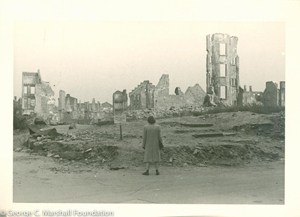
I have decided to forgo my initial project on tracing the immigration and culture of the American South through food in favor of documenting the Marshall Plan.  While my original topic was rich and personally interesting to me, I was having a difficult time finding the original documents I was looking for (diaries, manifests, recipes).  I think this

Frankfurt 1946
Frankfurt 1946

will be a great project for a later time.  Instead I looked at the assignment in a slightly different way: to follow the documents.  I knew that if I chose a more modern historical event, there would be more documents.  The next step was to find an event that was rich and interesting and could be used to ask over-arching generative questions.  The Marshall Plan meets both criteria perfectly.  In talking with Erik Nelson about his project on the Treaty of Versailles, it became clear to me the the Marshall Plan presented a complete change in post-war policy.  Rather than punish and weaken the losing sides, the Marshall Plan sought to strengthen not just our allies in Europe, but Germany and even Russia as well.  This was a controversial plan and there are entire libraries dedicated to documenting characters who put this plan together.  It could easily be argued that this was the high water mark for U.S. foreign policy.

The Set Up

I will use a mixture of photographs, posters, and speeches to show the many facets and interests involved in this monumental action.  Before Congress could approve the billions of dollars required, both America and Europe needed to come together in a new way.  The United Nations is in it’s infancy and this will be a major test.  While a necessary ally during the war, relations between the United States and the Soviet Union are already showing signs of mistrust and antagonism.

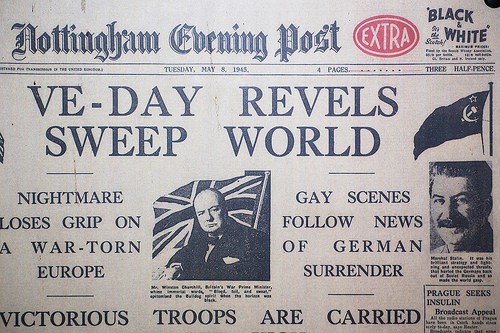
Nottingham Evening Post May 8, 1945

The Questions

The overall purpose of the unit is to have the students use historical thinking to look at the Marshall plan in an authentic way from many perspectives.  They should be able to address the larger questions this event brings up:

  • Are there responsibilities to the victors in war?
  • Is there a quid pro quo for reconstruction/ nation building?
  • How did the Treaty of Versailles influence the making of the Marshall Plan?
  • Why was the United States in a position to help in the first place?
  • How did the United States relationship with Russia help or hinder European reconstruction?

Looking Ahead

Looking Ahead...
Looking Ahead…

I am eagerly looking forward to working on this project.  Not only am I getting practice in designing instruction that challenges students, I am learning so much about the subject matter.  At this point these DBQ projects take a tremendous amount of time to assemble.  But I am beginning to see how the process can be streamlined.  The more comfortable I am knowing where to look for documents, what questions to ask, and how to put it all together, the easier this will all become.  In the mean time I am enjoying the self directed project based learning as a student.  I hope my students will come away with some of the same enthusiasm.