Digital History

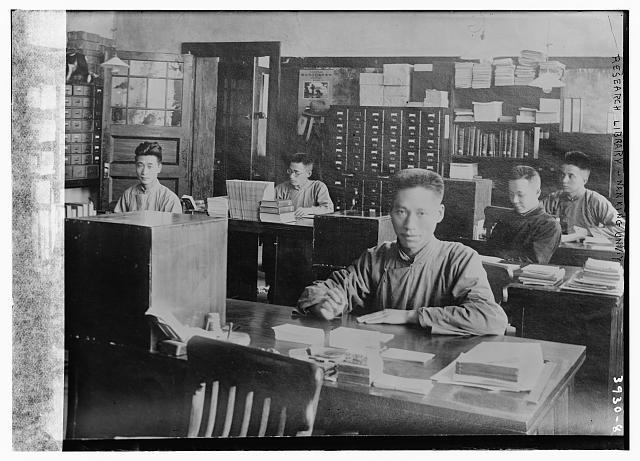
Nanking Uni

Prompt: Write a blog post in response to our class on digital history.

Our Digital History class was definitely a fun experiment. Taking a site like Twitter, which is often one of the social networking sites that get blocked in school, and making it an actual tool to be used for learning was impressive. Thinking about how that would translate into a Middle/High School class is a bit challenging for me though because it was hard to keep a room full of graduate students focused on the single task at hand without getting distracted by Miley Cyrus or The Walking Dead or whatever other nonsense Twitter has the tendency to throw at users. One thing that might have reigned it in a bit is if the class as a whole had a larger, classroom conversation on the #engsschat questions and then, as a class, contributed some of the highlights of what we discussed.

The second highlight of the Digital History class for me was being able to get my hands on really cool data machines… my favorite was the NYT Chronicle website (check out my search here).  Giving us resources to explore our own curiosities led to some serious engagement… obviously there’d be some issues with students looking up problematic/inappropriate information but I think that could be cleared up with clear and concrete guidelines set ahead of time. Ultimately, resources like NYT Chronicle and GapMinder was incredibly engaging and letting kids explore and play discover/historian in a Social Studies class could be a breath of fresh air for students.

In regards to how “historians” can leverage these digital tools for research/instruction/professional growth, I’ll focus primarily on instruction. Going all the way back to our first day of class, when we were asked to work in groups to create an image of what was needed to be a good Social Studies teacher, I think these digital tools could be a really cool opportunity to see what students can create/find/produce. I could see a teacher showing students how to use GapMinder and then telling them, “In a group of three, use GapMinder to find different social/economic/health data that has a strong positive or negative correlation. After your group feels that your data is strongly connected, think of a way to creatively explain how they connect to each other.” Products may be all over the place but students would have to tap into multiple skill sets to complete the task: team work, research, reasoning, etc. I love the idea of using these tools in a classroom!

Image Credit:

Digital Idggbain 22350 http://hdl.loc.gov/loc.pnp/ggbain.22350

Control Numberggb2005022348
Digital History: Using Tech (Effectively) in the Classroom

digital history

Prompt: Write a blog post in response to our class on digital history. 

In this week’s class, we played with various methods to incorporate technology directly in our classrooms. We used tools such as Twitter, GapMinder, nGramViewer, and NYTimes Chronicle to explore different ways to present information to students and engage them in research and information-seeking. While we were working with these tools, it wasn’t difficult to think of ways that I could incorporate these tools into lesson plans, such as having students search different names for classifying people in the NYTimes Chronicle tool to analyze changes (see my example here). However, whenever I think of incorporating technology into my lessons, I always try to ask myself whether or not the addition of technology is effective, or if the lesson could help students learn just as well without the use of technology.

I think, when it comes to technology, teachers like the idea of incorporating it into their lessons, but often get stuck with the same sorts of technology, always using the same resources and never really analyzing whether or not the technology is helping students. For this reason, I was skeptical of our use of Twitter in this class. I’ve seen various teachers use Twitter as a tool to encourage students to summarize their ideas “in 140 characters or less.” This is great when it comes to some lessons/content, but doing it after every lesson can get monotonous. I don’t think this is Twitter’s most effective use in the classroom.

One thing that I highly valued in our class-time engagement with twitter was the session in which we participated in a live chat. We had the opportunity to share our ideas and learn from other teachers across the country. It was a great lesson in collaboration, not to mention self-validation (when teachers across the country favorited or re-tweeted my comments, it made me feel that I had some good ideas, even though I may not have had much classroom experience).

I think there might be a way to use Twitter (real Twitter, and not just the Twitter format) in our classrooms as well. Giving students the opportunity to share their work and seek help or comments from people they might never meet could be a great way to engage and motivate students. In many ways, allowing them to share their best work with someone other than a teacher or family member gives them perspective they might not get otherwise, and shows them that they can be proud with a certain product. I don’t think this necessarily requires Twitter or other social media. But I do think their is value in using those types of digital information gathering and sharing to inform how we create our lessons.


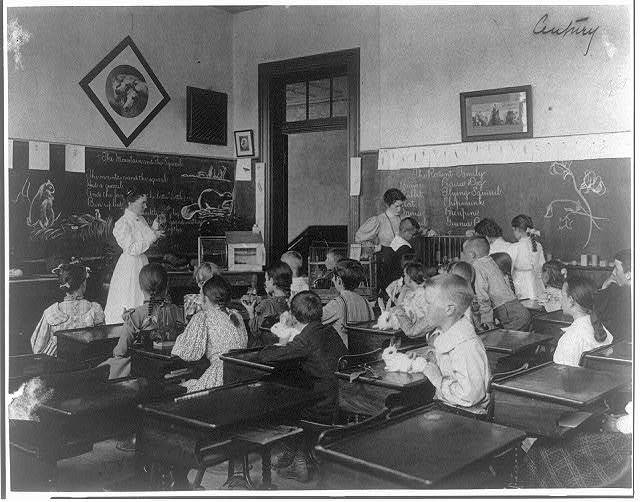
Image Credit: Library of Congress

  • Title: Washington, D.C. Public Schools – classroom scenes and school activities
  • Creator(s): Johnston, Frances Benjamin, 1864-1952, photographer
  • Date Created/Published:  ca 1899

The Technology of History

Classroom-technologies
Classroom Technologies

Prompt: Write a blog post in response to our class on digital history.

During the week of 10/26 we explored digital means that can be used to diversify our lesson material.  Of particular interest in this class was the use of websites and engines designed to show trends over time.  Such websites include the following: GapMinder, NGram Viewer, and the NYTimes Chronicle.  The trends that these programs are capable of showing are of use to us as educators because it allows show some of the material we would otherwise lecture about.  For example it is one thing to say that the use of various racially charged words spiked during times of strife; however, by using utilizing NGram Viewer to search the collection of digitized literature available through Google it is possible to show this.

I can see these sites being of particular use in an social studies inquiry class because of their ability to coalesce data into an easy to understand format for the students to digest.  An example of this would be if a student wished to examine the origins of certain controversies.  By searching the language of various forms of literature (books, newspapers, magazines and journals) NGram Viewer and NYTimes Chronicle give the students access to what seemed to be hot topics from various periods in our history.

Personally, I greatly enjoyed the use of these tools in class and am going to incorporate them where I can in my various placements.

Despite the amazing things that technology can bring to the classroom we must be wary of its ability to take control of the classroom.  Technology can make things easier but its use needs to be regimented so that it supplements not instructs.  Like I said before, being able to show what you are talking about is a great idea.  That is what technology should be for the classroom.

Image Credit: Hets Virtual Plaza

The Trends of Technology

cool

Prompt: Write a blog post in response to our class on digital history.

This week in class we discussed digital history. We have been focusing a lot on how we can use modern technology within the classroom in order to teach history. This particular week, we looked into resources that reveal historical trends. Technological tools can be a powerful source in teaching history to our students. Not only do they provide an alternative visual, but they are also often times hands-on, allowing students to interact with the tool and discover trends on their own agenda. I think that there are many benefits in allowing students to use different technological tools. First of all, provided with the proper resources, students can use these tools individually, instead of one visual up on the board. These days there are excellent hands-on tools that students can interact with on their own. Therefore, instead of the teacher showing students what they want their students to get out of the graph or visual, students can come to their own conclusions and create their own ideas about what they see. In the GapMinder for teachers page, we watched a video about students exploring a GapMinder graph called “Wealth & Health of Nations.” These students reflect on their own conclusions and conjunctions about what the graph is revealing to them.

I am a firm supporter in emphasizing trends throughout history when we teach history. It is a crucial aspect of looking at stories of the world. It helps students to make connections and to see the bigger picture. History doesn’t only need to be viewed and taught by time periods. It can also be taught by specific topics and factors that we can explore throughout time. Sources like gapminder, Google nGram Viewer, and New York Times’ “Chronicle” allow students to explore trends throughout time. Chronicle is an excellent source that shows how often a specific word was mentioned in New York Times newspapers throughout American history. For example, the frequency of which the word feminism was mentioned spiked during the1910’s and the Women’s Suffrage Movement, and then was barely mentioned again until the 1970’s. This can help students to infer a lot about feminism in American history. However, I think that this is a limited source because it only refers to the frequency of words in this one newspaper, therefore Ngram Viewer is a good alternative, featuring all written literature.

All of these tools provide teachers with alternative sources. Teachers nowadays are no longer limited to their own sources and ideas, as these tools are created and shared online. Furthermore, technology also opens up the doors for professional collaboration. The internet is now an ever-updating source of useful tools shared by fellow teachers. The possibilities for teachers now seem to be endless as they share and benefit from each other’s sources and ideas.

Photo: January 15, 2012

Alan Levine. It’s Cool Here