
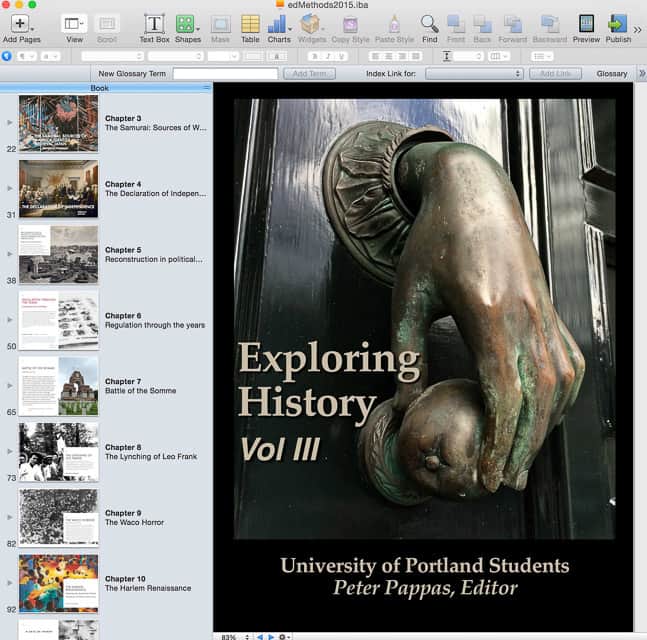
Our New iBook – Exploring History Vol III

Exploring-History-IIIHere’s our new iBook just published by our Fall ’15 class at the University of Portland. Free at iTunes. Static pdf version Exploring History Vol III (29 MB)

It features thirteen engaging questions and historic documents that empower students to be the historian in the classroom. The units draw from a fascinating collection of text and multimedia content – documents, posters, photographs, audio, video, letter and other ephemera. “Stop-and-think” prompts based on CCSS skills guide students through analysis of the primary and secondary sources. Essential questions foster critical thinking. All documents include links back to the original source material so readers can remix the content into their own curated collections.

All of our students assignments had a public audience on this class blog and were designed to meet our three class goals:

  • Learn to think like a historian.
  • Become a skillful Instructional designer
  • Develop technical skills for production, reflection, growth and professional networking.

The lesson design process began early in the semester when students designed lessons in historical thinking skills based on the work of Sam Wineburg and the Stanford History Education Group (SHEG). They focussed on three key skills – Sourcing, Contextualizing and Corroborating. Then students identified essential questions worth answering and gathered documents to explore the question in an extended lesson design process.

Exploring History: Vol III was our PBL capstone and is available on iTunes in 51 countries around the world. Here’s a post (from fall 13 class) that describes our project workflow (including how we utilized iBooks Author).

Here’s Exploring History: Vol I created by our fall 2013 class. And Exploring History: Vol II designed by our fall 2014 class.

Here’s the US and World History lessons in chronological order:

  1. Finding Egyptian Needles in Western Haystacks 
by Heidi Kershner
  2. Pompeii by Caleb Wilson
  3. Samurai: Sources of Warrior Identity in Medieval Japan 
by Ben Heebner
  4. The Declaration of Independence by David Deis
  5. Reconstruction in Political Cartoons 
by EmmaLee Kuhlmann
  6. Regulation Through the Years 
by Chenoa Musillo Olson / Sarah Wieking
  7. Battle of the Somme by John Hunt
  8. The Lynching of Leo Frank by Jeff Smith
  9. The Waco Horror by Alekz Wray
  10. The Harlem Renaissance by Monica Portugal
  11. A Date of Infamy by Mollie Carter
  12. Anti-Vietnam War Imagery by Felicia Teba
  13. Examining the Ongoing Evolution of American Government by Eric Cole
Class 4: Historical Thinking

PhrenologyPixOur class begins with a review of the Sam Wineburg reading and TEDEd flipped lesson Who is the historian in your classroom? That will also provide a chance to discuss the efficacy of flipping content.  What are the challenges and opportunities for that approach?

Today we begin our study of historical thinking skills based on the work of Sam Wineburg and the Stanford History Education Group (SHEG). We will focus on three key skills – Sourcing, Contextualizing and Corroborating. See historical thinking chart (pdf at SHEG).


Assignment for Class 5

You will each design a historical thinking mini-lesson based on the Beyond the Bubble assessment model.

We will use this assignment as a chance to create a shared Google presentation. I’ve prepared some brief Google Presentation video tutorials. You can find them at this YouTube playlist / Working with Google Slides.

Here’s the Fall ’14 project that you can look at (but not edit). Can you do better?

Note: each of you will be contributing to the same Google Slides presentation. I’ve listed your names in alphabetical order in the presentation. You will turn that name placeholder slide into your mini-lesson title slide. You will insert additional slides in your section of the presentation as needed.

All mini lessons should include

  1. Title slide for your mini-lesson. Make it catchy!
  2. Your name as author of the mini-lesson on your lesson title (your lesson will take multiple slides in the presentation – have your name in small font at bottom of each slide)
  3. Target students – by grade level
  4. Indication of one (or more) of the historic skills to be studied – Sourcing, Contextualization, Corroborating
  5. One or more historic documents. Text, image and videos can be inserted into the slide. Longer documents can be linked to via URL or saved in Google drive with link to it.
  6. Source URLs for all documents used
  7. Essential question
  8. Scaffolding questions for students to use with documents
  9. Brief description of how the documents and scaffolding questions should reinforce the targeted historic skill(s)

I’ve collected some great websites that include many of the major archives from around the world.

Best Sites for Primary Documents in World History

Best Sites for Primary Documents in US History


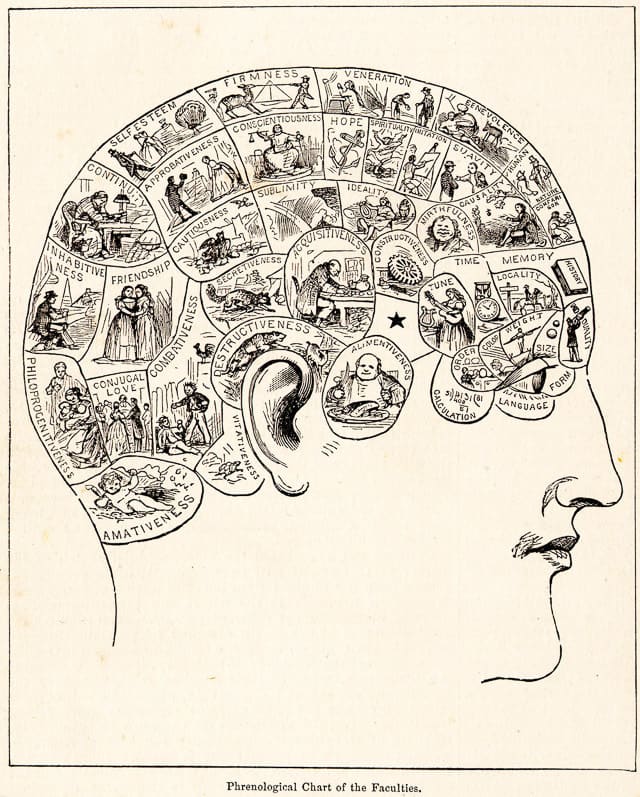
Image credit: Phrenology diagram Wikipedia
Source From People’s Cyclopedia of Universal Knowledge (1883)

Shoutout from Sam Wineburg

We are very pleased that our Ed Methods class is getting recognition on the Twitters from one of our inspirations – Sam Wineburg of the Stanford History Education Group

Click to see how we used SHEGs historical thinking skills approach in Class #4 
This lesson became the foundation for our class-published iBook  –
“Exploring History Vol II.”  Available free at iTunes.

Thinking Like A Historian: Lesson Collection

Beginning in Class 4, we began a study of historical thinking skills based on the work of Sam Wineburg and the Stanford History Education Group (SHEG). We focussed on three key skills – Sourcing, Contextualizing and Corroborating. Students were assigned the task of designing their own historic thinking skills lesson based on that model and collecting them in a shared Google presentation. We took time in Class 5 to do some peer evaluation of the work. As a final assignment, students were asked to reflect on the process and use their lesson as the basis for a blog post. See them all here.