
Class 2: Designing Lessons / Social Media Audits

Three key elements of student engagement
This week we consider two very different themes – social media and instructional design. The class begins by addressing key elements of lesson design :

  1. Higher-order thinking
  2. Student choice and reflection
  3. Effective classroom strategies

This  portion of the class lesson includes three major elements:

  • Practical examples of Bloom’s taxonomy in the form of sample exercises and questions. They are used to anchor a conversation on Bloom in action.
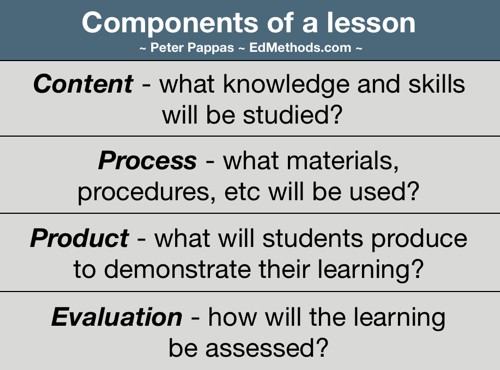
  • How student choice can impact key lesson elements – content, process, product, evaluation.
  • Demonstrate a student-centered approach to a teacher presentation as a way to foster reflection (instead of listening to a straight lecture on the subject)

The lesson is driven by a Keynote presentation. Handout (42MB pdf)  We will use an audience response system to gather student input. The lesson includes multiple activities that illustrate the content. Student will be led through discussing their reactions to the activities to connect them to the content. This lesson will serve as a kick off to their first assignment to write and share a Lesson Study.
key lesson components

In the second half of the class we’ll meet in small groups to share our personal social media audits. We’ll be focusing on rolling out our new Google+ Community and learning how to use some it’s features. It’s a private group and will serve as an extension of classroom discussion through posts, comments, and Hangouts.

Assigned Readings for Class 3: None

Written assignment for Class 3:

Lesson Study I is due next week.

The goal of this assignment is two-fold. First to offer supportive feedback on your lesson development through a peer review process. Second to offer some “lenses to look through” that help you easily see the essentials of a lesson. It is not a substitute for the School of Education lesson plan format. Think of it as a pre-lesson plan planning guide. This is not some exercise for the benefit of your instructor. This should be a process that works for you. So feel free to modify to meet your particulars. Use a scale that works for you – focus on just a small segment of a larger unit, or look at the entire unit. Don’t like Bloom? Use another schema to discuss the kinds of thinking that your students will need to successfully complete the assignment. Assignment here. (383 KB pdf) Sample lesson study (378 KB pdf)

See results of this assignment in the first student posts
 

Class 8: Report, Regroup, Goal Setting

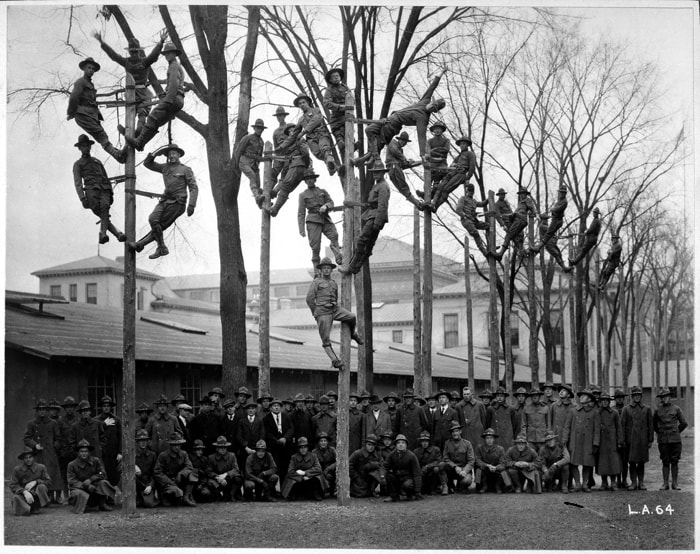
Class in Pole-ClimbingThis class was was devoted to taking stock of what we had accomplished and making plans for the rest of the semester.

We reported back on progress on the Nikkei project. See Peter’s post on the project – Student Consultants Design Museum Curriculum and Mobile App

Erin, Sam and Peter did a presentation at the OAtS Conference at OHSU. Teena and Amit Jain (from Gamma Point) were there as well. We got some great feedback on the app – features, navigation and uses. Aram and Tom took some photographs in the neighborhood after meeting with Todd at Legacy Center. Todd’s been focusing on finalizing material available from Nikkei archives.

Each team met during class to set goals for their component of the project. Kyle and Peter zeroed in on their intended audience for their virtual museum. Collin, Aram, Tom and Sam discussed feedback from the conference presentation and discussed next steps in the app design.

The “Museum in a Suitcase” team (Christina, Kristi, Cory, Heather, Erin and Damian) – discussed the scope of the lessons they will design. See update in Christina’s comment below

We conducted our second lesson study  with Kyle, Peter and Tom in the “Fishbowl.” Their classmates observed from outside the fishbowl. They used a T chart to track two items – lesson strengths and challenges. Feedback from in and outside the fishbowl will be used by students to improve their lesson idea.

Peter reviewed expectation for the upcoming DBQ design assignment and demonstrated use of the Learnist website that students will be using to present their DBQ’s.  He also shared the sample DBQ he posted at Learnist. Incarceration of Japanese Americans During WWII 

Image Credit:

Class in Pole-Climbing in the course for telephone electricians, with some of their instructors. University of Michigan., ca. 1918
Original Caption: Vocational training for S.A.T.C. in University of Michigan, Ann Arbor.
U.S. National Archives’ Local Identifier:165-WW-119A(1)
Created By: War Department.

Class 7: Lesson Study II Fishbowl / Nikkei Planning

Fishing is good near Klamath Falls Oregon

Lesson Study II

We are beginning our second round of lesson studies. This time we are sharing lesson ideas in groups of three over the next four weeks. Three students will troubleshoot their lesson ideas – with a focus on content, process and product. They’ll do this within “the fishbowl.” Their classmates will observe from outside the fishbowl. They’ll be using a T chart to track two items – useful questions they heard in the fishbowl and question that “should” have been asked. Feedback from in and outside the fishbowl will be used by students to improve their lesson idea.

Portland Assembly Center

Nikkei project planning session

Students are serving as curriculum consultants to the Nikkei Legacy Center. We used class time to work in our three project teams:

  1. “Museum in a Suitcase” – Developing a set of lesson plans for intermediate through high school students to support a traveling suitcase filled with historic artifacts on the incarceration of Japanese-Americans. ( Christina, Kristi, Cory, Heather, Erin and Damian)
  2. “Virtual Museum” – Creating an online collection of lessons that parallel the installation at the Nikkei Center tracing pre war life, incarceration, camp conditions and acclamation following the war. I would serve as a pre or post visit enhancement. (Peter and Kyle)
  3. “Japantown Walking Tour” – Developing a native iPhone app walking tour of the historic Japantown in Portland. It will include geo-fenced text, photos, audio, video and tools for sharing user reaction to the content via social media. (Collin, Aram, Tom and Sam)

Image Credits: Fishing is good near Klamath Falls, Oregon OSU Special Collections

Photo of Nikkei Legacy Center installation

A Reflective Lesson

This week, our class focused on creating a ‘lesson study.’ Each lesson was supposed to relate to a possible topic that we might be teaching in the near future. After meeting with a partner that had a similar topic, we discussed strengths and weaknesses of the potential lessons. Everyone seemed to have put a lot of thought into the general idea of their lesson which spawned a great classroom discussion.

Throughout the discussion process, I took so many notes about awesome future projects that I could tweak to meet my class’s needs. For example, I really like the idea of Levels of Questioning which gets students involved in creating their content objectives. (Level 1- basic content such as who, what, when; Level 2- How or why questions; Level 3- the generative question or “In your opinion…” question that asks students to reason and provide evidence.) Another idea that I want to think more about for American history was the Mock Congress idea. It seems daunting to deal with those logistics but that’s what colleagues are for!

Image

Image from Mr. Volk’s Mad Science Website at Drake Middle School

This class is full of awesome ideas as well as some great future social studies teachers. I feel confident in others’ opinions and advice. Everyone is so willing to listen and contribute to the conversation. In terms of this last assignment, my partner definitely helped me think about some futures issues with my lesson study but, at the same time, delivered constructive criticism.

Overall, this project let me think about the more important components of putting together a lesson. I think this assignment worked well so that the class could generate new thoughts and ideas about what is necessary for student learning. I look forward to doing this when we have actual lesson plans to come up with.