Turning the Classroom on its Head: Experimenting with the Flipped Lesson

Scene from a United States-run Ebola treatment facility in Monrovia, Liberia, during Secretary-General Ban Ki-moon’s visit to the facility.
Scene from a United States-run Ebola treatment facility in Monrovia, Liberia, during UN Secretary-General Ban Ki-moon’s visit to the facility.

Prompt: Students were asked to design a flipped lesson and then write a blog post that showcases their flipped lesson and reaction to designing it.

Using the lesson creation tool from TedEd and a VICE News video, I created a “flipped” lesson on the West Africa Ebola outbreak for hypothetical high school students. The video and questions are designed to quickly introduce students to some of the major obstacles that faced health workers, governments, and ordinary West Africans at the height of the epidemic. The knowledge that students would gain in the course of viewing the video would inform the next day’s in-class discussions of the crisis and the world’s response to it.

From a technical standpoint, creating a flipped lesson using TedEd was a surprisingly straightforward process. It was very easy to include the scaffolding necessary to support students’ full engagement with the selected content using the built-in questions features. Careful use of guiding questions is key to successfully directing students’ attention to the most important details of a video that they are viewing outside the classroom setting.

The most obvious potential problem with  “flipping” lessons is the possibility that students simply won’t actually view or consume the content. That is to say that there is some risk that, in attempting to “off-load” knowledge acquisition to non-class time, it becomes difficult for teachers to ensure that knowledge acquisition takes place at all. There are strategies teachers can use to try and prevent this (e.g. making student responses to the in-video questions a formal assignment), but I think that discovering the best approach to mitigating this risk may require some trial and error on my part.

I am intrigued by the notion of the flipped classroom. Instructional time is very limited and I am certain that tools like TedEd can help teachers use their time with students more productively. I also like how easily teachers can scaffold students’ experience interacting with material by pairing video content with questions; in addition to supporting students’ experience with , these questions have the potential to generate useful data for teachers in real-time. I look forward to using flipping strategies in my classroom.

Photo: Evan Schneider, UN Photo

Let’s All Flip

President Lyndon B. Johnson signs the 1964 Civil Rights Act as Martin Luther King, Jr., and others, look on.

Prompt: Students were asked to design a flipped lesson and then write a blog post that showcases their flipped lesson and reaction to designing it. 

I think that the flipped lesson has a variety of benefits for teaching students. This concept is becoming more and more feasible as technology develops. The beauty of the flipped lesson is that it allows time in classrooms to achieve higher levels of learning with teacher scaffolding. In normal classrooms, teachers instruct in class and then homework is often students’ only opportunity to apply their knowledge and achieve higher learning. In this system, the teacher is not there to scaffold or assist with higher level learning, nor can students collaborate with their classmates. Nor is it guaranteed that students complete their homework, thus falling further and further behind in higher learning.

However, my concern with the flipped classroom is this same thing. What is to guarantee that students perform the task before they get to class? Those students who normally don’t complete their homework or don’t have time will most likely not watch the assigned video or do the assigned reading either. However, I am not sure if there is anyway to fix this problem. No matter what we assign as homework, there is no guarantee that students will complete the assignment.

On the other hand, teachers in the flipped classroom can become a greater source of knowledge and help in the classroom.There is a wide range of resources that teachers can use to instruct their students in their flipped lesson. They can find educational videos, visuals, and put readings online. Students can then come up with their questions and begin to think and reflect about the instruction before they come to class.

I made a flipped lesson using TEDEd. Check it out!  Election of 1964 

Mr. Conservative


Photo: Cecil Stoughton, White House Press Office (WHPO)

July 2, 1964

The One Thing You Should Know

3g10232v2

Prompt: Students were asked to design a flipped lesson and then write a blog post that showcases their flipped lesson and reaction to designing it.

For my unit that I will teach in student teaching, I am covering World War One. As I was designing this unit I wanted to think of interesting ways to present the information to students. My cooperating teaching uses a loose flipped classroom model anyway; the students do the reading for homework (they have two days since we are on a block schedule) and then we have discussions, or activities, in class.

For this unit I have probably over done it on the readings; I wanted to give them a broad understanding of things that were happening during the war and a chance to read the primary sources to figure out their own opinion of what happened. This is how I started the unit, in the middle we are taking a look at various historians perspectives on the war to give the students a broad scope and help to shape their ideas.

I’m hoping that by giving them the primary sources first and allowing for deep analysis in class, they will better be able to judge the historical accounts and take what they need out of them for their final paper of the unit.

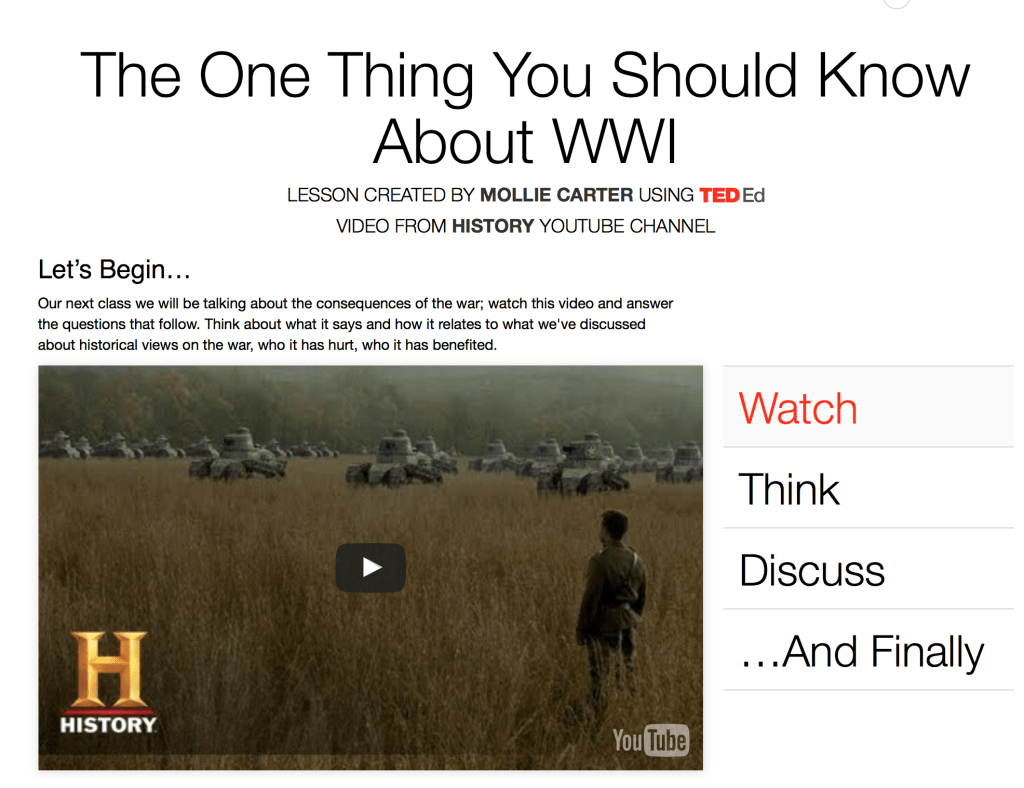
At the tail end of the unit, we will be discussing the consequences of the war and the lasting effects. That’s where a flipped lesson comes in The One Thing You Should Know About WWI.

one thing about wwi

I picked yet another historians perspective on the entirety of the war, but in video form with the use of other visual media to make their points. It’s from the History Channel and it’s entitled “The one thing you should know about WWI”, similar to this post. Following the video there is a short (and easy) quiz and a discussion. As far as their homework goes this is easy.

The next day in class we will be working on an in-class group presentation about preventing this history from repeating itself. I will preface the class with some modern examples of similar actions or conflicts; the students are supposed to be keeping up on current events. And then they will divide into groups to create a sticky-poster about what lessons from WWI modern politicians should keep in mind as they govern their nations.

As an aside, designing the lesson on TEDEd was incredibly easy and, as a peer pointed out, very supportive. There are lots of options as to what to include with the video lesson whether that is a quiz or a discussion or an area to include further links. You can add a lot of depth to the lesson, if one so chose.

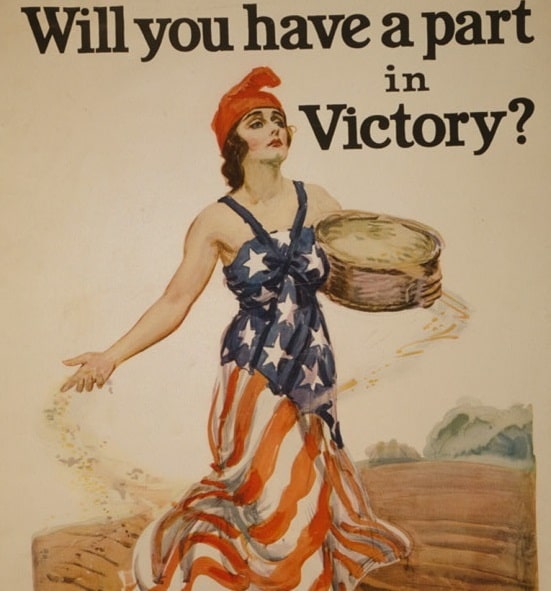
Source: Library of Congress
Title: Will you have a part in victory?
Creator:James Montgomery Flagg
Year: 1918
(Picture is link to source)

Class 10: The Flipped Lesson

The traditional classroom is filled with a lot of lower-order, information transmission that can be-off loaded to “homework” via content-rich websites and videos. That frees up more classroom time as a center for student interaction, production and reflection.

While some may think flipping is all about watching videos, it’s really about creating more time for in-class student collaboration, inquiry, and interaction.

Designing a flipped lesson begins with thinking about what’s the best use of classroom time.

Flipping content is also a catalyst for transforming the teacher from content transmitter to instructional designer and changing students from passive consumers of information into active learners taking a more collaborative and self-directed role in their learning.

Over the first 9 weeks of this class, I have used video tutorials to pre-teach material using a flipped approach. For example here’s a sample of a TEDed video lesson we used earlier in the course to teach historical thinking skills.

I’ve also used short tutorial screencast to provide specific just in time training for students as needed. This has freed up class time since we haven’t had to teach for example, how to use WordPress.


I’ve sent a link out to students to watch the slide deck in advance of today’s class. So we’ll spend time exploring two options to create content. Students will be asked to design a flipped lesson during this class using one of the following methods.

Use TEDed to host existing YouTube content

Teacher can use existing videos on TEDed and YouTube to create customized lessons. They can use, tweak, or completely redo any lesson featured on TEDed, or create lessons from scratch.  Visit this YouTube Playlist to a few short tutorial videos on using TEDed.

Create your own screencast to share with students

There are many free and easy to use apps for creating screencasts. One option is the free Snagit Chrome extension for screen casting (great for Chromebook schools). For our class activity we’ll be using the  QuickTime Player app built into Macs.  Here’s a how to video tutorial on creating a screencast with QuickTime Player.


Assignment for Class 11

Students will design a lesson using one of the two methods above. They will then write a blog post that showcases their flipped lesson and reaction to designing it. Feel free to generalize on the challenges and opportunities of flipped delivery of course content. See student posts here.

Students that develop a screencast can upload and host the video on Media@UP edMethods Flipped Lessons.

Students that use TEDed for lesson design can include a link to their TEDed lesson in the blog post.