
For One-to-One, Start at Square One

Teacher and class

Prompt:  Assume you have your first full time teaching job and the principal tells you that you’ve been selected to pilot the  “1 to 1 Project.”  What are your thoughts about the opportunities and challenges that  presents?

Talk to a group of teachers, and bring up one-to-one classrooms, and you will probably hear lots of opinions. Five years ago, their response would have been overwhelmingly negative. Ten years ago, probably just laughs. Opinions have changed drastically, but not more since one-to-one has become a reality in many schools. Technology is overwhelmingly available, even if not every classroom is equipped with the latest web-enabled electronics. Often, students have access to technology of their own; they are constantly multi-tasking and learning and socializing, all things that are vital to their development as adolescents. Yet, in many one-to-one classrooms, those that have greater access to technology outside the classroom are not necessarily better off than their peers with more limited access. In such classrooms, students of all ability and intelligence levels too easily fall behind because of their teachers’ assumptions that they know how to use the technology they have been given.

In my limited experience volunteering in one-to-one classrooms, specifically social studies classrooms, teachers generally prefer to begin implanting technology in the classroom by assigning research projects. Students choose or are assigned a topic and are sent to the broad reaches of the internet to find information that they will later present in a PowerPoint, style mandated, of course. The assignment seems simple enough. However, it is not uncommon to find that students do not know how to navigate the infinite repository of information that is the internet. They type the name or title of their topic into their chosen browser, pick the first source, often a semi-reliable wiki source, and copy/paste the information into their presentation. Not only is their research flawed, so, too is their presentation. An assignment that the teacher intended to spread out a vast amount of information and share it with the class just became a waste of class time, and required even more time to re-teach the content.

Suggested solution? First, teachers need to make sure that their students know how to conduct effective research, the methods and strategies that will help them be successful. This not only means how and where to search, but also, what kinds of questions they should ask of their topic and their sources. Sourcing and contextualization are key in any kind of historical research. These should be step one.

Step two is creating an intentional research question for students to answer. Guiding questions and scaffolding are exceptionally useful when encouraging students in a specific research direction. Students need to know exactly what they should be looking for, and what the end product should be if they are to be successful in their endeavors.

Finally, students need to be introduced to what might be called the best practices of presentation. Presentation is as much for the presenters as it is for the audience. If the audience has not learned something by the end of the presentation, it has been for naught. Therefore, it is important that students know the best ways to teach content so that their peers will remember it. This is all about teaching to the brain, and using educational neuroscience to their benefit. This does not require much background, except the kinds of visual representations that are most meaningful.

In the end, there is more to one-to-one classrooms than research and presentations. But if teachers don’t start at square one and teach the building blocks of using that technology, students will be no better off than when they started.


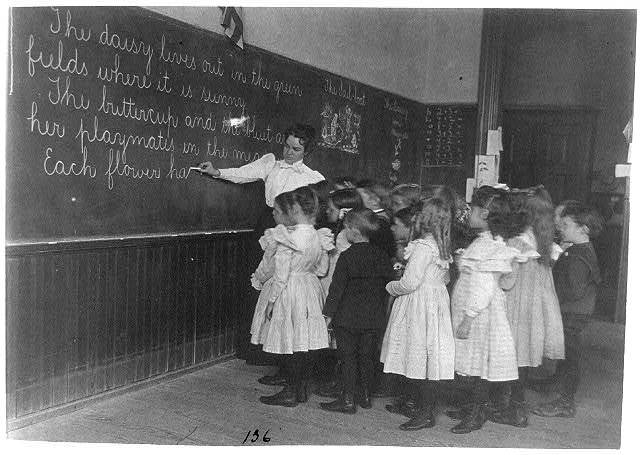
Image Credit: Library of Congress

Title: Elementary school children standing and watching teacher write at blackboard, Washington, D.C.
Creator(s): Johnston, Frances Benjamin, 1864-1952, photographer
Date Created/Published: CA 1899

“Just Google It”

edu48

Prompt:  Assume you have your first full time teaching job and the principal tells you that you’ve been selected to pilot the  “1 to 1 Project.”  What are your thoughts about the opportunities and challenges that  presents?

Like many others, I believe that technology in the classroom can be a huge asset to teachers and students. A few pros of 1:1 technology is that it gives students who may not have access to technology at home to now have a personal device to complete work at home. It also allows students to easily share information through apps such as Google Docs, Padlet, or Haiku Deck. It also gives students the capability to presenting their learning through difference mediums, such as: videos, voice recordings, power point presentations, and even animations. However, from personal experience of participating in a school that enforced the use of 1:1 laptops, I can also see the cons of incorporating it in the classroom.

As an individual pursuing a career in teaching, I see the use of 1:1 Ipads or laptops as an opportunity for students to connect with a learning style that best suits their digital generation. 20 years ago, teachers had set time aside in class to go to a computer lab, and instruct students how to use a computer. Now, Ipads, tablets, and laptops are within arms reach in the classroom, and sometimes students are more technology literate than their teachers. It amazes me as to how easy it is for students to resolve their problems, questions, or confusion by pressing a few buttons. Finding an answer for almost anything can be done with a simple, “Google.”

Although the incorporation of a 1:1 device can easily help students advance in their research, create presentations or videos, and even participate in communities through blog posts such as this, it can also be easily abused. With technology students are capable in completing work at much faster speeds, and with that extra free time students then have the leisure of browsing the Internet, and going off subject within the classroom. Even if the Wi-Fi of a school is able to block content and sites such as Facebook or YouTube, students can be so tech savvy and find proxies to get around it. I mean, I have witnessed teachers ask students how they can get around a system in order to show a YouTube video multiple times. For me it is a fear that even if I do have the power to monitor and check what my students are doing on their computer or tablet, I do not have the time to monitor 15-25 screens constantly to ensure students are not deviating from the class agenda.

Lastly, I strongly believe that handwritten notes and penmanship is a necessary skill in life. Although I understand that having a 1:1 device does not necessarily mean using it for everything in the classroom, I do not want my students constantly relying on a keyboard, online power points, or snapping a picture of class notes to gather information. I want my students to retain information by physically feeling and expressing their thoughts onto a piece of paper. There have been multiple studies done that have concluded that by physically writing individuals are able to retain information better, improve their writing, and remain focused, and I believe that it is because students are able to physically create something, and organize their thoughts in a way that best represents the way they think.

If I were to be put in charge of a 1:1 program, I would want to emphasize that the device is a tool to support learning within in a classroom, rather than attempt to revolve a class agenda to incorporate the technology.

Image from: http://www.glasbergen.com/search/technology+cartoons/?count=12

Reality Bytes

Prompt:  Assume you have your first full time teaching job and the principal tells you that you’ve been selected to pilot the  “1 to 1 Project.”  What are your thoughts about the opportunities and challenges that  presents?

Despite its obvious utility, the adoption of one new piece of technology into classrooms was exceedingly slow.  The main arguments against its inclusion were that it risked eroding basic skills such as writing and math, and that its presence would be a constant distraction for students.  The fear and resistance of teachers was so great, it took several years for this technology to achieve ubiquitousness.  I am, of course, talking about the roll-out of basic handheld calculators in the 1970s.

Do these arguments sound familiar?  They should.  It is the same stone-walling discourse levied against the use of iPads or laptops in schools.  Surprisingly (or perhaps not), similar anti-distraction arguments were made against the use of blackboards around 1900.  There is a pattern of resistance to innovation here that seems to be less about the technology itself than with the human experience.

A wiser man than me once said, “The only constant in the world, the only thing that never seems to change, is that the world is constantly changing.”  Make no mistake about it, in our lifetimes the agent of change in the world is technological innovation.  These changes are dynamic, rapid, and socially revolutionary, and such comprehensive change creates vast uncertainty.

For we measly humans, dealing with uncertainty is an emotionally trying experience, especially for those of us born well before the full swing of innovation.  These emotions are particularly heavy for people uncomfortable using new technology, and breed aversion and resentment in those feeling left behind.  It is easy to see where resistance to change might arise among people who have developed a comfortable routine (cough cough *teachers* cough cough).

However, consider for a moment if you were not born so long ago.  Consider if you were in fact born right on the crest of this wave of change.  Your frame of reference would not consider this environment a tumultuous one, but simply business as usual.  The rapidly evolving dynamics of social change due to innovation would be your normal state of operations, not an aberration.  As future teachers it is essential that we understand this to be the reality for our students.

Children today are born into a world where the regular use of technology is the status quo.  They are born with a “silver iPad” at their fingertips.  For these kids there is no novelty to using technology, it is simply the way they interact with the world.  It is not just how they entertain themselves, but also how they communicate with friends and family, conduct business (banking, shopping, etc.), and, most importantly for we future teachers, it is how they learn.

Today, we live in a “just Google it” society with anything you’d possibly like to know literally at our fingertips.  There is now more information in the pocket of a child in sub-Saharan Africa than was available to the President of the U.S. just 15 years ago.  There is immeasurable power in this capacity with potentially revolutionary consequences.

So, what does this mean for our classrooms?  A recent study indicates that developing healthy relationships with students is vitally important to academic success.  Cultivating these relationships inherently involves finding common ground with students and creating interactions that feel natural to them.  Considering the digital reality in which kids now live, the absence of technology in today’s classrooms creates a foreign and unrelatable environment, with the teacher as its focal point.  This is a core structural element of the classroom that can fundamentally alienate students.  In essence, teachers who don’t fully embrace technology may find themselves increasingly unable to understand and connect with their students.

Image: link

1:1 Classroom: Disaster Waiting?

Prompt:  Assume you have your first full time teaching job and the principal tells you that you’ve been selected to pilot the  “1 to 1 Project.”  What are your thoughts about the opportunities and challenges that  presents?

There is no doubt that technology in the classrooms has huge potential. Access to technology creates huge possibilities for learning. If I were to have my own 1:1 classroom, I would want my students to have access to iPads. iPads, when used to their full potential, have huge potential for many different uses. Students will be able to create their own content, whether it is a short presentation on an app like Haiku Deck, or a short video made using the camera app, there are many opportunities for students to showcase their learning. As you can see, I have a very positive outlook on the use of technology, besides its obvious use as an aid in research and writing. The use of technology to create gives students the chance to make their learning interesting for themselves.

In my 1:1 classroom, I would also use technology to allow students to explore the content. We would still use textbooks and the occasional lecture, but by using tech like iPads, students can find ibooks and content on the internet to explore an event or topic deeper. In my classroom, I would want my technology to be an asset, rather than a distraction. That would require the finding of sources of learning that keep students interested in the work that they are doing, rather than as an excuse for them to get on their social media. While there is high possibility for students to get easily distracted, there is even greater potential for students to become that much more engaged in their learning.


Image Credit:  https://upload.wikimedia.org/wikipedia/commons/8/84/Hindenburg_burning.jpg

Description: The Hindenburg Zeppelin as it caught fire and crashed in Lakehurst, New Jersey in 1937.