Incarceration and the Bill of Rights

Image

I’ve always enjoyed creating lessons. While they are difficult at times, there are few other feelings akin to creating something with the express purpose of educating others. While this lesson is no different, and I am excited to have it be used in classrooms, I still have some reservations. The chances of me seeing any other educator using this lesson is incredibly close to zero, and while this is not a major hang up I feel as the creator of this lesson that I should observe each of its uses in order to modify it.

This lesson is created for high school classes. While this lesson can be used in its own solo lesson, it would be much more effective if this lesson was part of a larger unit on either World War II or a unit that focuses on the Bill of Rights.

Note: While it is possible to do this as a stand-alone lesson, it would be much more efficient if paired with another lesson educating about Japanese Incarceration. As another note: the times given for note taking etc. are not hard set, change them to best fit your classroom.

Grade Level: High School

Overview: Students will focus on the Japanese incarceration and its constitutionality in terms of the United States of America’s Bill of Rights.

Goals: Students should be able to think critically as well as discuss and support a chosen point of view.

Standard: Core Standards

CCSS.ELA-Literacy.RH.11-12.1 Cite specific textual evidence to support analysis of primary and secondary sources, connecting insights gained from specific details to an understanding of the text as a whole.

CCSS.ELA-Literacy.RH.11-12.3 Evaluate various explanations for actions or events and determine which explanation best accords with textual evidence, acknowledging where the text leaves matters uncertain.

CCSS.ELA-Literacy.RH.11-12.5 Analyze in detail how a complex primary source is structured, including how key sentences, paragraphs, and larger portions of the text contribute to the whole.

Objectives: To better understand Japanese incarceration and the Bill of Rights.

Resources: Suitcase, writing utensils, Bill of Rights handout, blank paper.

Procedure:

  • Ask students if they have prior knowledge on the Japanese incarceration during World War II, if students have no knowledge of this event quickly go over the basics of what happened.
  • Pass out Bill of Rights worksheet and have students read through the sheet.
  • As students are reading the Bill of Rights, number them between one and three. Students numbered one will be debating that the Japanese incarceration WAS constitutional while the students numbered two will be arguing that it was NOT constitutional. Students numbered three will be the judges.
  • Give students ten minutes to construct an argument that defends their assigned side. Judges should be monitoring other two students making sure they are on task and creating arguments. Students should be writing down their notes and arguments on a blank sheet of paper.
  • Break the students into groups of three, making sure to have one student of each number in the group. Students will then, in five-minute turns, argue their viewpoint. In the next five-minute turn students will both defend their argument while attempting to undermine their opponents’ argument. At this time the teacher should be walking around taking notes on students’ activities.
  • Judges should be taking careful notes as to both of the debater’s arguments. At the end of the assigned time the judge should write down which debater they believe had a stronger argument and why they believe this person was right.

Formative Assessment: Students will turn in their completed notes on the Bill of Rights

Summative Assessment: Students will be required to write a short essay on the unit test arguing for one viewpoint or the other.

Bill of Rights photo from: www.forbes.com

Bringing Primary Sources to the Classroom: Nikkei Center Suitcase Lesson

           ImageFor the EdMethods class a few peers and I have created a set of lessons for the Nikkei Legacy Center (a museum located in Portland, OR) to pair with the museum’s suitcases. Educators can check out the suitcases, which contain numerous primary sources about Japanese Americans in Portland and their time spent in incarceration camps. The lessons we created range from elementary, middle to high school level.

Creating lessons is always a bit of a challenge but it is even more of a challenge when making them for someone else. The suitcase project has been a great way to practice my lesson making skills by making sure the lessons are thorough in explanations, complete in resources but still flexible so teachers can adapt them to their classrooms.

My lesson is for a middle school social studies classroom. The lesson (that can be broken up into two days) focuses on the incarceration of Japanese Americans from a cultural perspective. The lesson will show students the daily life of internees. The lesson uses readings, videos, and primary source documents with individual and group activities. The lesson would be best used in a class that has already covered World War II.

Here is the procedure of the lesson. For a PDF of the whole lesson click here Suitcase Lesson. (138KB pdf)

Overview: Today’s lesson will focus on the incarceration of Japanese Americans from a cultural perspective. This lesson would fit in after learning about WWII.

Goals: To understand the experience of Japanese Americans being incarcerated during the WWII.

Objective(s): Students will be able to identify the key aspects of life for Japanese Americans in incarceration camps during WWII.

Standards:

CCSS.ELA-Literacy.RH.6-8.1 Cite specific textual evidence to support analysis of primary and secondary sources.

CCSS.ELA-Literacy.RH.6-8.2 Determine the central ideas or information of a primary or secondary source; provide an accurate summary of the source distinct from prior knowledge or opinions.

CCSS.ELA-Literacy.RH.6-8.9 Analyze the relationship between a primary and secondary source on the same topic.

CCSS.ELA-Literacy.RH.6-8.7 Integrate visual information (e.g., in charts, graphs, photographs, videos, or maps) with other information in print and digital texts.

Resources: suitcase, pencil/pen, paper, projector, internet access, printed documents included in lesson plan

Procedure:

  • Ask students if they know the following terms: interned, incarceration, Japanese-American, Nisei and Issei. If not, go over as a class making the definition together using previous knowledge.
  • Read them Scenario A. Have them write a short paragraph on how they would feel, what would they do. Then share with a partner. Have a few students share with the class aloud. [Attached to lesson plan. Called “SCENARIO A”]
  • Have students read brief background on why the Japanese Americans were incarcerated. Either read aloud, popcorn style or at teacher discretion. [Attached to lesson plan. Called “HISTORICAL CONTEXT”]. Answer follow up questions.
  • Have students watch a short interview with George Takei about leaving behind his life to go to an incarceration camp. Answer follow up questions [Attached to lesson plan. Called “Video Questions.”]
  • Have students read about life in the incarceration camps. Split up students into different groups based on the sections. Then have them create a poster depicting their section. Share with class. Have class answer as a whole the follow up questions. [Attached to lesson plan. Called Behind the Fence: Life in the Incareration Camp]
  • Show pictures of incarceration camps. Have students draw connections between what they read and what they see in the pictures. Have class discussion. [Pictures in suitcase. Choose from the following images: G3, G2, I6, I5, D2, I3, I4, H2, F2, G1]
  • For the remainder of class and homework, have students write a letter home to a friend pretending to be an incarcerated Japanese American. Have them use material that they learned about from the day. Have them express their feelings of being interned, and have them tell their friend if they still feel like an American after this experience.

Formative Assessment: Students will answer follow up questions to readings, and the class will go over them as a whole.

Summative Assessment: Students will write a letter pretending to be an incarcerated Japanese American.

Photo Credit: A Japanese Child in an incarceration Camp from http://all-that-is-interesting.com/japanese-internment-camp

Class 12: Publishing our DBQs with iBooks Author

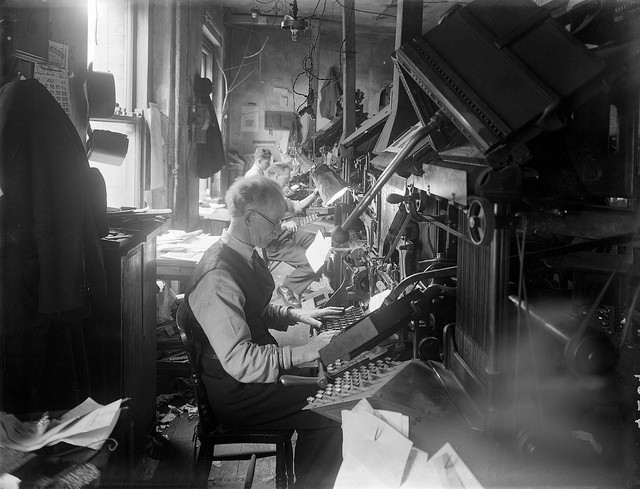
Typesetters working  linotype machines Waterford NewsOver the next few classes we will devote time to editing / formatting our DBQs for iTunes publication of a class DBQ collection. Peter will provide instruction in using iBooks Author. Students will use  material from their DBQ Design project as the foundation for their contribution to one chapter of the class iBook. Peter will arrange for publication on iTunes with all student work credited. DBQ assignment here.

Project Reflection at Ed Methods
Students willing write a reflection on their DBQ design project. That will be done in the form of a blog post to Ed Methods – due by class time 11/25. Students should be sure to go back and quote their original DBQ post and note how their project evolved over time by answering three questions:

  1. What were the learning goals of this DBQ – what skills or content did you want students to master?
  2. To what extent did your final project achieve those goals?
  3. What did you learn about the DBQ lesson design process? (Note: do not discuss the merits of Learnist. It’s about the teaching not the technology.)

The DBQ design blog post should include an image from their DBQ and a link back to their DBQ on Learnist. This post will introduce their DBQ to the world. Peter will also re-publish their post as a guest blogger at Copy / Paste to broaden the audience for their work.

Class DBQ iBook
As a group, the class will review each other’s work before inclusion in the iBook collection of DBQs. Each student (or team) will contribute one DBQ in the form of a book chapter. It will include the project reflection as a way of introducing the DBQ. Students will collaborate on book design decisions and Peter will include a sample chapter and an introduction to the book.

Technical aspects
The iBooks will be designed using iBooks Author in the Mac lab. Students will bring digital versions of their DBQs to the lab – including all image and sound files, text files, citations and URLs. Note: YouTube videos will be inserted into the iBooks using ibooksgenerator.

For more see:

Image credit: Typesetters working on linotype machines at the Waterford News. Date: Friday, 29 July 1938.
This newspaper was set up in 1848, and is still going strong as the Waterford News and Star in print and online.
National Library of Ireland Ref.: P_WP_4269

Class 11: Mock Trials in the Classroom

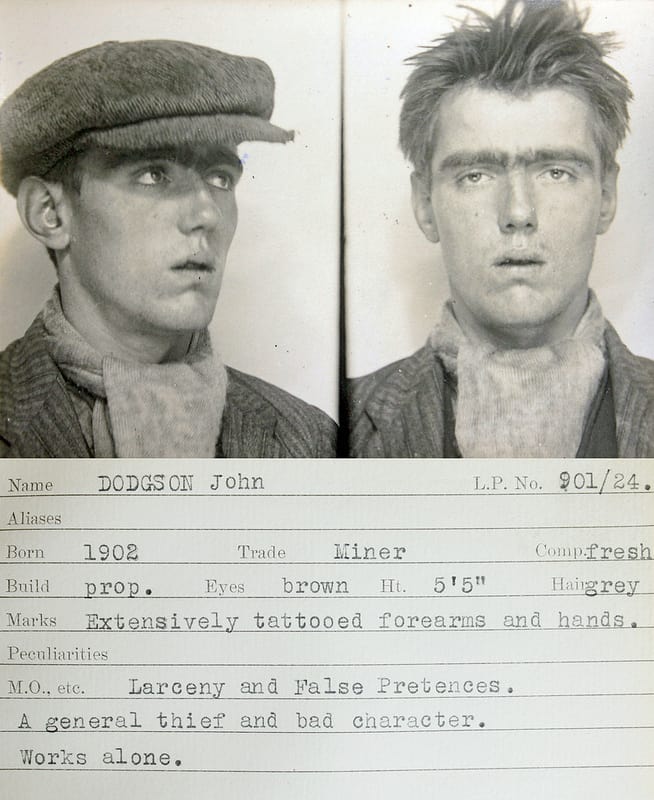
john-dodgsonI’m a big fan of using mock trials – they embody critical thinking in the classroom. Over the years I wrote a number of cases which proved to be effective tools for improving student analytic skills and Common Core skills. Here’s two posts from my blog on using them in the classroom. And here’s a link to two mock trials and an appeals case that I developed.

This week we will be visited by Ms. Barbara Rost, program director, Classroom Law Project. She will guide us through a mock trial – The People Vs Carter (2.4mb PDF) – and provide resources for law related education. (Be sure to follow that link – loads of lesson plans!)

Barbara graduated with a Bachelor of Science from Portland State University after using the 11-year plan to earn her degree, something she does not advocate for others. Three years later she earned her J.D. from Lewis & Clark Law School. She enjoys combining her interests in law and education in her work at Classroom Law Project. She is married, has two daughters in college and a really cute dog.

Classroom Law Project is a non-profit organization dedicated to bringing civics, government and law to Oregon classrooms K-12. Teachers and students know CLP through programs such as mock trial, con team, Law Day conference (for students), Civics Conference for Teachers, court tours, weekly current events, professional development and more. CLP makes civic education fun. Its mission statement: Classroom Law Project is a non-profit organization of individuals, educators, lawyers, and civic leaders building strong communities by teaching students to become active citizens.

Image credit: John Dodgson / Mug Shot / 1930s

This mug shot comes from a police identification book believed to be from the 1930s. It was originally found in a junk shop by a member of the public and subsequently donated to Tyne & Wear Archives & Museums. No information is available to confirm which police force compiled it but evidence suggests it’s from the Newcastle upon Tyne area.
This image is part of the Tyne & Wear Archives & Museum’s set “Newcastle upon Tyne criminals of the 1930’s.” Accession no. DX1190