Let’s Eat Grandpa – 7th Grade Introduction to the Importance of Grammatical Conventions

Content

The lesson will take place within a unit that focuses on grammar and conventions in writing in order to meet 7th grade standards.

Process

Opening/Warm-Up: Every morning the instructor in my classroom writes a ‘welcome note’ on the board. This lesson’s welcome note will be slightly different, it will be written without any capitalization or punctuation. The welcome note will include seating instructions and the also instruct the students to take out a sheet of paper and write the answer to the question, “What is the most commonly misspelled word in America and why do you think it is so often misspelled?”

After a short time they will be asked if they noticed anything confusing about the note. They will then be instructed to re-write the sentences in the note as individuals, making corrections to capitalization and punctuation if needed. The students sit in desk groups of four or five and after making their corrections the students will discuss their edits in their desk groups and come up with corrected sentences they all agree on. One student from each table group will then come up to the board and re-write the note with the edits the group has agreed upon. The instructor will then reveal the correct corrections to the class.

Introduction Lecture: Why is it important for us to understand the correct usage of grammar when writing? Each table group will have 5 minutes to come up with a one sentence response to this question. The class will then briefly discSomeecardsuss.

Spell Check Generation Prezi– The instructor will show slides illustrating examples from writing composed on a computer: grammatical mistakes on Facebook, typed resumes, etc., in order to prove wrong the notion that with computers helping us we don’t need to learn the rules. The presentation will also cover the basic lessons we will be focusing on. Capitalization, punctuation, sentence structure, parts of speech etc. With each slide the students will be encouraged to rate themselves on what they believe their level of competence is in each area 1 to 5. 1 being they feel they require a significant amount of instruction or clarification on the concept, to 5 being they feel very confident on their already formed knowledge base.

Another concept that will be addressed is the hard truth that much of understanding grammar is pure memorization. How do you know your name must always be capitalized? Because you have had to write it 5,000 times. By the 400th time you have probably realized you need to capitalize both your first and last names, right? What are some ideas the class has to facilitate memorization of the grammatical rules they may find difficult? Also the introduction of the idea that conventions are MORE than just rules. The are a foundation with which to base the expression of their ideas.

Product

Students will be motivated going into the unit on conventions to appreciate their real world application, and to reflect on the areas they need to focus on while in the unit. Not all students are the same. We all have trouble with different areas, I want them to appreciate this from the beginning and begin to focus on those lessons in the unit where they need particular instruction.

Evaluation – At the end of the first lesson students will write in full sentences a brief exit self-reflection on their confidence with grammatical conventions. What common errors have they noticed themselves making: commas, title capitalization etc. How do they think the best way is for them to memorize the correct uses?

What kinds of thinking will students need to do to participate in the lesson?

Knowledge, comprehension, some analysis of their own tendencies.

To what extent do students have options or choices regarding these lesson components?

I am there to facilitate the introduction but I will want them to constantly be reflecting on their own experiences with grammatical conventions as I teach the introduction lesson and make suggestions on how best to link what they know about conventions to what they struggle to remember. The lesson’s overarching purpose is to motivate the students to understand the importance of learning grammatical conventions however dry it can seem sometimes, and to take responsibility for their own learning as we progress through the unit.

Personal Reflection

I have heard teachers say much of their lesson planning is facilitated by “working backwards”. From the concept or output they are hoping the students to master or achieve to the steps required in the lesson to arrive there. The planning of this lesson helped clarify for me, why that is a helpful process. To understand the route to take, first you must know where you are going. My upcoming work sample is going to be focused on grammatical conventions, a topic I find a little daunting for various reasons. How do I engage 7th graders and motivate them to want to learn and to be advocates for themselves? How do I keep it exciting? This lesson was my first attempt at understanding what shape that might take. I have a long way to go, but this exercise and the peer review that followed was very valuable to me.

Photo credit: someecards.com

Taking a Stand

March photo

Content  This lesson is the introduction to the Cause unit, which asks students to think about a cause they would be willing to stand up for, even if it required great personal sacrifices. By the end of the unit, students will have written a short essay that includes an introduction, the problem, what should be done, what they can do individually and a conclusion. They will also create a collage that represents their cause.

This lesson will introduce different historical and current day civil rights leaders, asking students to identify the individuals and their causes. Then, students will begin brainstorming the cause that’s important to them.

Process  Students will have read about Cesar Chavez in a previous lesson. I will use a Prezi to start today’s lesson, using student participation to identify the different leaders and their causes. There are some leaders that students may not recognize, but the causes are varied and relevant to their daily lives. We will also discuss what elevates a cause to international recognition. The students will then brainstorm causes that are important to them personally.

Product  At the end of the lesson, students will have identified their cause for the project. They will then begin working on the first draft of their topic sentence and engage in a peer review process that will extend into the next lesson.

Evaluation  Students will not be expected to identify all the leaders, but I hope that the presentation will lead to a conversation about the different causes and the overall idea that there are issues that are worth taking a stand for, even if it leads to personal sacrifices. Students will demonstrate understanding as they continue with the unit and create a short essay.

What kinds of thinking will students need to do to participate in the lesson? This lesson will ask students to remember what they have already learned about historical figures and world history, as well as analyzing what causes are important to them personally.

To what extent do students have options or choices regarding these lesson components? As this is an introduction, student ownership is limited to demonstrating the information they learned last year. Student ownership will increase as they identify their personal cause and begin their essays. They will also have full control of the art portion of the unit, creating their collage. They will work together to peer edit their essays throughout the process.

Personal Reflection This is my first experience co-teaching with my cooperative teacher to introduce a unit and my first time using Prezi as a tool for student discussion. I’m not sure how the class will react to the discussion component, as this is only our fourth class together, but I hope I’ll be able to engage students into a deeper level of conversation, beyond yes and no answers. Thanks to my EdMethods classmates for their help in designing this lesson!

Image Credit: Mississippi Department of Archives and History

April 8, 1968

Dots Not Feathers: Ancient India for Sixth Graders

1916528_524613398697_4368720_n

The following is a lesson study for part of a 10-lesson unit on ancient India that I will be teaching in October. For the purpose of my work sample, I will likely focus on Hinduism, the caste system, the life of Prince Siddhartha, and Buddhism.

Lesson Study (The Life of Siddhartha)

Content (knowledge, skills, course curriculum/standards)

Ss were assigned a reading in advance of the lesson: chapter 16 from History Alive! They were also instructed to make a chronological list of what they believe are the most important events that occurred in Prince Siddhartha’s life.

Curriculum: Ancient India: Buddhism: The life of Siddhartha Gautama. This lesson will serve as a precursor to a lesson (or two) on Buddhism.

Process (materials, procedures, CW/GW/PW/IW*)

Ss will share their list of what they believe to be the most important events from the life of Prince Siddhartha (IW), first with a partner (PW). Then as a class (CW), we will compile one master list of the scenes the Ss believe are the most important to know/cover, as well as how many Ss need to be in each group, and what roles need to be played. Ss will then create tableaux to illustrate the life of Prince Siddhartha in groups (GW; the same # of groups as our agreed upon list of life events).

Product (produced to demonstrate learning)

Tableaux: In small groups, Ss will create tableaux scenes (one per group) highlighting the pivotal moments/main events in the life of Prince Siddhartha.

Evaluation (assessment)

Formative assessment of their performances in the tableaux, participation in the class conversation, and their individual lists of the important events in Siddhartha’s life.

What kinds of thinking will students need to do to participate in the lesson?

Evaluation: what were the pivotal moments in the life of Siddhartha?

Demonstration/illustration (kinesthetic): how do I show this event clearly through a visual scene created with my body and the bodies of my fellow group members?

To what extent do students have options or choices regarding these lesson components?

Ss get to help create the list of “scenes” (important moments in Siddhartha’s life) that will be performed in the tableaux, and Ss have to decide (in small groups) how to demonstrate/show their scene.

Personal Reflection:

Initially, I did a lesson study on the entire ancient India unit, which is the document I brought to our peer review session.  It was important to me to explore everything I wanted to cover. However, the lesson study format turned out to not be the best method for me to explore these options. To fit an entire unit on one page, I had to pick and choose from various threads of thought, which contributed to a lack of cohesion in the document. My thanks to Andy for supporting my use of visual and kinesthetic activities and encouraging me to continue in that direction. My thanks to Erik for helping me focus in on what topics I really want to address and providing follow-up peer review support.

* These designations are Individual Work (IW), Pair/Partner Work (PW), Group Work (GW), and Class Work (CW), terms I acquired at the Paris Teacher Training Centre whilst working on my TEFL certificate.

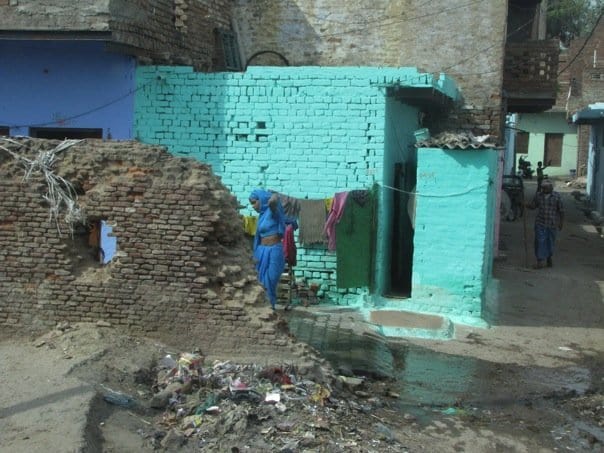
Image: “Lady in Blue,” taken by the author in New Delhi, India, in October 2009. Available on Flickr.

Looking Into 7th Grade Social Media

IMG_1742

An introductory technology lesson by: Erik Nelson

Content: Recently our school district decided to purchase iPads for all students, from K-12. Students will be using the devices in the classroom, and also taking them home. In the social sciences, internet connected devices can be used to harness the collaborative and exploratory power of social media and internet resources while allowing students to create content in relevant ways. In this lesson students will begin to think about the types of social media used by classmates to gain a baseline of information about their social media experiences. Students will use this information to begin framing the conversation of transparency, digital citizenship, and proper use of social media for the 21st century. This lesson will begin setting the foundation for discussions with students around proper use of technology in the classroom and in their personal lives as the school year progresses.

Process:

Part One: Class Technology Survey

  • Step 1: As a group we will discuss and define “social media” and “regular use”. Table groups create combined lists of social media they regularly use.
  • Step 2: Students will create 2 sided labels for every social media app used in class. These labels will be posted on our classroom “window wall” that opens to the hallway.
  • Step 3: Students will take turns marking a dot on the window with dry erase marker next to every app they personally use. At the end, all the classes will contribute information to our “window chart.” (See photo above, you could use the classroom windows for the same purpose)

Part Two: Transparency Discussion

  • Discuss and record answers to:
  • What does our class use social media for?
  • Why did we put the class chart on the glass wall?
  • Why is social media transparent?
  • How is transparency positive and negative?

Part Three: Create a Manifesto

Create personal “social media manifestos” that students can “post” on their sites. (Each student will write a paragraph defining their personal declaration about how they will act using social media in a transparent world. Consider self, family, peers, school, world.)

Product: All the classes will combine to create a visual chart of how many individuals use each social media app. Reflections will be written in class notebooks to questions written after discussion. Written “Social Media Manifestos” can be either collected by teacher (for students who do not use social media but are around it daily) or posted by students with link for teacher to access.

Evaluation: This lesson is intended to be a starting place for all future discussions of social media use in the classroom and in personal life. Students will mark their use of social media on the “window wall,” and the metaphor of “transparency” will be used throughout the school year to reference social media use. Students will write answers to discussion questions in their class journals. Finally, students will create a short written declaration of how they intend to act using social media, hopefully posting it to their social media sites for the world to see their stance of proper use of transparent digital media.

What kind of thinking will the students need to do to participate in the lesson?

This lesson requires students to use lower order thinking to label and list social media they use. Then students will be asked to use higher order thinking to place their use of social media into the larger world.

To what extend to students have options or choices regarding these lesson components?

Much of this lesson is teacher driven, especially at the middle school level. It is imperative that students connect their use of social media to the idea of transparency, and the teacher may need to direct them to that connection. Once transparency and safety have been discussed, students have choice in how they will create their own declaration of social media usage. From the conversation students will have opportunities to take varying degrees of stances towards using social media.

My reflection on this lesson: Creating a lesson for seventh graders about social media use was new to me, as I am used to high school students. I have been struggling with creating lessons that balance structure and direction with organic student engagement. I am indebted to Kristi and Christy for their help in directing me to focus on the end product that students can create. The “social media manifesto” came to life in these discussions, and has the power to be shaped and used in any classroom with a high degree of student choice. It is hard to know the long term impact this lesson may have, but certainly there are opportunities to revisit the transparency metaphor as needed throughout the school year.

__________________________________________________________________

Image Credit: Erik Nelson 2014