Analyzing Current Events as an Adversarial Process

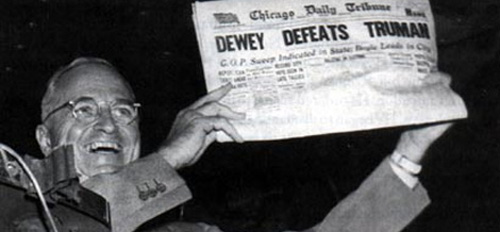
2008-08-16-deweydefeatstruman

Assignment – Every day, the class will examine a current event. Students will sign up for presentation dates upon which they will present their current event articles in a PowerPoint presentation. Every three consecutive presentations will fall under the auspices of the following categories: Civil rights; immigration; government regulation of personal behavior; energy security and climate change; the economy, stupid; electoral races and ballot measures; national security; foreign policy. Additionally, each student will be assigned a presentation for which they will play the devil’s advocate, playing counterpoint to the class discussion following the PowerPoint.

Content – Students will have an opportunity to examine and reconstruct their opinions on American political, economic, social, cultural, industrial, etc. opinions, and configure contemporary world events within their pre-existing schemata. They will also have the opportunity to practice sharing their thoughts on emotionally charged issues in a public forum. To effectively play the devil’s advocate, they will have to objectively examine arguments from multiple angles.

Process – Students will begin by taking a survey, in which they will be asked to “Briefly discuss your positions on the following world issues. Indicate how you arrived at your position on each issue.” They will write short responses on the following:

  • American politics, including issues related to immigration, civil rights, economic policy, national security, gun control, etc.
  • Social issues, including issues related to privacy, human rights and humanitarian issues, climate change, governmental regulation of personal behavior, etc.
  • Foreign policy issues, including foreign aid, energy security, nonproliferation, conflict and stabilization operations, counterterrorism, etc.

Their answers will be used to determine for which topic and for whom they will play the devil’s advocate. Students may have to argue opinions that are contrary to what they actually believe.

Students will also answer: “What do you hope or expect to gain from the current events exercises? Do you think your opinion will change on any of your positions? On what issues do you hope or expect to gain a more-developed understanding?” At the end of the unit, when everyone has presented, they will answer appropriately reflective questions.

During each presentation, students will complete their daily analysis worksheets, upon which they will take notes of the presentation and class discussion.

Product – Students will create PowerPoint presentations to summarize their current event, providing background information and their analyses of the topics. At the conclusion of the presentations, students will provide three questions to guide a classroom discussion following their explanation and background of the topics.  The questions should be open-ended and should ask for students to provide thoughtful responses related directly to the current event.

Evaluation –

Grading Components

Intro sheet:                                                    10 pts

Current event presentation:                          30 pts

Devil’s advocate performance:                    12 pts

Current event analyses:                               48 pts

Current Events:

Daily Analysis

Take notes as the presenter presents his/her article. Then participate in the discussion using your notes to guide you, and reflect on the class discussion.

  1. How would you classify this article? Political Economic Social Cultural Combination _____________/_____________ Other __________________
  1. Write a list of things that you learned from this presentation.
  2. Write down a list of things that you are confused about or questions you have?
  3. In the best words you can possibly choose, what is the article’s point? What is the article about?
  4. Provide a summary of the class discussion. What points did you find the most thought-provoking? Did your opinion or position change as a result of the discussion?

Devil’s Advocate Self-Reflection

  1. Which arguments or points you made were the most effective at eliciting responses from the class?
  2. Did any of the arguments or points you made raise awareness of your classmates?
  3. Did your opinion or position on the subject at issue in the article change? What new things did you learn in researching the devil’s advocate position?

PowerPoint Grading Rubric

Summary of article is written in the student’s words, and is not simply copy and pasted from the article.             1   2   3   4   5

At least one other source of information was used to further explicate the article’s topic, with appropriate APA citations.           1   2   3   4   5

Background provided is accurate and thorough   1   2   3   4   5

Student actively and confidently leads discussion, asks follow up questions if necessary to individual students, and included as many students as possible in the discussion.    1   2   3   4   5

The three questions were open ended and led to a good discussion about the topic.             1   2   3   4   5

The PowerPoint presentation slides used an appropriate amount of text, were easy to read, and well designed.              1   2   3   4   5
[image credit]

“The People happen to love me.”

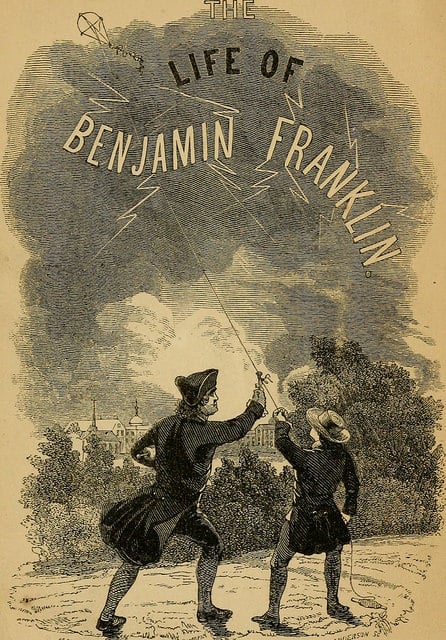
The Life of Benjamin Franklin

Image from Page 6 of The Life of Benjamin Franklin

Lesson Study: First Draft

Content: Students will be given a quote by a famous historical figure, or a quote about an important moment in history. Preferably, these quotes would be ones that are not typically associated with the speaker or moment, so that students will have to think harder about the context the quote could have been given in. For example:

“The People happen to love me. Perhaps that’s my fault.” -Benjamin Franklin

Process: The quote (with speaker and the approximate date when it was said or written) would be put up on the projector for the class to read. Each student will then be given a few minutes to think about and write down ideas about what they think the context of the quote is and who the speaker is. This could be long bullet points or a short paragraph, whatever form they decide their work should take. What was the speaker really trying to say? What does it say about the time it was said during? If they know who the speaker was, they can write down what background knowledge they possess about this person. If they do not, they can speculate who they think the speaker was. Students will then share their ideas in pairs or small groups and will come up with a consensus for their group, which will be written down and given to me. I will then read out these ideas, conduct a short discussion, and then give a lecture on what the quote was really about.

Product: This is a lesson to be repeated, and by the end of the mini-unit, the students should each have a collection of reflections written down that they would be able to turn in.

Evaluation: With these reflections, I would like to stress to the students that there are no wrong answers. It does not matter if they were completely wrong about their theory, as long as they are able to clearly explain why they thought the way that they did. They should also be able to reflect on how their thinking changed after they learned about the true context of the quote. Ultimately, the mini-unit would be ended by having each students find a quote of their own, and to repeat the exercise. Another possible final assessment option would be to have each student make up a quote that a historical figure might have said, or about an event. They would then exchange quotes with another student, and would essentially teach a mini-lesson to their classmate.

What kinds of thinking will students need to do to participate in the lesson? Ideally, over the course of the mini-unit, students will have to employ every level of thinking according to Bloom. First, they must remember and understand the history behind each quote to some degree. They will then take what background knowledge they have, and apply that to their understanding of the quote, which they will then analyze and evaluate what the true meaning of it is. With their final assessment, they will have to apply everything they have learned from the previous lessons in order to create a product of their own for a fellow student to evaluate.

To what extent do students have options or choices regarding these lesson components? Students can express their individuality through their own interpretations. Each lesson will start with them being given the chance to think whatever they wish, without any prompting from me. They will also be given choices when the time comes for them to create their own mini-lesson.

Reflection

I went about designing my lesson study by starting with the Benjamin Franklin quote above. I came across it in a reading for a history class, and decided that I needed to come up with a way to implement it into my future teaching. That got me thinking about other historical quotes that I enjoy for their wildness. I decided to structure my lesson study around this idea, and decided to focus it upon context and perspective.

Accomplishing the peer reviews was easy. The hardest part for me was not knowing how much feedback I was supposed to contribute. As a college student, and a soon-to-be teacher, I’d like to think that I am good at taking and giving constructive criticism. Going into the peer review sessions, we knew that we were supposed to be helping each other, and that it was nothing personal. A big part of teaching is being able to realize that what you’re doing isn’t working, and being able to set aside your pride and admit that you need to make changes. Accordingly, a class of future teachers should have no problem with constructive criticism. This is not going to be something I’ll have the chance to teach in this student teaching placement, but I hope I will be able to implement it in my advanced placement.

Class 3: Peer Review / WordPress Tutorial

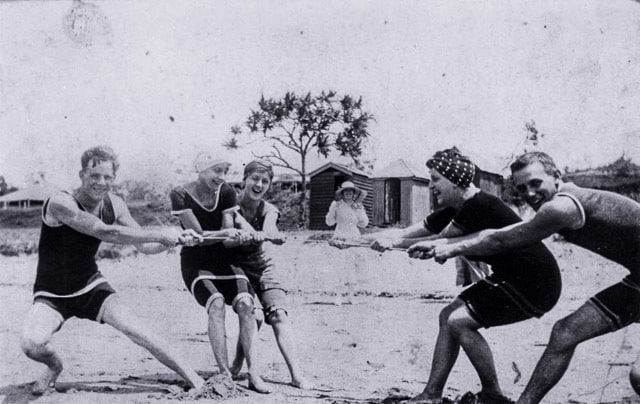
Beach tug of war at Southport, 1917

Peer Review

Last week’s class introduced key elements of lesson design and assigned Lesson Study I.  This week we are going to conduct two peer reviews of each lesson study, before it gets “turned in.” This models the student centered approach – with your peers sharing their higher-ordered review of your work – analyzing and evaluating it’s content. Following their feedback, you get to reflect on your work before turning it in.

We’ll manage the lesson study this way:

  1. You should bring in 3 copies of your 1st draft. (two to share and to one keep their notes on).
  2. You will be randomly put in the first peer review paring
  3. Meet and greet: exchange a quick 1 min intro to your lesson study – grade, subject, scope (one class lesson or a larger unit?)
  4. Exchange written drafts and study for 3 mins. Mark up your copy if you see typos or want to add suggestions. Develop 3 questions  you will ask for clarification.
  5. Student A questions B. Student B responds 3 mins
  6. Discussion / Brainstorming / B takes notes to captures modifications 3 mins
  7. Reverse roles with Student A’s work under review
  8. This should take us about 20 minutes to review each other’s work. You will then be assigned to another student to repeat the peer review process

After everyone has completed two reviews you will then have about 20-30 minutes to make revisions to you lesson study. (A good time to talk to the instructor as well). You should also write a personal reflection on what they learned in developing their first lesson study and participating in the peer review process

Submitting lesson study as blog post: See results here

Students will turn in their revised Lesson Study I assignment as a post on this blog by 10 PM Sept 10th. It should include their lesson study as well as personal reflection. Each post should also have a historic photograph (public domain with citation) that matches the theme or subject of their lesson study.

I’ve prepared some brief WordPress video tutorials. You can find them at this YouTube playlist / WordPress tutorials for using our class blog These tutorials were made with a free Chrome Plug in called SnagIt.

Assignments for class 4 on historical thinking
I’ve used the TEDEd flipped lesson feature to curate a existing YouTube and turn it into a lesson to support next week’s class on historical thinking: Who is the historian in your classroom? Another way to flip a class.

Also do one online reading Thinking Like a Historian By Sam Wineburg


Image source:

Beach tug of war at Southport, 1917
State Library of Queensland link

Class 2: Designing Lessons / Social Media Audits

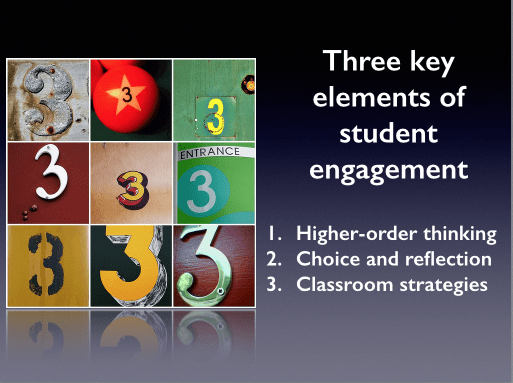
Three key elements of student engagement
This week we consider two very different themes – social media and instructional design. The class begins by addressing key elements of lesson design :

  1. Higher-order thinking
  2. Student choice and reflection
  3. Effective classroom strategies

This  portion of the class lesson includes three major elements:

  • Practical examples of Bloom’s taxonomy in the form of sample exercises and questions. They are used to anchor a conversation on Bloom in action.
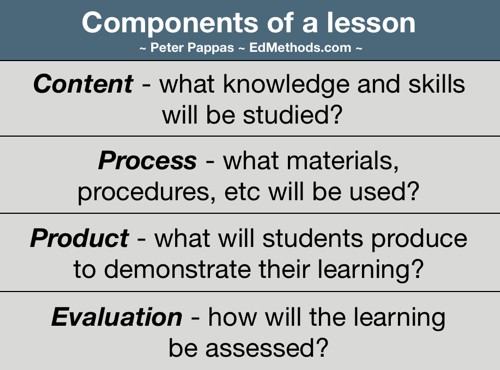
  • How student choice can impact key lesson elements – content, process, product, evaluation.
  • Demonstrate a student-centered approach to a teacher presentation as a way to foster reflection (instead of listening to a straight lecture on the subject)

The lesson is driven by a Keynote presentation. Handout (42MB pdf)  We will use an audience response system to gather student input. The lesson includes multiple activities that illustrate the content. Student will be led through discussing their reactions to the activities to connect them to the content. This lesson will serve as a kick off to their first assignment to write and share a Lesson Study.

key lesson components

In the second half of the class we’ll meet in small groups to share our personal social media audits. We’ll be focusing on rolling out our new Google+ Community and learning how to use some it’s features. It’s a private group and will serve as an extension of classroom discussion through posts, comments, and Hangouts.

Assigned Readings for Class 3: None

Written assignment for Class 3:

Lesson Study I is due next week.

The goal of this assignment is two-fold. First to offer supportive feedback on your lesson development through a peer review process. Second to offer some “lenses to look through” that help you easily see the essentials of a lesson. It is not a substitute for the School of Education lesson plan format. Think of it as a pre-lesson plan planning guide. This is not some exercise for the benefit of your instructor. This should be a process that works for you. So feel free to modify to meet your particulars. Use a scale that works for you – focus on just a small segment of a larger unit, or look at the entire unit. Don’t like Bloom? Use another schema to discuss the kinds of thinking that your students will need to successfully complete the assignment. Assignment here. (383 KB pdf) Sample lesson study (378 KB pdf)

See results of this assignment in the first student posts