
Lessons from the DBQ

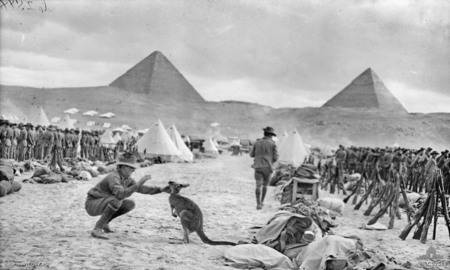
Source: http://aso.gov.au/titles/historical/landing-of-australian-troops/extras/

Thus far, the DBQ has been a very challenging, but educational, experience. I initially began this journey thinking that I would do my DBQ on Operation PB Success. However, I found that would not be feasible so I changed my topic to the Anzacs in Egypt during World War I and perceptions of the ‘other.’ Through this, I have learned how to conduct a successful history lesson without a lengthy lecture. The setup of my DBQ allows students to interact successfully with the material and make an argument without needing in-depth background on the topic beforehand. Students, therefore, practice thinking like historians and the classroom becomes more student-centered.

Another lesson I have learned from the DBQ is how to find primary sources. Finding primary sources is, clearly, very important to the DBQ process. The internet makes it possible to track down hundreds of primary sources from a range of websites whether they be from an academic institutions or a small blog. In order to ensure that my sources are reliable, I have found that government websites are really helpful in locating legitimate primary sources. While it is certainly tempting to just steal primary sources without worrying about their origin, I believe it is important to ensure that I am giving my students something that is quality and genuine.

I would really enjoy using this DBQ in a class that was exploring World War I. Race hate is a reoccurring theme in wars and this DBQ gives students another avenue in which to explore it. When we think of race hate we often think of groups such as the Nazis, but it is important to show students that there are many dimensions to history and while it is easy to villains only one group, it is not necessarily accurate. Racial prejudices come in many shapes and sizes and can be found in all eras. The Anzacs provide another perspective to historians. It is not my intent to belittle the bravery of the Anzacs in World War I. Rather, I want students to remember that history is not black and white. It is not simple and it is not static. It is fluid and gray. It is their job to sift through it and make a claim and support it with evidence as historians in training.

Content vs. Process

In addition to being practice in how to go about making a DBQ, this assignment has also been a solid lesson in how not to create a DBQ. I feel that as an actual practicing teacher, this will be easier as I will have a better idea of what I want and need the DBQ to do. I will have a topic in mind, and a message that I am trying to convey to the students, or messages that I want them to come up with on their own. There will be more structure in place. Creating a DBQ in the manner that we did for this class allowed me too much freedom, I feel. I needed a more concrete goal, as my DBQ turned into doing whatever I wanted to with it, not trying to meet specific requirements for student learning.Lady Bird and Students

Going along with that, I decided early on that I wanted to create an image based DBQ. I found my resources, and shaped my DBQ around what I had discovered. If I were to do this again, I would reverse my work flow. The topic would come first, and then I would find documents that fit with it. There would be more diversity in the sorts of documents that I included, rather than just using images.

While I do like my DBQ, and feel that it would get students to think about something that wouldn’t normally cross their minds, I am less pleased with the process that I went through to create my DBQ. My problems aren’t so much with my content as with my process. If anything, I became too attached to  my content, and struggled to make changes because of that.

Image Credit:  White House Photo Office Collection courtesy of the National Archives.

Taking Shape: Thoughts on creating DBQ’s

screenshotAfter spending a few weeks exploring the different avenues available to me for my DBQ, I am finally on a focused track to the finish.  After switching my topic from the more obscure food history topic to the much more document rich Marshall Plan, my issue was not where to find documents, but just the opposite.

There were so many great documents, I found myself following lead after lead on possible directions to take the assignment.  While I learned a tremendous amount about the Marshall Plan, the state of Europe after WWII, and the different opinions throughout U.S. and Europe about the plan, I didn’t feel like I was getting any closer to completing the assignment. But I was finding photos, documents,  and getting more information. Through this research I was able to narrow my focus and choose an angle on which to focus: the differing views on the Marshall Plan from Europe, Russia, and at home in the U.S.. My next challenge was to step away from the history and just look at the documents.  What was I trying to say?  What were the documents telling me?  I finally focused on assembling documents that could tell a story.  Once I had a clear narrative of what I wanted the students to see, the guiding questions practically wrote themselves.

Next up for me is to add the last few pages into iBook Author and begin to fine tune the look and feel.  I will have my classmates review the work to ensure the documents and questions create a clear narrative that will guide the students to address the enduring questions of the unit.

This assignment has been exciting for me on two main levels.  First learning how to write this type of assignment for my students will be something I will continue to work on throughout my career. I am a big believer in having students think like historians.  The other facet is just how much I enjoyed researching the history surrounding the Marshall Plan. Reading all the documents and seeing all the photos was like a DBQ itself.  I will continue to practice, learn, and hopefully inspire my students to do the same.

Practice Makes Perfect?

Teacher Lorraine Lapthorne

As I approached the DBQ assignment, I decided to use images and texts from a literacy class assignment I had just completed. At first, I thought I had a head start, since I had a collection already curated, but as I continued with the assignment I realized I had started in the wrong place. While it was nice to have images and text, I should have started with the essential question AND what I wanted students to experience as they worked through the DBQ.

Working backwards, one of the challenges is finding the essential question that ties everything together. My previous assignment was over a broad topic – the Civil Rights Movement – which I’ve realized is much too broad for a DBQ exercise. Finding the right essential question was key to finding a way to connect the materials together.

The next step was to really think about what I wanted my students to learn as they worked through the DBQ. My first set of materials were loosely related, but would require students to take some large leaps to find the connections. Even with scaffolding questions, it seemed like a stretch. Once I had an essential question identified, then I could focus on the historical thinking skills I wanted students to experience as they worked through the DBQ.

This experience reminds me that the only way to get better at something new is to continue to practice. I have a much better sense of how to organize my thoughts around creating a DBQ and look forward to adding this learning experience to my curriculum development skills.

Image Credit: Teacher, Lorraine Lapthorne conducts her class in the Grade Two room at the Drouin State School, Drouin, Victoria. nla.gov.au/nla.pic-an24229822