Working as individuals or in 2 person teams, students will design a document-based lesson (DBL) question suitable for inclusion in our iBook (available at iTunes).
See Class 6 for recommendations for DBLs and Teaching with Documents. Your DBL will include:
Introduction of the DBL with brief historic context as needed.
Generative / essential question
About 5 – 8 related documents (image, text, video, audio) that will assist the students in answering the generative question
Clear statement of what students will be asked to do
Close reading scaffolding question for each document to assist the student in examining the document
A good example of a DBL is Progress and Poverty in Industrial AmericaThis is a pdf version of one of my iBooks. (note: you will not have full function of all the gallery and video widgets). It uses 11 documents, which is a bit more than I expect for your DBL.
The DBL Design Assignment will be accomplished in steps:
Step 1: Develop a proposal which will be submitted for peer review. You should be prepared to deliver a 2 min pitch to class. (not a written assignment to be turned in) Due date: 10/12.
We’ll do a bit of “speed dating” of our ideas for the DBL Assignment. Students will form two lines and have 2 minutes to pitch their DBL design idea to each other and share some feedback. Then one line will shift and we repeated the pitch exchange. In all students will pitch their idea three times.
The goal of this phase is to gather feedback from peers regarding the following:
You have an interesting generative / essential question worth answering.
Your initial appraisal indicates there are suitable documents available.
You have an idea for how students will be asked interpret your documents.
Step 2: Submit a preliminary idea for your DBL design project for Peter’s feedback by 10/19. It should be posted to a shared Google folder.
Step 6: Write a reflection on your DBL design process and post to our blog (your final post). It will also be added to your iBook chapter – due 12/6.
Step 7: Final design session in Digital lab 12/7
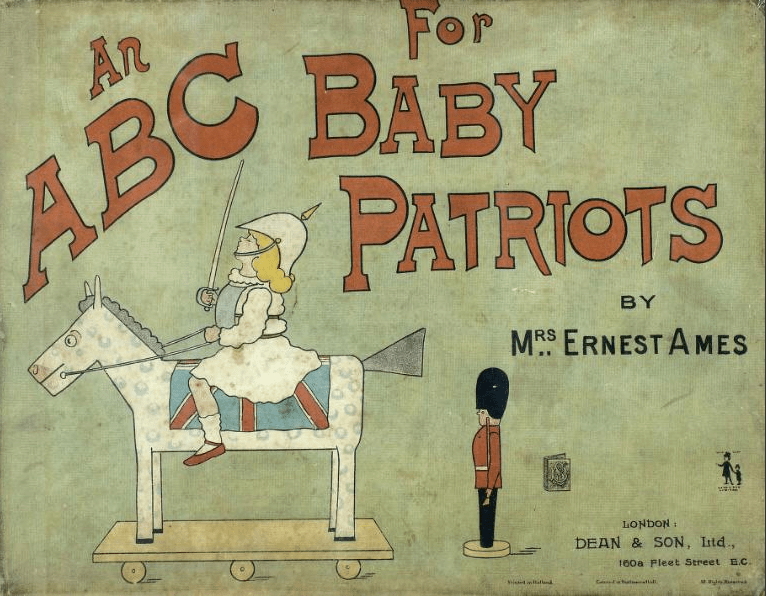
Title: “An A B C, for baby patriots”
Creator: Ames, Mary Frances
Publisher: Dean & Son
Place of Publication: London (160a Fleet Street E.C.)
Publication Date: [1899]
Archive: University of Florida UF00086056:00001
Lesson Context: This lesson is intended to conclude discussion of the loyalists as a part of the American Revolution. The lesson asks them to analyze different images from the colonial period to get a better understanding of loyalism and its impacts in the American colonies.
Essential Question:Was Thomas Hutchinson the villain that many American patriots made him out to be or was he an American hero?
Historical Thinking Skill: Contextualization and Sourcing
What kinds of imagery does the artist use to depict Thomas Hutchinson?
What kinds of things would you assume from this print about what people thought of Hutchinson?
Do you think this image is representative of the feelings of all American colonists about Hutchinson?
Rationale: Students will be encouraged to consider the types of images and metaphors that each artist uses to describe Thomas Hutchinson in each image. Students should compare/contrast them.
Scaffolding questions for discussion:
What has changed from image 1 to image 2?
What was going on in the colonies and Great Britain between 1774 and 1775, when these two sources were published?
What other questions would you ask about these sources to better understand Thomas Hutchinson as a historical figure?
Suggested assignment for further analysis:
Based on discussion and students’ answers to the scaffolding questions for each individual image, students should chose the image they find more compelling, and create their own image that reflects similar themes. For instance, if they decide that loyalists such as Thomas Hutchinson were patriots who wanted freedom but also wanted to maintain relationship with Great Britain, they would choose the second image, and use similar metaphors in their own drawing.
Reflection:
With this particular lesson, it is important to bring the two historical thinking skills (contextualization and sourcing) to the forefront of discussion. Students should begin to recognize that the sources, produced in 1774 and 1775 respectively, by different artists, both in Boston, reflected changing perceptions of loyalists during the war. By 1775, the drama of the American Revolution had escalated, and Thomas Hutchinson was no longer the governor of Massachusetts. The second image, rather than representing his death, represents instead his fall from power, and the mourning of those loyalists who supported him.
Historical thinking skills: Corroboration and close reading
Guiding question: How did Americans react to the immigrants at the turn of the century?
Background: The 10th graders have started a unit on the Progressives at the turn of the century. To start this unit, I gave a lecture setting up a framework for the students to be thinking about but also gave them some background information about the era. In specific relation to the issue of immigration, we talked about the rise in immigrants to the country between the years of 1880 and 1920. We briefly touched on the hardships many immigrants faced upon arriving in the country but I wanted to give the students a chance to see if from the American’s perspective and the Progressive perspective. I would also hope to tie this lesson to conversations currently happening in the country around immigration, but for this lesson probably not beyond picking out the similarities.
An Illustration from a Japanese Edition of Romance of the Three Kingdoms
By: Benjamin Heebner
Target Students: 6th Grade
Historical Thinking Skills: Contextualization, Close Reading
Essential Question:What are the foundations of the right to rule for Chinese Emperors?
Rationale: The scaffolding questions are based around the comparison and contrasting Chinese, Sumerian, and Indian religious practices and how they relate to the right to rule on a graphic organizer. Using this as the base point Students will make a guess about how the Chinese will use religion to legitimize their Right to Rule. This activity is based on the previous information that the students are worked on in class already. In addition a close reading of the Mandate of Heaven, the logical manifesto of the Chinese Right to Rule will be done after the comparison and contrasting activity in order to either affirm of dis affirm their guess.
Primary Sources:
In the twelfth month of the first year… Yi Yin sacrificed to the former king, and presented the heir-king reverently before the shrine of his grandfather. All the princes from the domain of the nobles and the royal domain were present; all the officers also, each continuing to discharge his particular duties, were there to receive the orders of the chief minister. Yi Yin then clearly described the complete virtue of the Meritorious Ancestor for the instruction of the young king.
He said, “Oh! of old the former kings of Xia cultivated earnestly their virtue, and then there were no calamities from Heaven. The spirits of the hills and rivers alike were all in tranquility; and the birds and beasts, the fishes and tortoises, all enjoyed their existence according to their nature. But their descendant did not follow their example, and great Heaven sent down calamities, employing the agency of our ruler- who was in possession of its favoring appointment. The attack on Xia may be traced to the orgies in Ming Tiao… Our king of Shang brilliantly displayed his sagely prowess; for oppression he substituted his generous gentleness; and the millions of the people gave him their hearts. Now your Majesty is entering on the inheritance of his virtue; — all depends on how you commence your reign. To set up love, it is For you to love your relations; to set up respect, it is for you to respect your elders. The commencement is in the family and the state….
“Oh! the former king began with careful attention to the bonds thar hold men together. He listened to expostulation, and did not seek to resist it; he conformed to the wisdom of the ancients; occupying the highest position, he displayed intelligence; occupying an inferior position, he displayed his loyalty; he allowed the good qualities of the men whom he employed and did not seek that they should have every talent….
“He extensively sought out wise men, who should be helpful to you, his descendant and heir. He laid down the punishments for officers, and warned those who were in authority, saying, ‘If you dare to have constant dancing in your palaces, and drunken singing in your chambers, — that is called the fashion of sorcerers; if you dare to see your hearts on wealth and women, and abandon yourselves to wandering about or to the chase, — thar is called the fashion of extravagance; if you dare to despise sage words, to resist the loyal and upright, to put far from you the aged and virtuous, and to seek the company of…youths, — that is called the fashion of disorder. Now if a high noble or officer be addicted to one of these three fashions with their ten evil ways, his family will surely come to ruin; if the prince of a country be so addicted, his state will surely come to ruin. The minister who does not try to correct such vices in the sovereign shall be punished with branding.’…
“Oh! do you, who now succeed to the throne, revere these warnings in your person. Think of them! — sacred counsels of vast importance, admirable words forcibly set forth! The ways of Heaven are not invariable: — on the good-doer it sends down all blessings, and on the evil-doer it sends down all miseries. Do you but be virtuous, be it in small things or in large, and the myriad regions will have cause for rejoicing. If you not be virtuous, be it in large things or in small, it will bring the ruin of your ancestral temple.”
The Mandate of Heaven, Selections from the Shu Jing (The Classics of History) (6th Cen. B.C.E.) Retrieved from Link on 9/30/15.
Pictures:
Ox Scapula at the National Museum of ChinaAncient Ziggurat in IraqQin Shi Haung: First Emperor of China
Scaffolding Questions:
What emphasis could the Ancient Chinese be placing on the role of religion and the supernatural in Chinese society if they do not have large temples like the Sumerians, and Indians did?
Look at the illustration of Qin Shi Huang, what do you notice about the clothing that he is wearing? It is similar to the illustrations of Egyptian Pharaohs, Sumerian Kings, and Indian Rulers that we have seen in class so far?
How does the Mandate of Heaven stand up to the Written Laws of the Sumerians in explaining why a King should rule?
What does the Mandate of Heaven tell us about the role of the supernatural in Ancient China? Does this change the answer to the question above? If yes then please explain the change.
Summary and Reflection: During this lesson students will be tasked with first refreshing their background information by reminding them about the information that we have gone over in classes before. Then by asking the first two scaffolding questions the students will have the chance to compare their previous knowledge with the new Chinese information that we are introducing in class. Once we have gone over first two scaffolding questions I will have the students Close Read the Mandate of Heaven. During the close reading students will focus on taking margin notes and once they have finished the notes they will answer the last two scaffolding questions on the Close Reading sheet to show their understanding of what it meant to be the ruler in Ancient China.
I found the SHEG model to be informative in forming questions that allow me to see what my students are thinking and show that they get the concepts that I want them to see as well. It serves as a nice model to base what particulars I want my students to focus in on as they navigate the waters of Primary and secondary sources. In particular while the skills and questions that they promote are more suited for non ancient history classes it is a format that allows me to do a lot even though there are very few Primary sources to draw upon. I will use the SHEG model in the future when I need to do primary source analysis in my classes since the format makes primary sources more than a question and answer session and allows students to show their interaction with the source itself.

 Working as individuals or in 2 person teams, students will design a document-based lesson (DBL) question suitable for inclusion in our iBook (available at iTunes).


