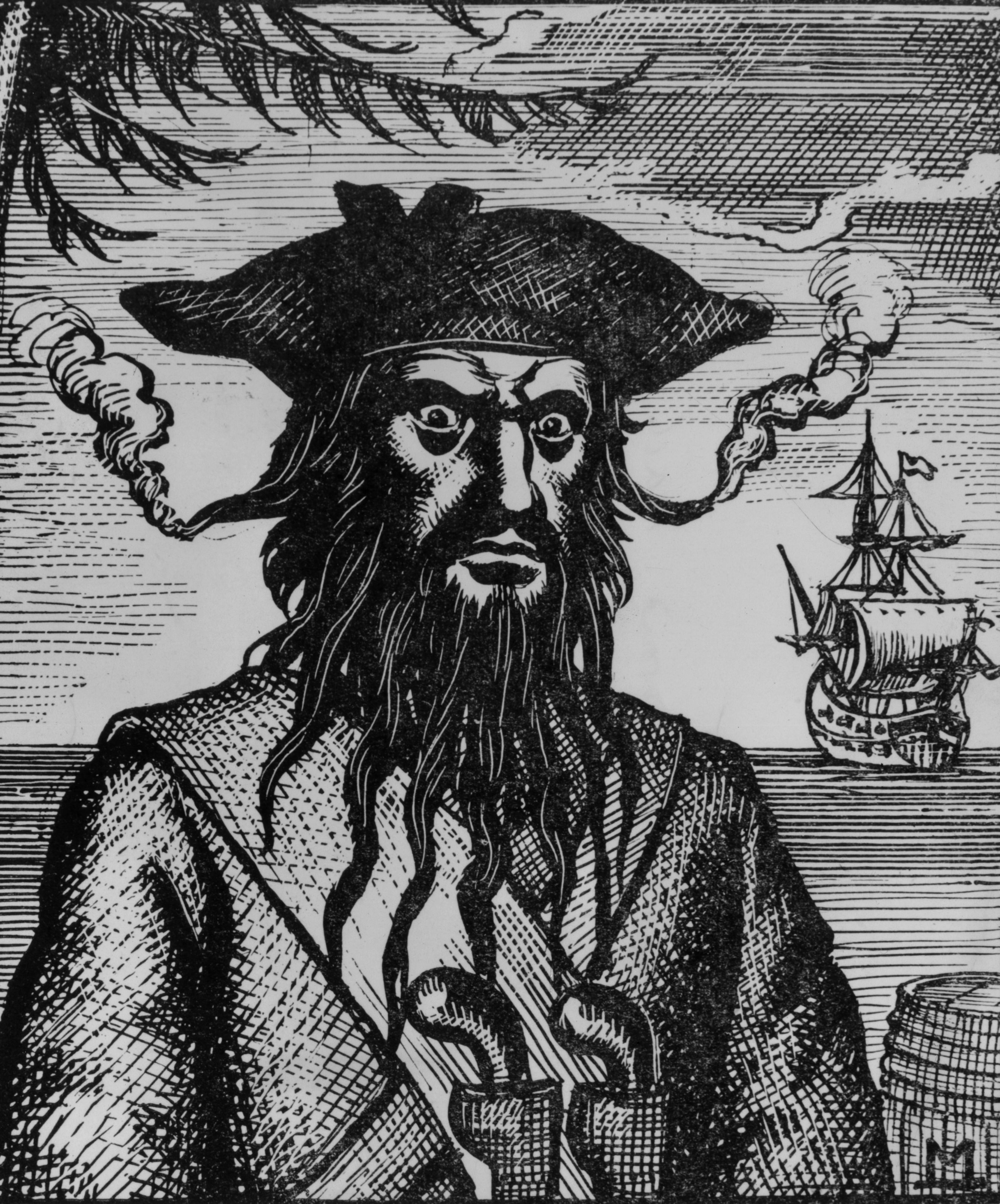
The Death of Blackbeard

A Lesson for 8th grade U.S. History Students

undefined

Content:   Sourcing and Corroborating Primary Documents

  • Students will review 3 different accounts of The Battle of Ocracoke Inlet,  which resulted in the death of notorious pirate Edward “Blackbeard” Teach.
  • In groups of 2-3 they will read and discuss each document, creating a Venn Diagram to help process the similarities and differences in the primary sources.
  • Benjamin Franklin, who was 13 years old at the time of the battle, penned a ballad about the death of Blackbeard.  His poem will be presented on the projector and read to the class.
  • Essential question :   Which author’s work could have influenced the young Benjamin Franklin when he wrote his ballad about Edward “Blackbeard” Teach?
  • Students will write a short argumentative piece answering the question above, defending their choice with evidence from the texts.
Materials:

  • Questions to think about while reading:
    • For whom is each author writing their document?
    • Did the author have any ulterior motive while writing their account?
    • What conflicting accounts can you identify between the documents?
    • How does each document characterize Blackbeard?
    • What other type of source/document would be useful for a comparison?


Account #1:  The Governor’s Letter

officialletters00brocgoog_0545officialletters00brocgoog_0546

Account #2:  Newspaper Article

Published in The Boston News-Letter, dated “From Monday Feb. 16 to Monday Feb. 23, 1719”:

“… Governour Spotswood of Virginia fitted out two Sloops, well manned with Fifty pickt Men of His Majesty’s Men of War lying there, and small Arms, but not great Guns, under the Command of Lieutenant Robert Maynard of His Majesty’s Ship Pearl in pursuit of that Notorious and Arch Pirate Capt. Teach, who made his escape from Virginia, when some of his Men were taken there, which Pirate Lieutenant Maynard came up with at North Carolina, and when they came in hearing of each other, Teach called to Lieutenant Maynard and told him he was for King GEORGE, desiring him to hoist out his boat and come aboard. Maynard replyed that he designed to come aboard with his sloop as soon as he could, and Teach understanding his design, told him that if he would let him alone, he would not meddle with him; Maynard answered that it was him he wanted, and that he would have him dead or alive, else it would cost him his life; whereupon Teach called for a Glass of Wine, and swore Damnation to himself that he either took or gave Quarter.

“Then Lieutenant Maynard told his Men that now they knew what they had to trust to, and could not escape the Pirates hands if they had a mind, but must either fight and kill, or be killed; Teach begun and fired several great Guns at Maynard’s Sloop, which did but little damage, but Maynard rowing nearer Teach’s Sloop of Ten Guns, Teach fired some small Guns, loaded with Swan shot, spick Nails and pieces of old Iron, in upon Maynard, which killed six of his Men and wounded ten, upon which Lieutenant Maynard, ordered all the rest of his Men to go down in the Hould: himself, Abraham Demelt of New York, and a third at the Helm stayed above Deck.

“Teach seeing so few on the Deck, said to his Men, the Rogues were all killed except two or three, and he would go on board and kill them himself, so drawing nearer went on board, took hold of the fore sheet and made fast the Sloops; Maynard and Teach themselves then begun the fight with their Swords, Maynard making a thrust, the point of his Sword went against Teach’s Cartridge Box, and bended it to the Hilt, Teach broke the Guard of it, and wounded Maynard’s Fingers but did not disable him, whereupon he Jumpt back, threw away his Sword and fired his Pistol, which wounded Teach. Demelt struck in between them with his Sword and cut Teach’s Face pretty much; in the Interim both Companies ingaged in Maynard’s Sloop, one of Maynard’s Men being a Highlander, ingaged Teach with his broad Sword, who gave Teach a cut on the Neck, Teach saying well done Lad, the Highlander reply’d, if it be not well done, I’ll do it better, with that he gave him a second stroke, which cut off his Head, laying it flat on his Shoulder, Teach’s Men being about 20, and three or four Blacks were all killed in the Ingagement, excepting two carried to Virginia: Teach’s body was thrown overboard, and his Head put on the top of the Bowsprit.”


Account #3:  Lieutenant Maynard’s Letter

Printed in The Weekly Journal, or British Gazetteer, 25 April, 1719:

“I sail’d from Virginia the 17th past, with two Sloops, and 54 Men under my Command, having no Guns, but only small Arms and Pistols. Mr. Hyde commanded the little Sloop with 22 Men, and I had 32 in my sloop. The 22d I came up with Captain Teach, the notorious Pyrate, who has taken, from time to time, a great many English Vessels on these Coasts, and in the West-Indies; he went by the name of Blackbeard, because he let his beard grow, and tied it up in black Ribbons. I attack’d him at Cherhock in North Carolina, when he had on Board 21 Men, and nine Guns mounted. At our first Salutation, he drank Damnation to me and my Men, whom he stil’d Cowardly Puppies, saying, He would neither give nor take Quarter. Immediately we engag’d, and Mr. Hyde was  unfortunately kill’d, and five of his Men wounded in the little Sloop, which, having no-body to command her, fell a-stern, and did not come up to assist me till the Action was almost over. In the meantime, continuing the Fight, it being a perfect Calm… I boarded his Sloop, and had 20 Men kill’d and wounded. Immediately thereupon, he enter’d me with 10 Men; but 12 stout Men I left there, fought like Heroes, Sword in Hand, and they kill’d every one of them that enter’d, without the loss of one Man on their Side, but they were miserably cut and mangled. In the whole, I had eight Men killed, and 18 wounded. We kill’d 12, besides Blackbeard, who fell with five Shot in him, and 20 dismal Cuts in several Parts of his Body. I took nine Prisoners, mostly Negroes, all wounded. I have cut Blackbeard’s head off, which I have put on my Bowspright, in order to carry it to Virginia. I should never have taken him, if I had not got him in such a Hole, whence he could not get out, for we had no Guns on Board; so that the engagement on our Side was the more Bloody and Desperate.”


Benjamin Franklin’s Ballad:

Benjamin Franklin never published his ballad, only referring to it in his autobiography.  However, in his collection The Papers of Benjamin Franklin, Leonard W. Laboree provides one stanza given to him by George Hayward, a Boston physician and contemporary of Ben Franklin:

“So each man to his gun,
For the work must be done,
With cutlass, sword, or pistol.
And when we no longer can strike a blow,
Then fire the magazine, boys, and up we go!
It’s better to swim in the sea below
Than to swing in the air and feed the crow,
Says jolly Ned Teach of Bristol.”

  • 13 year-old Benjamin Franklin

Product:

  • As they read, students will fill a Venn diagram with information about the battle.  They should focus on the supporting details and characterizations given in each document.  This diagram will be used to help them choose which text they’d like to write about.
  • In their 1-2 page essays, students will argue for their chosen account, defending their position with details from the text.  3-4 examples should be included, and comparisons should be tied directly to Ben Franklin’s poem.
  • Upon conclusion of writing, designate a corner of the classroom for each primary source, and have students move to the corner of the piece they chose.  Discuss the class distribution as a group, focusing on the reasons why each student chose their text.  Encourage them to share specific examples and make note of common threads among the class.

Reflection

I am excited to have an opportunity to teach this lesson, as I think it has great promise to generate some interest.  The swashbuckling affair that was the Battle of Okracoke Inlet takes advantage of the inherent coolness of pirates, and is balanced nicely by tying in the impact on Benjamin Franklin.  This helps ground the fanciful world of the golden age of pirates in reality, and demonstrates that these people and events had a real impact on American society in the 18th century.

I would like to have found online documents for the Boston-Letter article and the printing of Lt. Maynard’s Letter, however my internet research skills did not prove proficient.  Regardless, in this case the content of the documents is the interesting part, as it’s never too difficult to get kids to read about dramatic battles, even if they are written in Olde English.

I found the process of creating this lesson very exciting as I became more of an expert on Blackbeard.  The investigatory nature of sifting through the accounts gave me a real “history-detective” feeling, and stimulating similar sensations in students will help make this lesson more impactful.  If students can learn and participate in detailed investigations of primary sources while being entertained by the novelty of pirates, I think my work here is done.

Sources

coming soon

Photos

“Capture-of-Blackbeard” by Jean Leon Gerome Ferris – Licensed under Public Domain via Commons – link

Image: “Blackbeard the Pirate” link

“Black Beard’s head on the end of the bowsprit”.  Image: United States Library of Congress.  Prints and Photographs Division.  Digital ID cph.3c16074

One Minute to Midnight: Decision-Making During the Cuban Missile Crisis


Target Students:
11th and 12th grade

Historical thinking skills: This lesson develops students’ sourcing and contextualization skills.

Essential question: On what bases did the US and USSR make decisions leading up to and during the Cuban Missile Crisis?

Context within Curriculum: To participate in this lesson students must be familiar with the broad contours of post-WWII global politics. In particular, students should be able to describe key differences between the US and USSR, be aware of the existence of NATO and the Warsaw Pact, and have basic knowledge of nuclear weapons.

Primary documents:

  1. CIA Special National Intelligence Estimate, “Major Consequences of Certain U.S. Courses of Action on Cuba,” October 20, 1962.
  2. Prime Minister Fidel Castro’s letter to Premier Khrushchev, October 26, 1962.
  3. USSR, Cable, TOP SECRET, Dobrynin Report of Meeting with Robert Kennedy on Worsening Threat, October 27, 1962.

All sources via The Harvard Kennedy School of Government’s Belfer Center at

Key Documents

Scaffolding questions:

  • Who (or what) wrote/produced these documents?
    • How does the identity of the author change the way we interpret the documents?
    • What were the author’s goals or purposes?
  • These documents are very different from one another. How does their form affect the way we interact with them as historians?
  • Who would have read these documents and what kind of information would they have wanted from them? How might that information have been used?
  • What can we infer about the relationship between Cuba and the USSR from Castro’s letter? Further, what do we know about US-Cuba relations at this time?

Goals: Students will synthesize what they know about Cold War history (context), international relations, and that which they can infer using these documents to develop an explanation of the Cuban Missile Crisis:

  • The US, USSR, and Cuba all sought security
    • The documents support this (compromise re: NATO missiles in Turkey; Cuba’s fear of invasion by the US; US worries that its actions could provoke retaliation by the USSR)
  • Governments make decisions, predictions, with limited information
    • Implication: Decisions cannot be perfectly rational; based on predictions about others’ behavior

Students produce:

Students will be divided into four smaller groups, two groups assuming the role of the US and two becoming the Soviet Union. The individuals within each of these small groups will work collaboratively to analyzing all three documents included in the lesson. These groups are then asked to develop a cohesive “policy proposal” to the entire class. These proposals can take a wide range of forms, although it is essential that students identify 1) a “policy priority” that is rooted in a group’s reading of the primary material (e.g. removal of US missiles in Turkey) and 2) a rationale that details the group’s reasoning for making the specific recommendation that they have chosen (e.g. “we recommend invading Cuba because the CIA report indicates…”).

Reflection:

With this activity I set out to use an exciting, high-profile incident to guide students to a broader understanding of the machinations of international politics. The process of developing the lesson and, the helpful feedback I have received from peers in particular, has helped me to identify major shortcomings that have both improved this lesson and will help me produce stronger lessons in the future. To fully realize the potential of learning through primary documents, I have found that it is essential that lessons be appropriately sequenced and scaffolded. Striking the balance between frustrating students by presenting them with materials they are ill-equipped to understand and over-scaffolding to the point of boredom will be a focus of mine as I grow as a teacher.

Title Image: EXCOMM meeting at the White House Cabinet Room during the Cuban Missile Crisis on October 29, 1962


“Gone In A Day” – The Vanport Flood 1948

Vanport

Target Students: 3rd Grade

Historical Thinking Skill: Corroborating

Guiding Questions: How did the people of Vanport react to the flood? How did the Government react to the disaster?

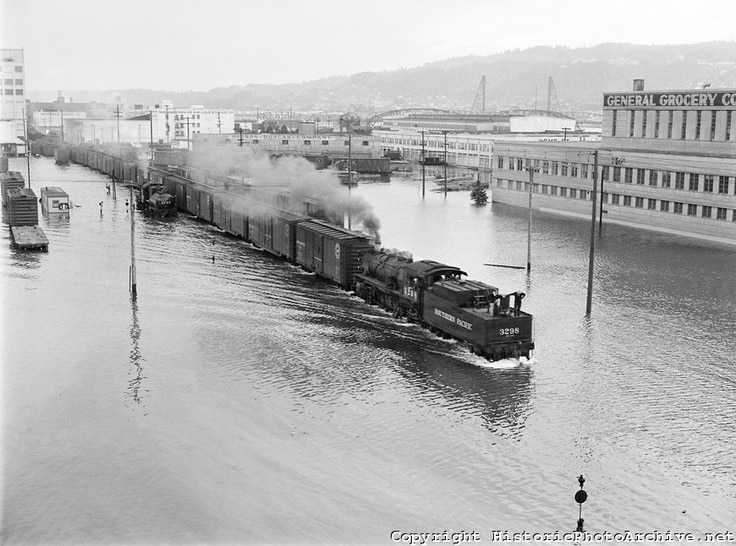
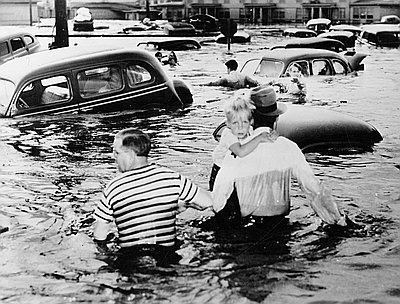
Lesson Context: This lesson is intended to to be an introduction/exposure to primary sources for my class of third graders. Students will be given two videos to watch: one deals with personal interviews about the people living in Vanport, and the other is video of the flood. Students will also be given one primary source textual document to read. Students will use these three sources to discus the reliability of each source and the idea of what constitutes a source.

vanport people

Video Sources: 

Guided Question related to the video:

  1. How can we tell that the interview from the video reflects what happened on that day?
  2. Can we trust the video?
  3. What are your thoughts about the flood?

Purpose: The purpose of the video guided questions is to get students to think about what a primary source is and how it can be used. Since this is students first introduction into primary sources it is important to stop after each video and discuss as a class the above questions letting students guide the conversation as much as possible.

Primary Text: 

vanport pdf

Scaffolding Questions: 

  1. When was the video made? When was the document written?
  2. Which source is more reliable?
  3. What don’t we know from the reading and the video? Where else could we look?

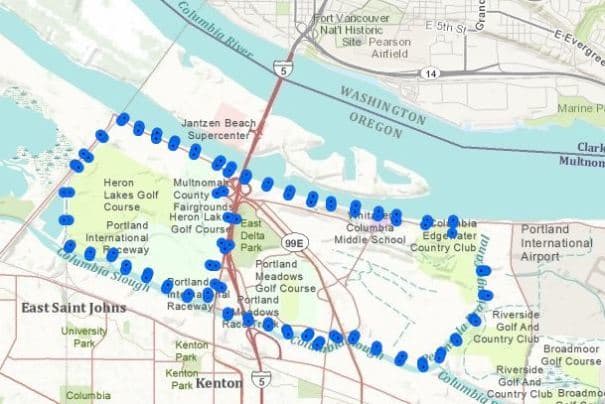
vanport map

The scaffolding questions are the meat of the lesson. The overall goal is getting students to compare the information that is in both videos versus the information that the text document gives them. The lesson is primary based on conversation rather than product. For a product have students write down their own answers to the scaffolding questions before conducting the conversation.

Reflection:

The combination of videos and the text document is to show students that primary sources can come in all forms and that just because something is not a written text it can still be used as a primary source. As technology advances our sources will too. I did not want to overload my third graders with a bunch of long text, and spend half of the day going over every piece of information in the text. Instead I wanted them to see what information they could pull out that was related to the question.  This lesson would follow the water cycle unit in science so that students will have a base knowledge of how a flood works and where on all the water came from.

I found the design process for this mini lesson a bit challenging. I wanted to do something related to my current student teaching; however, third graders do not have the skills or base knowledge to do anything advanced with primary sources. If I could get them to just be exposed to a primary sources and show them how to compare them that it would be about the right starting point for third graders to get exposed to historical thinking. I anticipate that I would have to spend a lot of time front loading different aspects of a primary source.


Sources: 

Abbott, C. Vanport (1st ed.). The Oregon encyclopedia. retrieved September 25, 2015  Link

[guruburgess]. (2014, 12 6). Oregon’s Memorable Century 1948 Vanport Flood [Video File]. Retrieved from  Link

Map [online image]. (2015). Retrieved September 25, 2015 Link

Peski, Brain Van. (2008). Vanport: Oregon’s Lost City [Video File] Retrieved From Link

Portland Flood, with switching trains [online image]. (1948). Retrieved September 25, 2015 Link

Vanport, Vanport Flood of 1948 [online image]. (1948). Retrieved September 25, 2015 Link

Class 6: Literacy DBL

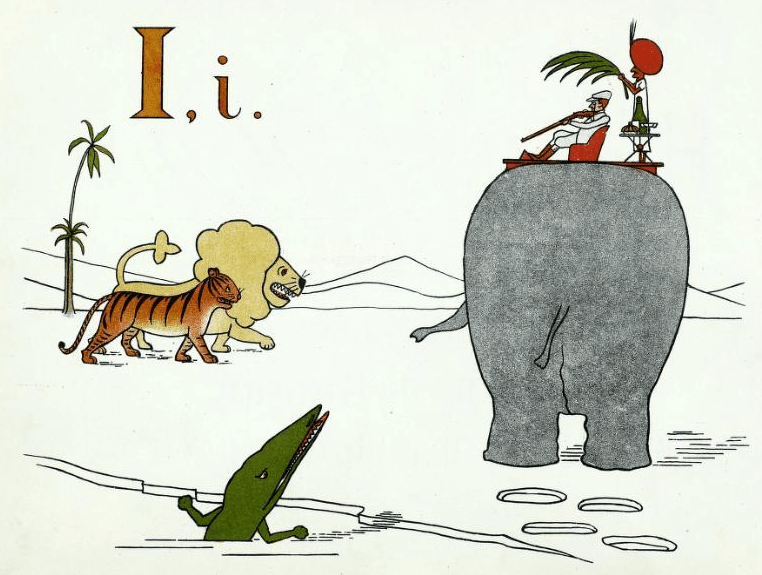
I is for India

I is for India,
Our land to the East
Where everyone goes
To shoot tigers, and feast

Common Core offers an incentive for teachers to use historic documents to build literacy skills in a content area while empowering students to be the historian in the classroom. But a document-based lesson (DBL) in this context requires four key elements to be successful:

  1. The right documents.
  2. Knowing how to look at them.
  3. Letting students discover their own patterns, then asking students to describe, compare and defend what they found. These historical thinking skills correlate with edTPA’s language functions.
  4. Basing the task on enduring questions, the kind that students might actually want to answer.

Class 6 offers strategies for assisting students to more closely read a document (in all their multimedia formats) by answering three Common Core questions.

  1. What did it say?
  2. How did it say it? See: SHEG – Sourcing, Contextualizing
  3. What’s it mean to me? See: SHEG – Corroborating

Here’s a handout of my slide deck 3.2MB pdf


Assignment:

Students will design their own literacy DBL. Assignment (note – various due dates)

For source material, I’ve collected some great websites that include many of the major archives from around the world.

Best Sites for Primary Documents in World History

Best Sites for Primary Documents in US History


Here’s some some sample DBLs that I have designed:


Page from: “An A B C, for baby patriots”
Creator: Ames, Mary Frances
Publisher: Dean & Son
Place of Publication: London (160a Fleet Street E.C.)
Publication Date: [1899]
Archive: University of Florida UF00086056:00001