The Dog That Started The Space Race

Laikapicture

The Dog That Started The Space Race

By John Buckley
5th Grade

Develop Historical Skills:
Sourcing and  Contextualization

Essential Question:
What were the reasons Laika was sent into space and what impact did it have on U.S. and Soviet relations?


Laika’s Journey to Space and the Cold War

American News Reel from 1957


Laika’s Journey to Space and the Cold War
Historical Documents: Discus the images as a class and their author’s perspective, place in history, and motive.
John Buckley

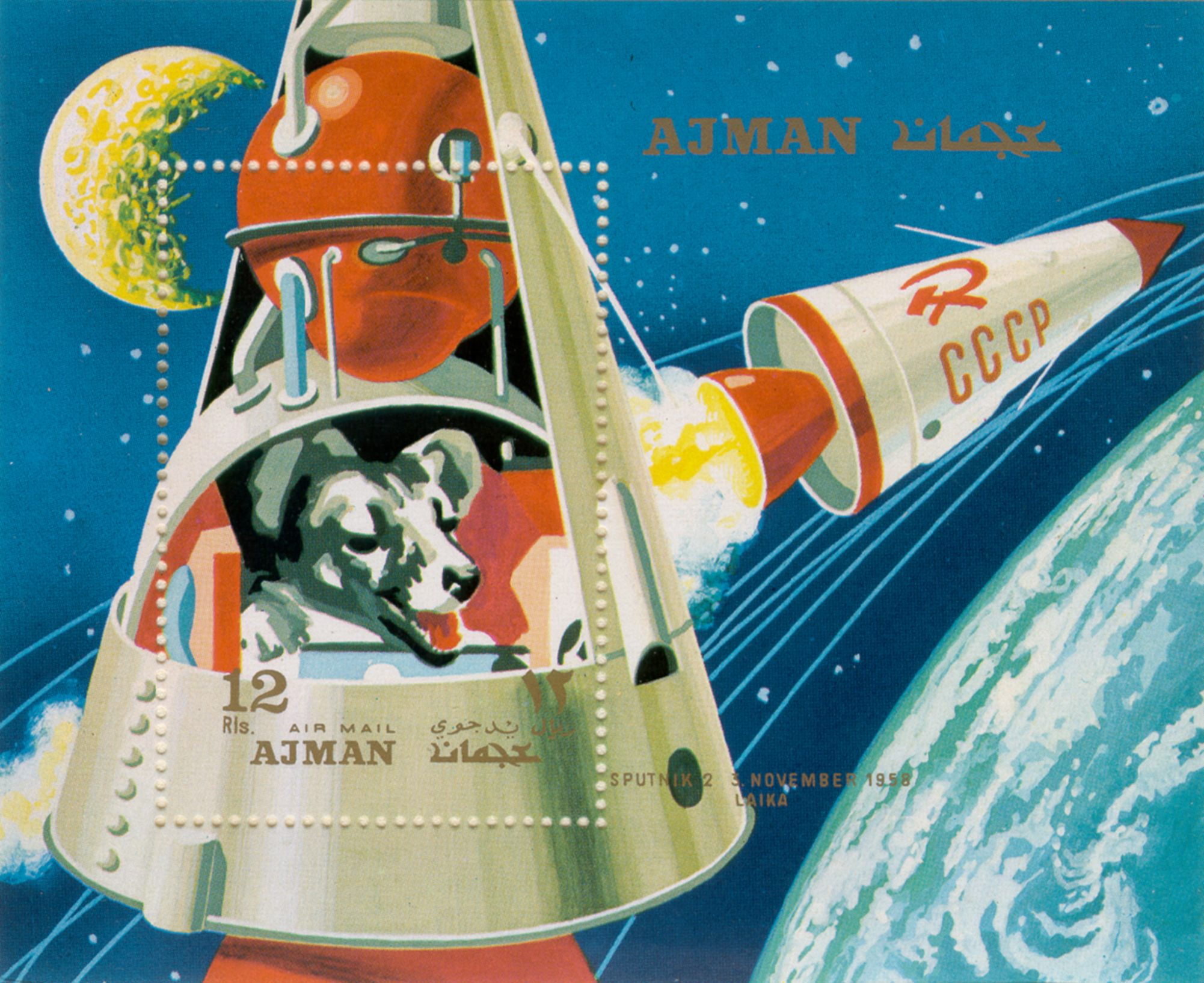
LaikaPicture2 LaikaNewspaperRussian LaikaUSSRStamp LaikaNewspaperArticle

Laika on a Soviet Postage Stamp

Laika as a Cartoon Character Hero

New York Times Newspaper Headline

Key Vocabulary Words
(To accompany article in worksheet form.) Discuss key vocabulary words as a class before having students break up into small groups to discuss the article and discussion questions.

Cold War: intense rivalry after World War II between the Soviet Union and its satellites and the democratic countries of the Western world, under the leadership of the United States.

Space Race: The competitive nature of the nations involved in space exploration.

Arms Race: Competition between countries to achieve superiority in quantity and quality of military arms.

Euthanised: To put an animal to death to end suffering or for convenience.

Depletion: The reduction in the number or quantity of something.

R–7 Sustainer: A key part of the Soviet Rocket.

ICBM: Intercontinental-Ballistic Missile, a rocket or missile type of missile that can fly from one continent to another
Source
Laika’s Journey to Space
*Give Students worksheet below to read and discuss in small groups.

“Laika 1954 – November 3, 1957) was a Soviet space dog who became one of the first animals in space, and the first animal to orbit the Earth. Laika, a stray dog from the streets of Moscow, was selected to be the occupant of the Soviet spacecraft Sputnik 2 that was launched into outer space on November 3, 1957.
Little was known about the impact of spaceflight on living creatures at the time of Laika’s mission, and the technology to de-orbit had not yet been developed, therefore Laika’s survival was not expected. Some scientists believed humans would be unable to survive the launch or the conditions of outer space, so engineers viewed flights by animals as a necessary precursor to human missions. The experiment aimed to prove that a living passenger could survive being launched into orbit and endure weightlessness, paving the way for human spaceflight and providing scientists with some of the first data on how living organisms react to spaceflight environments.
Laika died within hours from overheating, possibly caused by a failure of the central R-7 sustainer to separate from the payload. The true cause and time of her death were not made public until 2002; instead, it was widely reported that she died when her oxygen ran out on day six or, as the Soviet government initially claimed, she was euthanized prior to oxygen depletion.”
First Animals in Space

Discussion Questions
Scaffolding questions for students to use with documents:
1. Who made the video? When? And why?
2. Why did the Soviet Union want to send animals into space?
3. Was the United States alarmed about this event? And if so, why?
4. Did the event cause any fear or anxiety in United States? If yes, why?
5. If you were the Country’s leader, would you have sent Laika into space?
6. Did this event increase or decrease tensions in the Cold War between the U.S. and the Soviet Union?
Brief description of how the documents and scaffolding questions should reinforce the targeted historic skill(s)

This will allow students to discuss and grasp the background, context, and motivation of all parties involved. It will help students further understand the scope of historical events in proper framework.

Reflection:  As it relates to the SHEG lesson model, with this lesson I tried to focus on sourcing and  contextualization in the lesson design process. The challenges  I faced in preparing this lesson plan were making sure that the education piece is placed properly in the educational process. Meaning: The children would need some preparation work before hand concerning Space Exploration, Cold War, etc. etc. I do think it provides the opportunity to help intorduce 5th graders to not just a dog, but an opportunity to look “behind the curtain” of politics and world events and realize they are never exactly what they seem to be. Teaching historical thinking skills and critical analysis is essential in proper educational formation as they move towards adulthood.

Michoacán and the Purépecha: Native Memory Beyond the Aztec

11th or 12th Grade Social Studies

This lesson would be well situated inside of a larger Imperialism unit. It may be used as either an illustrative case study or an in-depth exploration of the Americas at the time of the conquest.

Requisite Knowledge:

  • Introductory knowledge of Spanish conquest of Central America under Cortéz
  • Introductory knowledge of Aztec history and culture
  • Introductory knowledge of Purépecha history and culture

Learning Targets:

  • Sourcing
  • Contextualization

Learning Segment Goal:

Students will apply their knowledge of the current cultural diffusion of Aztec values in modern societies to the historical record. In doing so, they will ask the question, how did the Aztec’s come to be remembered whereas another great society – the Purépecha of Michoacán – did not? Furthermore, are there any clues in primary sources created at the time of the conquest that suggest a possible reason?

Suggested Instructional strategies and learning tasks:

  • We might begin with an image similar to this and a similar subsequent slide:


Slide 1

Slide 2

  • After students have discussed this opener, perhaps in small groups, they will move on to reading and analyzing two sources:
    • Bernal Diaz: The True History of the Account of New Spain (Excerpt)
      • http://chnm.gmu.edu/worldhistorysources/sources/conquestofnewspain.html
      • While reading this source – or some shortened excerpt – students should be actively highlighting details and commentary. This can be done in a group setting or as a homework assignment. After reading this, they will answer the following questions:
        • What were the main details of the Aztecs recorded by Bernal Díaz?
        • Why do you think he chose to emphasize these things?
        • Who do you think he was writing for? Do you believe he meant for someone else to read this account?
    •  Relación de Michoacán – Franciscan friar Jerónimo de Alcalá
      • http://mansioniturbe.blogspot.com/2011/08/la-relacion-de-michoacan-or-chronicle.html
      • While reading this article, students should be actively highlighting details and commentary. This can be done in a group setting or as a homework assignment. After reading this, they will answer the following questions:
        • Who is thought to have written the Relación de Michoacán? Compared to the previous source, how is it important that a friar (priest) wrote it instead of a soldier?
        • There is a short excerpt from the larger work in the article. Although the book is far too long to read, you can assume that the rest is similar, with an emphasis on the details of history. How is this different from the account of Bernal Diaz?
        • How might the author’s intention signal a difference in the perceived importance of the Purepecha culture and people?
      • After reading both sources, we will end the lesson with a group project. Students will break into groups of 3-4. In these groups, they will create a graphic representation of the two sources and how they fit into the context of the conquest and colonialism. They should answer the following questions:
        • How did the context of the conquest influence different people to write and record different things? The students should give specific examples for each source.
        • What are some possible motivations from each historical actor – the friar and the soldier? How are they both similar and different?
        • Finally, students should add in a summary that addresses the Essential Question and ties it into specifics of the given examples.

Conclusion:

Although students may come to a variety of conclusions, here is one particularly relevant example. Because the Purépecha were less developed in terms of material culture, the main emphasis of the Spanish conquest on their lands was slave labor in their lucrative mines. There were caches of treasure hidden away for the Cazonci’s son. These were found and looted in due course. However, they did not have the cultural factors of the Aztecs. They did not have the cultural factors that affirmed the Conquistador’s fantasies about the new world. Therefore, there was less of an emphasis recording the culture of Purépecha and more on exploiting their natural resources.

Reflection:

I have a personal connection to this project. An undergraduate professor for whom I was completing an internship was heavily involved in researching the Purépecha. When she passed away from cancer, I was unable to complete the project, for which I had done a lot of research and preparation. That is why I chose to focus on these two cultures. Even so, this is a format that might work for a variety of colonial situations. I would strongly suggest that you bastardize this plan for whatever time period and cultural context you are teaching. The question itself is also applicable to a wider variety of lesson formats.

Black and “Wanted”: Enslaved Black Runaways

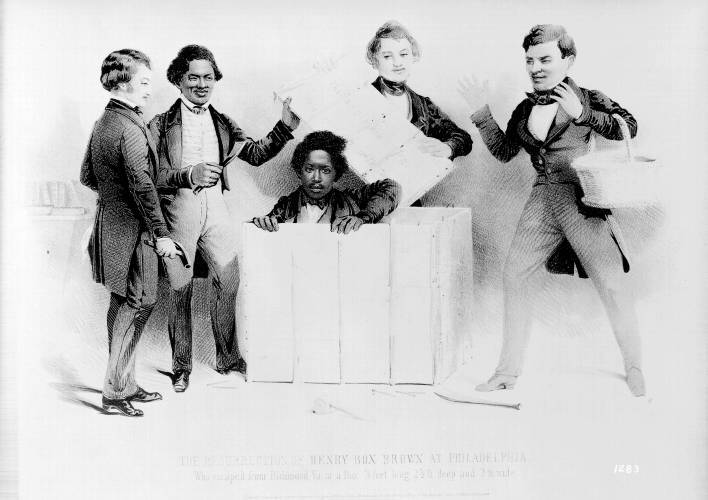
Henry Brown's Box

Mini-Lesson Created by: Alekzandr Wray

Target Students: 10th Grade

SHEG Skills: Close Reading, Sourcing, Contextualizing

Learning Topic: Runaway Slaves

Essential Question: What were the narratives being told about/by enslaved runaways during the 1850s?

Description: Students will discuss three documents which illustrate the perspectives of historic stakeholders in the issue of enslaved runaways. The first document, an excerpt from Frederick Douglass’ “Narrative of the Life of Frederick Douglass, an American Slave”, recounts his experience at the slave breakers’, Mr. Covey, property. The second document is about Drapetomania, a mental illness attributed to enslaved runaways by Samuel A. Cartwright. Finally, the third document is a reward poster published in Washington, D.C. by a local enslaver. Each document plays off of each other to paint different perspectives on the issue. Students will be asked to work in partners or in small groups to discuss scaffolding questions after each segment to further understanding.


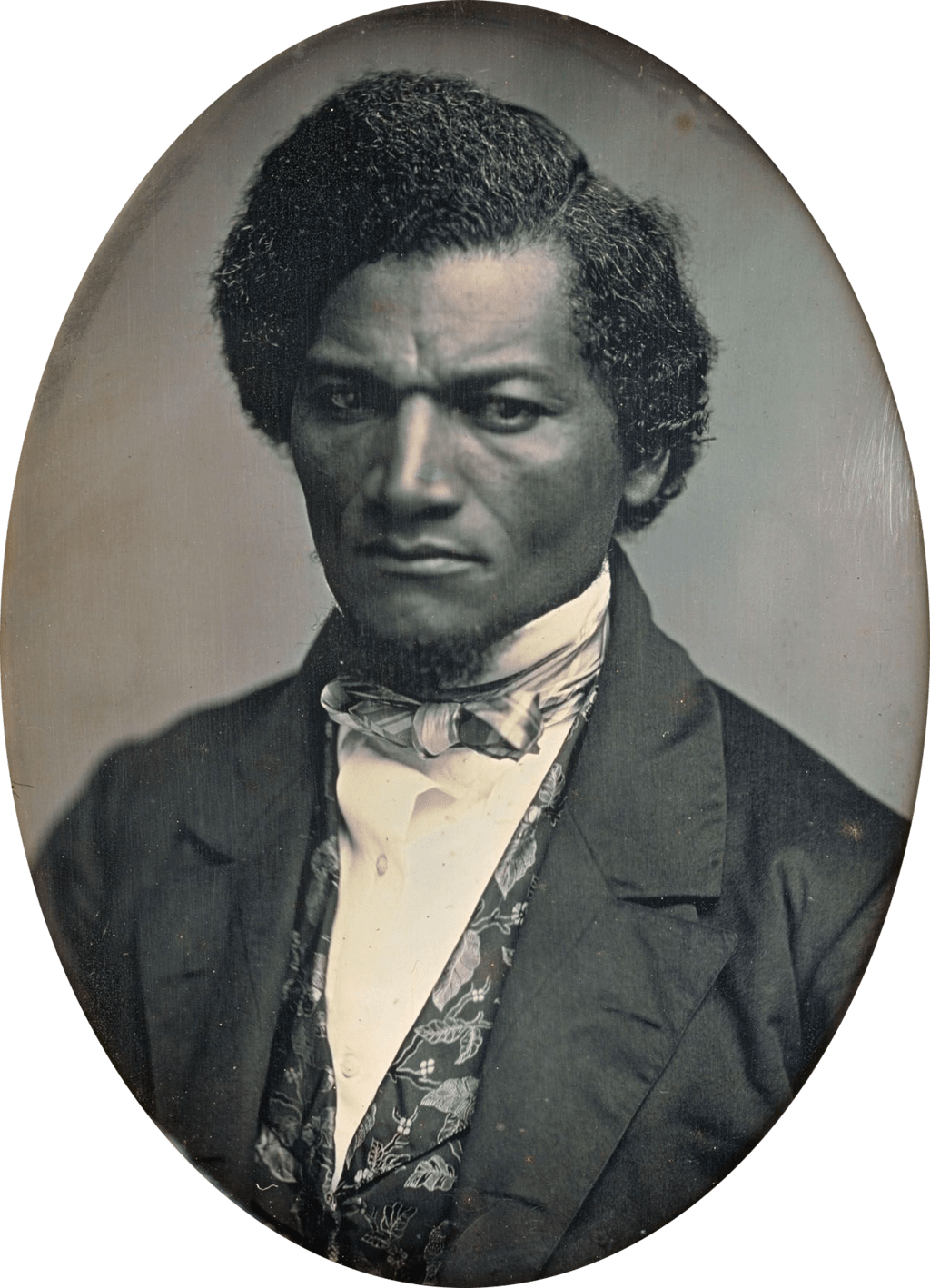
Frederick Douglass


Part I: Frederick Douglass & Mr. Covey

Students work in pairs to read the article, discuss it, respond to the prompts and take notes on their conversation.

Fredrick Douglass recalls being sent to Mr. Covey, a slave breaker (1833, Maryland)

“Master Thomas at length said he would stand it no longer. I had lived with him nine months, during which time he had given me a number of severe whippings, all to no good purpose. He resolved to put me out, as he said, to be broken; and, for this purpose, he let me for one year to a man named Edward Covey. Mr. Covey was a poor man, a farm-renter. He rented the place upon which he lived, as also the hands with which he tilled it. Mr. Covey had acquired a very high reputation for breaking young slaves, and this reputation was of immense value to him. It enabled him to get his farm tilled, with much less expense to himself than he could have had it done without such a reputation. Some slaveholders thought it not much loss to allow Mr. Covey to have their slaves one year, for the sake of the training to which they were subjected, without any other compensation. …

If at any one time of my life more than another, I was made to drink the bitterest dregs of slavery, that time was during the first six months of my stay with Mr. Covey. We were worked in all weathers. It was never too hot or too cold; it could never rain, blow, hail, or snow, too hard for us to work in the field. Work, work, work, was scarcely more the order of the day than of the night. The longest days were too short for him, and the shortest nights too long for him. I was somewhat unmanageable when I first went there, but a few months of this discipline tamed me. Mr. Covey succeeded in breaking me. I was broken in body, soul, and spirit. My natural elasticity was crushed, my intellect languished, the disposition to read departed, the cheerful spark that lingered about my eye died; the dark night of slavery closed in upon me; and behold a man transformed into a brute!”

Scaffolding Questions: 

  1. Who was Frederick Douglass and from what perspective was he writing?
  2. What was Douglass’ experience like with the slave breaker?
  3. Who do you think was Douglass’ intended audience when reflecting on his experience?
  4. Why did experiences like Douglass’ lead many slaves to runaway? Why did they cause many to stay?
  5. What parts of the passage stand out the most to you and why?
  6. How does the concept of “breaking” a slave land for you? What do you think that means?
  7. Can we trust him as a source for how slavery was? Why?

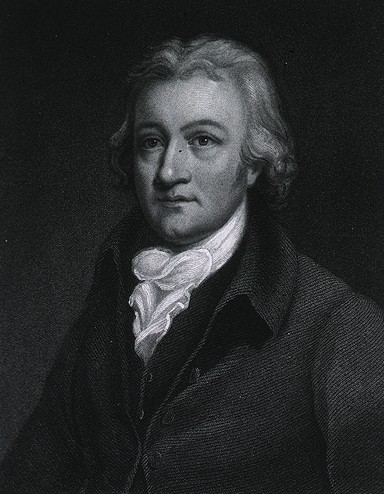
Samuel CartwrightPart II: Drapetomania & Samuel A. Cartwright

Students will each have a copy of Cartwright’s description of Drapetomania and will work in a group to discuss the article, while a scribe takes notes, and review the scaffolding questions.

Scaffolding Questions:

  1. Who was the author of the article, what did he do and what role did he serve?
  2. What was he writing about? What was his perspective? Who was his audience? What/who could he have been influenced by?
  3. Where in the United States was this article written and when?
  4. Why was “science” used to connect enslaved runaways to a mental “malady”? What purpose did it serve?
  5. What two types of treatment by enslavers did Cartwright claim were the chief primary causes of drapetomania?
  6. Is Cartwright a reliable source to consider when discussing enslaved runaways?

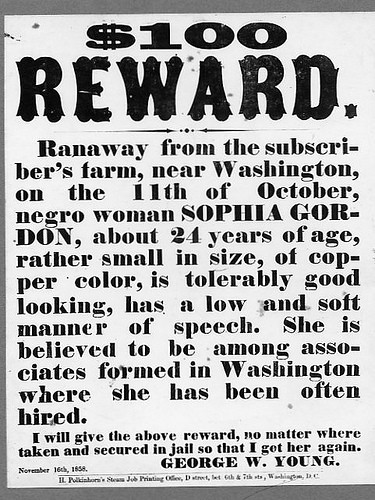
$100 Reward PosterPart III: $100 Reward, “… so that I get her again.”

Again, students will work in a small group to analyze the document, start a conversation using the scaffolding questions, and take notes to turn in.

  1. Who wrote this poster?
  2. Who are the beneficiaries of this poster? Who loses?
  3. What is the article’s purpose?
  4. Where and when was it written?
  5. How much is $100 in 1858 worth in today’s money?
  6. What gave enslavers the right to offer rewards for the capture/return of a human being?
  7. Why were posters like this common during this era?
  8. Does this poster give a reliable description of Sophia? Why? If not, what are the costs of its unreliability?
  9. What were some of the impacts of posters like this?
  10. Have you seen posters like this today? If so, where and who/what was the poster about?


Reflection: I believe what I put together is more of a series of mini-lessons that all connect rather than one mini-lesson that stands by itself: I’d likely have to dedicate a few class periods to teach this activity in order to do it justice. In the future, I’ll likely add an additional section to the presentation that covers the abolitionist viewpoint on the issue and then ask students questions that delve into corroboration territory; doing so would allow students the opportunity to tie each of the different sources together in order to create a larger view of the issue.

An aspect of the mini-lessons that I appreciate is that, at each step of the process, students are allowed to utilize community to further their own understanding and because each group will have a scribe to take notes on their conversation, the teacher can gain some really revealing information into her/his students’ thought process when they’re not being hovered over. That information can help determine where the large group conversation should lead and could be useful in deciding what future activities, if any, need to be planned for this topic.

Sources:

Henry Brown’s Box

$100 Reward Poster

Frederick Douglass’ Photo

Drapetomania

Samuel A Cartwright

Narrative of the Life of Frederick Douglass:

Narrative of the Life of Frederick Douglass (Boston: Anti-Slavery Office, 1845).

Reprinted in Eyewitness to America, David Colbert (Pantheon Books,  NY) 1997  p 143-146

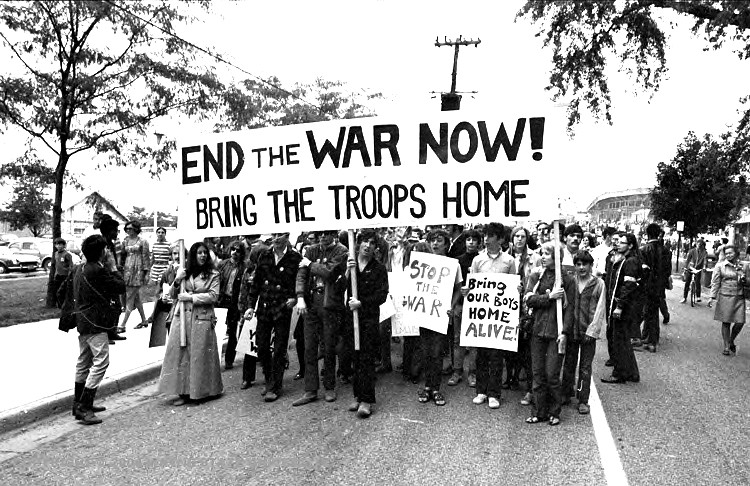
Views of Vietnam

Source: https://c1.staticflickr.com/9/8376/8525983904_2377fabcd0_b.jpg

By Felicia Teba

Target Students: 8th grade US History

Skills: Sourcing and Contextualization

Topic: The Vietnam War

Essential Question: How did the various  aspects of the war in Vietnam impact opinions on the war?

Description: The questions in this set of documents help students to understand that war doesn’t just impact a nation, but that it impacts individuals, and the Vietnam War was one of the most contentious.


Source 1: A Letter Home

August 27, 1967

Dear all,

Surprise! Charlton Heston visited our company for a few minutes, and I shook hands with him! He looked like an old farmer the way he was dressed in old drab green jungle fatigues. He said “almost everybody is backing us over here” and “I’d like a beer.”

Can’t think of anything else to say. The new library opened up– air conditioned and quiet.

Well, cheerio

Rick

Source: Dear America: Letters Home from Vietnam, edited by Bernard Edelman, p.158.

Questions

  1. Why do you think Rick wrote this letter?
  2. Who is Charlton Heston, and why was he visiting Rick’s company?
  3. Who do you think Rick was writing to in this letter?
  4. What do you think the war was like at this point in 1967?
  5. Did Rick write his letter before or after the Tet offensive? Would that have impacted what he wrote about?

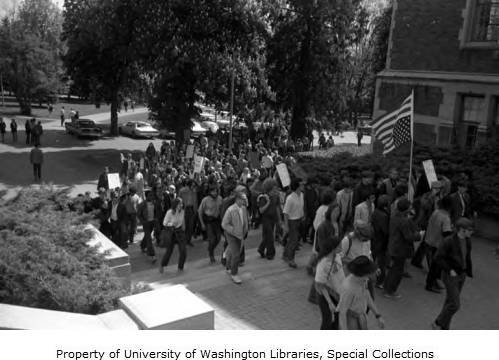
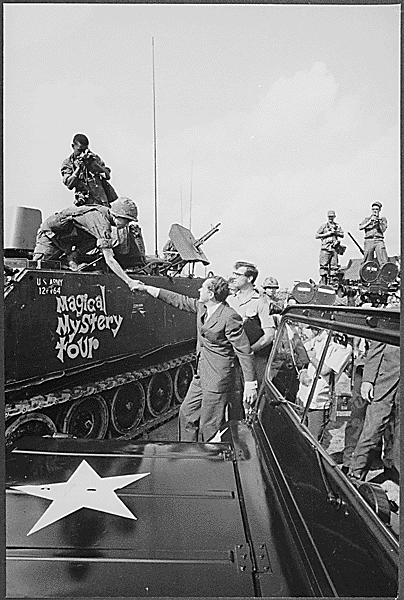
Source 2 & 3: Different Views of Support

Protestors_carrying_an_American_flag_at_a_rally_on_the_University_of_Washington_campus_May_7_1970
Protestors carrying an American flag at a rally on the University of Washington campus May 7 1970


Richard M. Nixon shaking hands with armed forces in Vietnam 1969

Protestors carrying an American flag at a rally on the University of Washington campus, May 7, 1970  Source
Richard M. Nixon shaking hands with armed forces in Vietnam 1969 Source

Questions

  1. Who is in this picture?
  2. What is going on?
  3. Digging Deeper Questions
  4. Why would it be important to take a picture like this?
  5. What audience would like this picture? Which audience would dislike this picture?
  6. On the picture on the right, why is the American flag upside down?

Source 4: “A Day in Vietnam”

Questions

  1. Who do you think made this video?
  2. Who is the audience?
  3. Why was this video made?
  4. What reason could there be for a video like this?
  5. If you were an American civilian at this time, how might this video impact your opinion of the war?

Reflections: In this assignment, I think I could have done better at providing a context for when I would teach these particular unit. To use this lesson, I would add a lecture that gives background to each of the sources, so that students are not left confuse about what I am asking them to look for. With this lesson, I think it would also be good to stick with just one type of source, like just soldiers letters, so that my set of sources is not too broad.