
Think-Pair-Share

Context of the Lesson

This unit focuses on exploring, breaking down, and understanding the use of literary devices in The Outsiders so students can have knowledge of the different components that make up narratives. Students will 1st learn how to identify different literary devices within the chapters of The Outsiders. By the end of the unit students will be able to have a better understanding specifically of mode/tone, setting, symbolism, and biases through participating in discussions and activities.

The students will be able to have an understanding of the literary devices tone and mode and be able to identify where it shows up in The Outsiders by writing responses to reading questions.

  1. Students will begin by completing a warm-up writing prompt that will begin to introduce the students to mode/tone
  2. Students will complete a reading reflection by responding to specific questions that deal with identifying mood/tone in the chapter along with other main ideas. 
  3. Students will complete filling out their literary device organizers with mood/tone covered in chapter 5. The teacher will walk around observing and the ideas will be discussed out loud as a class. 

Strategy Used

The strategy that I used was think, pair, and share. Throughout this unit plan and this specific lesson, I had plenty of times woven into the instruction where this strategy would show up. Prime examples of this were after any of the write-up times. This could have included either the warm-up questions or the reading responses. I had students think about the answers to the questions and or what they had written or organized their thoughts into. After the thinking, they were asked to share their ideas and such with partners at their tables. The fact that the partners were already chosen by expectation that it was their table mates checked off one of the parts in which Jennifer Gonzales said was key to getting the most out of this strategy in her post of it. Another one of the checklist elements that was being done, was that I wouldn’t just sit at my desk chair or be on my computer while this was happening, but rather I would walk around, listen to the conversations being taken place, and engage and respond to the conversations. The last element that was present from this checklist was that after students had gotten the opportunity to share in pairs, I mostly always opened it up to the class and had at least a couple people share out loud to the whole class their ideas.

What I learned from the experience

I learned that this strategy was great and effective for many of the same reasons upon which Jennifer highlights in her post. First and foremost, this was a helpful strategy because it served to break the content into smaller size pieces. The reading and deeper understanding of The Outsiders text and such is a lot of work and can be complex and overwhelming. This strategy allows students easier and more wholesome opportunity to interact with the text and their ideas and their thoughts. Another reason is that it allows the students to be active in the classroom and in their learning. The students are no longer just sitting there all day and just getting information. They are doing work to verbally process it and be able to take ownership of their learning. The last big benefit is the idea that it gives an opportunity for me to formally assess the students. Just by toning in to the conversations and engagement of the students, I am able to begin to grasp an idea of those students who are understanding the content at hand and those who might need more guidance and help.
Discussion Reflection

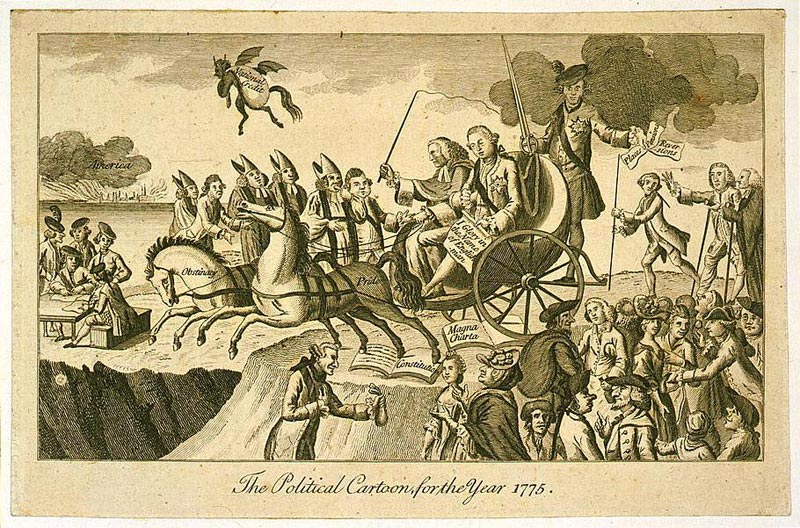
The first classroom discussion I’ve ever led was for a sophomore year government class who were learning about the early stages of the formation of the US. The discussion was simple; I asked them to analyze a photo below, and I had guiding questions to help spark discussion at the start of the class period.

Source

In the source, there were key documents that we spent time analyzing earlier on in the year, specifically the Magna Carta and the Constitution. I asked the students to analyze specific symbols within the picture (which I allowed them to find themselves) all in an effort to understand the perspective and message of the author. Using a simple think-pair-share strategy, I gave the students 4 minutes to discuss and find some key evidence that would allow them to provide an answer to the question, and I walked around during this period helping them with some scaffolding questions.

While the discussion provided some fruitful responses, I feel I did not help my students enough in learning how to analyze the source. I could have provided more scaffolding questions to the class, or better yet, I could have modeled the actions I wanted the students to take when analyzing the source. In a future discussion on the Colombian Exchange, I actually modeled how a source can be examined, and my students conducted a lengthier and more fruitful discussion, despite the fact that they were freshman as opposed to the sophomores who analyzed the photo above.

Modeling, proper scaffolding, and time devoted to small group discussions prior to bringing the discussion to the entire class has proved to be much more effective for me in my more recent discussions I’ve held.

Discussion Methods

“Taking Sides”

During few of our class discussions students have found themselves at odds about a particular topic or issue. Students have also expressed wanting to learn more about their peers by exploring one another’s thoughts and perspectives. I felt there was an opportunity here to introduce a discussion strategy that would allow them to share thoughts and perspectives in a controlled, respectful manner.

I chose to try a “Taking Sides” activity in which students would physically take sides in the classroom between the “Agree” and “Disagree” sides of the room. Before we began, I introduced a few ground rules:

  • One person speaks at a time. Allow your classmate to finish their thought before raising your hand to speak.
  • Responses must be respectful and show evidence of listening. “I agree with what you are saying about ______, however I feel…” or “I hear your point about _____, but I also think…”
  • Students can change sides whenever they feel compelled to

Once we practiced a few light questions like, “Coffee is the best beverage in the world” and “Books are more engaging than movies,” we pursued discussions such as, “I believe my education is valuable,” and, “School encourages me to be the person I want to be.” Students really seemed to get engaged with topics they felt strongly about. I saw a number of students struggling to hold back their responses, but they did a good job of listening to the speaker and holding their responses overall. Once we had worked through a few discussion prompts, I asked the students to think about how they would feel about a “Middle” or “I don’t know” section, and how it might change their perception of the discussions. The students wrote their responses as a reflection, which I collected as an exit ticket.

Most of the students responded well to the activity. Those who were not direct participants said they enjoyed hearing their classmates’ perspectives, and it prompted all of the students to reflect on their own views. A number of students changed sides throughout the activity, and found it was important for them to be able to adjust their position as the conversation evolved. I think it helped them see the value of working through a problem as a group, helping one another clarify what exactly they are talking about, and coming to the realization that they may agree on more things than they realize (though they may perceive themselves to be on opposite sides). It was a rewarding activity, and the students have been asking to do it again almost every day.

Patriots vs. Loyalists Discussion-Based Lesson

After spending a few weeks talking about colonial America and events leading up to the Revolutionary War, I thought it would be beneficial and important to have students view the historical context from the lens of both American Patriots and British Loyalists. The discussion-based learning approaches discussed in last weeks class were a solid fit for this analysis of perspective, and I decided to use the fishbowl strategy since the class size was large and splitting the class in half would allow/encourage introverted students to be quiet while the extroverted students dominate the conversation.

As a way to “spice up” the fishbowl style discussion approach, I decided to assign 16 of 29 students to either the “Sons of Liberty” (to represent patriots) and the “Parliament” (to represent loyalists) and had 8 students in each group. These groups were actively participating in a debate in the center of the room, and the remaining 13 students were assigned as “undecided” colonists that must choose to side with either the patriots or the loyalists. The 13 “undecided” colonists were assigned to take notes during the debate, then given 10 minutes after the debate ends to write a short statement paragraph explaining which side they will take and why.

Student were not randomly assigned to groups, since I already know who are the dominant speakers and who are the introverts, and I tried to accommodate students for the option they prefer. At the end of writing summaries and deciding on which side to align with, students were asked to join the group that they chose so those in the debate could feel like there has been a competition. Patriots were expected to win, mainly because I knew their would be an American romanticism regardless of the facts, so picking a “winner” of the debate is not necessarily representative of how information was presented — I made sure to clear that up with the students before the end of class!

This seemed to be a great way of engaging students in the lesson, however I could tell that a few students tasked with taking notes and writing a summary were likely distracted doing other things on their iPad. (Students at my school regularly use the iPads to take notes and write assignments, however the notes/summary from students who used pencil and paper were significantly more detailed and “engaged” than anything I received from students using their iPads. One thing I learned by doing this lesson is that it would be smart to require students to use pen/pencil and paper when taking notes and writing their summary, even if they typically use their iPad, only because the debate requires instructor focus which makes it more difficult to ensure everyone is on task.