
Reflecting on the DBQ Assignment

Image

The goal of my DBQ project was for students to gain an appreciation for how one’s perceptions of an event can be manipulated through media. The idea was for students to examine a variety of items, identify the techniques employed in conveying the message, and evaluate whether or not the techniques were effective. After investigating the media content within the lesson, students would apply what they learned by curating a series of media items that depict a certain perspective in a contemporary conflict.

Reading my original proposal for the project, I feel the final product achieves the goals I initially set forth. The lesson contains a variety of media types (print, posters, photos) and each example is accompanied by a set of questions that challenge students to do more than just identify what they see. I’m pleased with what I created because it approaches the study of history through a different lens. I can see this being more enjoyable than reading a history text or listening to lecture on a more traditional topic.

Though I am pleased with what I created, reservations do exist. This product has yet to be used. I don’t know how students or educators will react. Will they learn or appreciate the material I put forth? Will they find it engaging? It’s hard to say; especially since this was the first DBQ project I created. Teachers must always reflect and adapt. The project I created feels like a solid first step, but I want it to be used so I know how to make it better.

Once I decided upon a topic, the process was straightforward. However, I did run into one hurdle: curating the media. Selecting relevant pieces was challenging and time consuming. There is so much iconic media from the Vietnam era, but not all it was applicable to my objective. Using the wrong piece could lead to confusion and undermine what students are supposed to take away from the lesson.

A link to the final product on Learnist: Media & War

Image Credit: Louisiana State University Library 

LSU student Luana Henderson participated in a peaceful protest against the Vietnam War held in 1970 on the LSU campus. The poster behind her refers to the killing of four students by National Guardsmen during a protest that turned violent at Kent State University in Ohio. University Archives, LSU Public Relations.

This DBQ is part of our class-produced, multi-touch iBook. Available free at iTunes
DBQ “The Red Scare” Reflection

Image

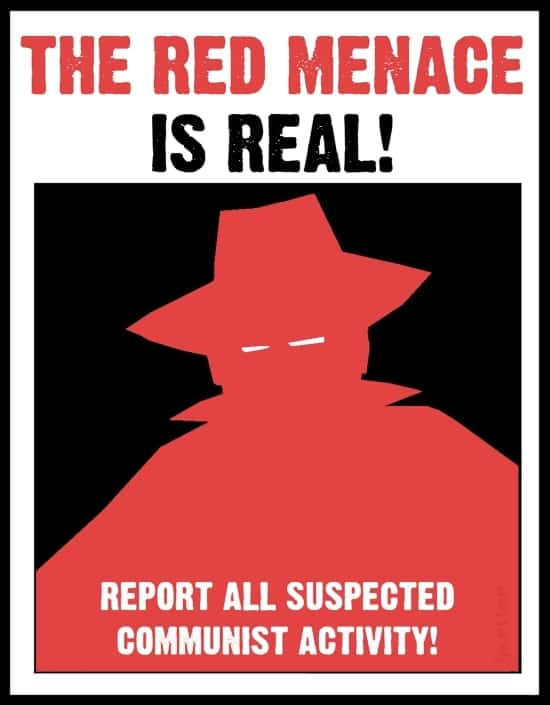
Christina Steiner and I have been working on this project for several weeks. We started out with the idea that propaganda is meant to stir feelings in a certain direction, bad or good. Then we decided that we wanted students to recognize the use of propaganda throughout history. Our general question was “What do we want students to learn from the DBQ overall?” The generative question that we formed out of this starting idea was: “How does a nation develop such an intense fear of an enemy, creating mass hysteria?”

We thought that a good starting point to understand such hysteria would be the Red Scare in 1950’s America. We wanted students to learn about the paralyzing fear of communism that existed among Americans at that time. We wanted students to understand what caused such terror to develop. We wanted students to think about what words, images, actions, and depictions might cause fear and what is needed to cause mass hysteria. Student will then be able to understand the driving force of the Red Scare in 1950’s America. The DBQ slowly leads students to think in an investigative manner.

Christina and I chose documents that would help answer the generative question. We found A LOT of interesting documents and images, but we tried to stick to those that would answer that generative question. This kept us focused on the task at hand. We also ended each document or image with follow-up questions, to scaffold student understanding of propaganda. We wanted each document or image to provide a great deal of information that could lead to greater student discovery and interaction with each piece.

The final project can be found here on Learnist and will soon be part of a larger iBook. Through this project, students will come to see and learn how America held such great fear of communism though images, books, comics, films, and posters. We looked specifically at media, examining the creation of enemies based on common perceptions rather than true events or facts.

This DBQ is part of our class-produced, multi-touch iBook. Available free at iTunes
Women’s Suffrage Reflection Part II

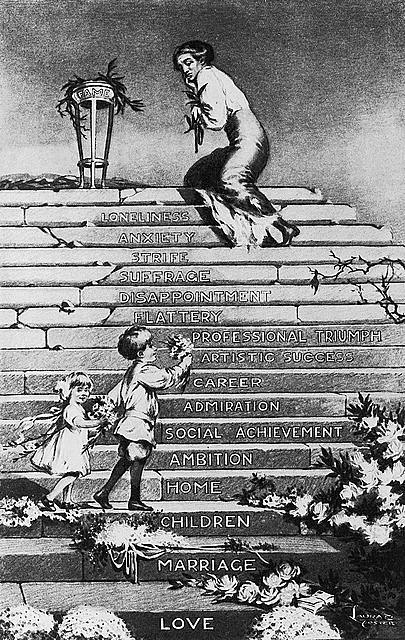
Looking backward  -Laura E. FosterWhen we first started working on this DBQ we knew that we wanted to educate students on how to best analyze propaganda, understanding what each piece is trying to say, being able to discover how each piece goes about conveying its message, and what historical events are transpiring to bring about such pieces of work. At the beginning of this DBQ lesson there was talk of only showing pro-women’s suffrage propaganda, but we discovered that if the students had only positive propaganda to view, then the lesson loses some of its strength. As a result we had to make a slight change my overall lesson. Instead of using only pro-suffrage pieces, we would also use anti-suffrage pieces and  the students would compare, contrast, and analyze these pieces as a whole as well instead of independently.

I personally believe that the final project achieved all of my learning goals. My partner had a large amount of excellent material that we used and as a result we were able to created a DBQ that pushes students to both compare and contrast multiple pictures, as well as analyze individual pictures at a deep level.

The biggest lesson that I learned while working on this DBQ is that you have to be careful with what photographic material you use. Pictures are one of the most important parts of a DBQ and if the DBQ has poorly chosen pictures than the overall quality of it will suffer greatly. I also learned that you need to be careful when choosing a topic. While something such as the women’s suffrage movement is well documented through images and propaganda, there are other events that are either lacking sufficient pictures or lack any diversity in their imagery.

This DBQ is part of our class-produced, multi-touch iBook. Available free at iTunes

You can find our DBQ at Learnist

Image credit:  Library of Congress:  LC-DIG-ppmsca-02940
Title: Looking backward / Laura E. Foster.
Creator(s): Foster, Laura E., artist
Date Created/Published: c1912 August 22.

Irish Revolutionary Period DBQ Reflection

Image

Irish Volunteers with the flag of the Irish Republic, Easter 1916. Courtesy of the BBC.

When I set out to begin my DBQ assignment, the scope was wide and the learning rather shallow. I realized fairly early on that I was looking at a yearlong unit rather than an isolated DBQ assignment, and set out to narrow my focus. I settled on the Irish Revolution, often called the Anglo-Irish War, as the subject of my DBQ. The revolution encompassed many of the points I had hoped to make in the larger unit on revolution, so it seemed like a good platform from which to teach. I had wanted to teach students about the relatively transient elements to many revolutions, that they are progressions rather than moments, summations rather than beginnings. The primary skill taught within the lesson would be the reading of primary documents as a means of historical inquiry. Once I narrowed the focus of my DBQ, I found it much easier to teach said skill. Rather than picking and choosing from a vast array of primary documents that, in some way or another, represented a 20th century revolution, the selection of ten images, documents, and artistic renderings of the Irish Revolution allowed for a deeper understanding of revolutionary sentiment at the outset of the 1900’s.

The final project, entitled “The Irish Revolutionary Period,” traces the development of the Irish Revolution from Easter 1916 to the outbreak of the Irish Civil War in 1921 through images and documents. I tried as best I could to limit the contextual history and allow the documents to speak for themselves, though it could be difficult at times. The topic is one I’m very familiar with, so it took a bit of effort to exclude my editorial inclinations. I feel the project is fairly well-rounded, though I would like a chance to supplement the DBQ with some background lessons. I learned that the process of putting together a DBQ can be especially difficult as a teacher, because it requires one to step back and allow the students to connect the dots, rather than doing the work for them. All in all, I’m happy with the product, and its one I’m bound to use in future lessons, wherever I end up teaching.

This DBQ is part of our class-produced, multi-touch iBook. Available free at iTunes