
Class 8: Teaching with Your Mouth Shut

Wanted for murder her careless talk costs livesDonald Finkel in his book Teaching with Your Mouth Shut, wrote “Our natural, unexamined model for teaching is Telling. The fundamental act of teaching is to carefully and clearly tell students something they did not previously know. Knowledge is transmitted, we imagine, through this act of telling.”

I admit to being guilty of dominating classroom discussion as a rookie social studies teacher. “Class, what were three results of the War of 1812? … Anyone? … Anyone??”

After years of facing this type of discussion, students learn that their comments are of provisional value until “approved” by the teacher. Over time, students stop listening to each other and only focus on what the teacher says or validates – “will that be up on a test?” When students are put in small group discussion, they rapidly get off subject. With no teacher to validate their comments, they naturally gravitate to other subjects where peer comments are valued – “what are you doing this weekend?”

Today’s class will explore strategies and resources for taking the teacher out of the role of information gatekeeper and encouraging productive student-centered dialogue.

We will begin with a peer review of student ideas the DBQ Assignment. Students will form two lines and have 2 minutes to pitch their DBQ design idea to each other and share some feedback. Then one line will shift and we repeated the pitch exchange. In all students will pitch their idea three times.

The goal of this phase is to gather feedback from peers regarding the following:

  1. You have an interesting generative / essential question worth answering.
  2. Your initial appraisal indicates there are suitable documents available.
  3. You have an idea for how students will interpret your documents. “What does it say, how does it say it, what’s it mean to me?”

The peer review will both reinforce the notion of getting the teacher out of the role of information gatekeeper and assist students in their DBQ Design process. Students will process the peer feedback using the Goal Setting Activity. (OETC Staff Development Strategies)

Next we will take part in another student centered discussion using the Fishbowl technique. Students will evaluate the activity as participant observers.

Finally we will explore a variety of student-centered discussion activities at OETC Staff Development Strategies and The Teacher Toolkit

Assignment:

Students will share their progress / reflection on the DBQ assignment as a blog post at EdMethods by Sunday Oct 26th. Here are some suggested approaches to the post.  Use what works for you. This will be a baseline reflection that you will look back on later to measure your progress with the DBQ design process

  • Explain how you intend to address the 3 questions above.
  • Use a sample document (or two) and related scaffolding questions to illustrate what you hope to accomplish.
  • Focus on the “big picture” of developing a DBQ that puts the student in the role of historian.
  • Reflect on the process we’ve used to peer review your ideas – has it been helpful?
  • What are the challenges you’re facing? What are you learning from the process?
  • How does (or doesn’t) this assignment build on the work we did on historical thinking earlier in the semester?

Image credit: Wanted! for murder : her careless talk costs lives ; Her careless talk costs lives

Keppler, Victor, 1904-1987 ; United States. Adjutant-General’s Office ; U.S. G.P.O. ; Distributed by Office of War Information 1944
Northwest University Library
Assignment: DBQ Design

An A B C, for baby patriotsWorking as individuals or in 2 person teams, students will design a DBQ question suitable for inclusion of our DBQ iBook (available at iTunes).
See Class  7 for recommendations for DBQs and Teaching with Documents. Your DBQ will include:

  • Introduction of the DBQ with brief historic context as needed.
  • Generative / essential question
  • About 5 – 8 related documents (image, text, video, audio) that will assist the students in answering the generative question
  • A scaffolding question for each document to assist the student in examining the document

A good example of a DBQ is Progress and Poverty in Industrial America  This is a pdf version of one of my iBooks. (note: you will not have full function of all the gallery and video widgets). It uses 11 documents, which is a bit more than I expect for your DBQ.

The DBQ Design Assignment will be accomplished in steps:

Step 1: Develop a proposal which will be submitted for peer review.
You should be prepared to deliver a 2 min pitch to class. (not a written assignment to be turned in)

Due date:  10/20.

We’ll do a bit of “speed dating” of our ideas for the DBQ Assignment. Students will form two lines and have 2 minutes to pitch their DBQ design idea to each other and share some feedback. Then one line will shift and we repeated the pitch exchange. In all students will pitch their idea three times.

The goal of this phase is to gather feedback from peers regarding the following:

  1. You have an interesting generative / essential question worth answering.
  2. Your initial appraisal indicates there are suitable documents available.
  3. You have an idea for how students will interpret your documents. “What does it say, how does it say it, what’s it mean to me?”

Step 2:  Students will share their revised idea as a blog post at EdMethods by Sunday Oct 26th. It should explain how you intend to address the 3 questions above. You may wish to include a sample document and related scaffolding question. Or you might want to focus on the “big picture” of what you are trying to accomplish with your DBQ. Feel free to note the challenges you face.

Step 3: Students will peer review a selection of classmates DBQ proposals in class on 10/27.

Step 4: Students will open an account at Learnist in class on 10/27 and use the site to post their working draft DBQ. 
Due date: Nov 3rd.

Learnist is a web-based curation site with built in social media tools – it can collect and comment on videos, blogs, books, docs, images or anything on the web. (Think Pinterest for education?)

Your Learnist board should be tightly focused on documents that help students answer the DBQ’s generative question. Each document should include one or two scaffolding questions which help the student to use the documents to answer the DBQ’s generative question.
For a sample of a Learnist board see your instructor’s Incarceration of Japanese Americans During WWII 

Your peers will be able to make comments after each document on your Learnist board to help you focus the DBQ. Since Learnist is open to the public, you can expect that others outside our class may comment as well.

Phase 5: Students will finalize their DBQs for inclusion in our iBook showcase.


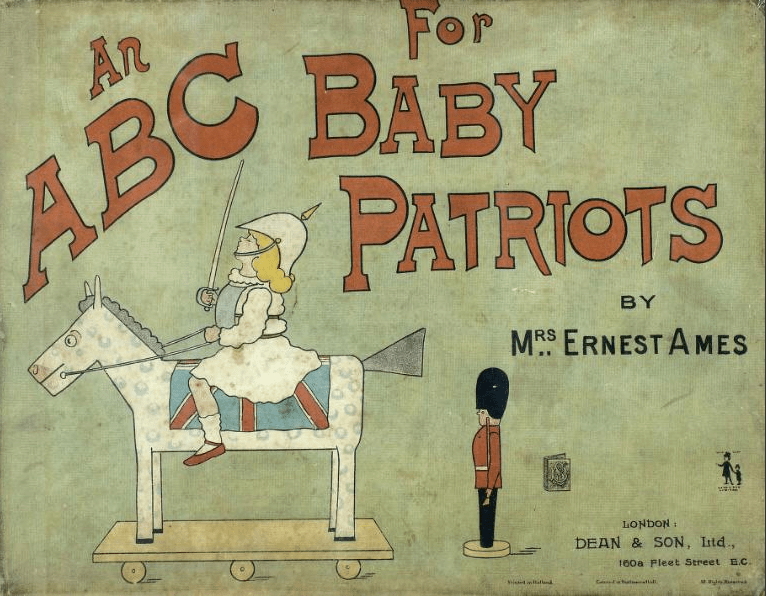
Title: “An A B C, for baby patriots”
Creator: Ames, Mary Frances
Publisher: Dean & Son
Place of Publication: London (160a Fleet Street E.C.)
Publication Date: [1899]
Archive: University of Florida UF00086056:00001

Class 7: Teaching with Documents

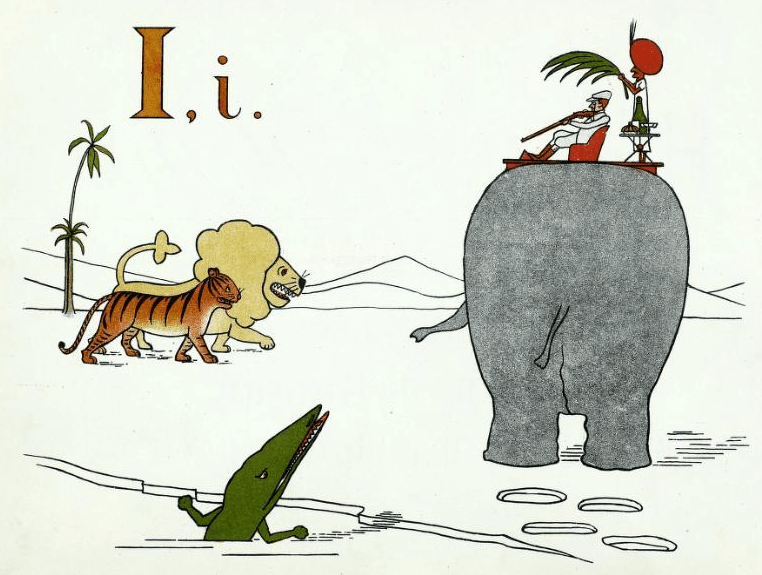
I is for India

I is for India,
Our land to the East
Where everyone goes
To shoot tigers, and feast

Common Core offers an incentive for teachers to use historic documents to build literacy skills in a content area while empowering students to be the historian in the classroom. But document-based (DBQ) instruction in this context requires four key elements to be successful:

  1. The right documents.
  2. Knowing how to look at them.
  3. Letting students discover their own patterns, then asking students to describe, compare and defend what they found.
  4. Basing the task on enduring questions, the kind that students might actually want to answer.

Class 7 offers strategies for assisting students to more closely read a document (in all their multimedia formats) by answering three Common Core questions.

  1. What did it say?
  2. How did it say it?
  3. What’s it mean to me?

Here’s a 1.3 MB pdf handout of my slide deck

Your best example of a DBQ is Progress and Poverty in Industrial America a pdf version of iBook below. It uses 11 documents, which is a bit more than I expect for your DBQ.

Next our class examined three sample iBooks. The first is my DBQ iBook “Progress and Poverty in Industrial America.” Next we looked at “Exploring History: Ten Document-Based Questions” an iBook designed by my fall ’13 EdMethods class. Finally we looked at my latest iBook, “Portland’s Japantown Revealed.” ~ All iBooks free at iTunes.

Assignment:
Students will design their own DBQ. Assignment (note – various due dates)

Examples of DBQ style questions


Page from: “An A B C, for baby patriots”
Creator: Ames, Mary Frances
Publisher: Dean & Son
Place of Publication: London (160a Fleet Street E.C.)
Publication Date: [1899]
Archive: University of Florida UF00086056:00001

Class 5: Historical Thinking Part II / Twitter #sschat

Across the continentThis class leads off with a live demo of the #sschat on Twitter (Mondays 4-5 PM Pacific). Chats are archived here.

Will use the event to begin a discussion of using Twitter to build a personal learning network (PLN). Students that have not already done so , will be asked to create Twitter accounts. More on Twitter hashtags here.

Next, we will turn our attention back to our exploration of teaching strategies for developing historical thinking skills. We will deconstruct The Battle of the Little Bighorn Lesson Plan from the Stanford History Education Group’s Reading Like A Historian and how it’s designed to teaching skills in Sourcing, Contextualizing and Corroborating. Keeping with our “western theme” we will take some time to develop lesson ideas for using “Across the Continent” an 1868 Currier & Ives print drawn by Frances Flora Palmer. [Above]

Finally we will turn do some peer editing of our shared Google presentation of collecting student-designed mini-lesson based on the Beyond the Bubble assessment model. Assignment | Product

Assignment for Class 6 – Shared Google presentation should be done by bed time 9/24. Blog post due by next class.

  1. Take the peer feedback and do a final version of your mini-lesson.
  2. Write a brief reflection on the process – it could include your take on historic thinking, the specific lesson model borrowed from SHEG, working with a shared Google presentation, peer review process, etc.
  3. Take all the content of your lesson plus the reflection and post it to our blog as your second authored post.

Reading assignment: Snapshot of a modern learner in SmartBlog on Education


Image credit: “Across the Continent” 1868 Currier & Ives print drawn by Frances Flora Palmer  Newberry Library