Class 8: Report, Regroup, Goal Setting

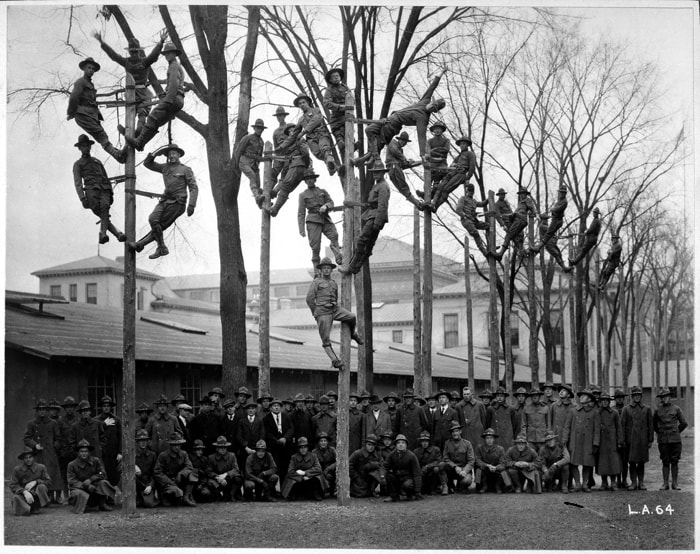
Class in Pole-ClimbingThis class was was devoted to taking stock of what we had accomplished and making plans for the rest of the semester.

We reported back on progress on the Nikkei project. See Peter’s post on the project – Student Consultants Design Museum Curriculum and Mobile App

Erin, Sam and Peter did a presentation at the OAtS Conference at OHSU. Teena and Amit Jain (from Gamma Point) were there as well. We got some great feedback on the app – features, navigation and uses. Aram and Tom took some photographs in the neighborhood after meeting with Todd at Legacy Center. Todd’s been focusing on finalizing material available from Nikkei archives.

Each team met during class to set goals for their component of the project. Kyle and Peter zeroed in on their intended audience for their virtual museum. Collin, Aram, Tom and Sam discussed feedback from the conference presentation and discussed next steps in the app design.

The “Museum in a Suitcase” team (Christina, Kristi, Cory, Heather, Erin and Damian) – discussed the scope of the lessons they will design. See update in Christina’s comment below

We conducted our second lesson study  with Kyle, Peter and Tom in the “Fishbowl.” Their classmates observed from outside the fishbowl. They used a T chart to track two items – lesson strengths and challenges. Feedback from in and outside the fishbowl will be used by students to improve their lesson idea.

Peter reviewed expectation for the upcoming DBQ design assignment and demonstrated use of the Learnist website that students will be using to present their DBQ’s.  He also shared the sample DBQ he posted at Learnist. Incarceration of Japanese Americans During WWII 

Image Credit:

Class in Pole-Climbing in the course for telephone electricians, with some of their instructors. University of Michigan., ca. 1918
Original Caption: Vocational training for S.A.T.C. in University of Michigan, Ann Arbor.
U.S. National Archives’ Local Identifier:165-WW-119A(1)
Created By: War Department.

Women’s Suffrage

Suffrage is one of the most important rights that an individual can obtain in a democratic society. Despite the importance of this right, the right to vote has been withheld from a vast majority of the population. This DBQ will focus on the the Women’s Suffrage Movement in the United States from 1900-1920.

Our generative questions are:
– What is the role of image media in the suffrage movement?
– How are pro-and anti-suffrage movements depicted in media?
– What are the biases that are found in image media?
– How are political, social, and economic factors portrayed in image media?
These generative questions are worth answering due to the facts that they will give students a better understand not just of the struggles females (and to a lesser extent minorities) had to overcome in order to receive the ability to vote. These questions will also give students a look at certain aspects of American life and culture in the 20th century.
There is a massive amount of media devoted to either defending or defeating the women’ suffrage movement, and as a result finding pictures that both support or attack the movement will be no trouble. Some of the photos that we will use are below:
handicapped_vintage_suffrage_propaganda_print-r6cf18d8cbe5f4edf99e42d6105edb7a1_wvg_8byvr_512 Suffragette1

Students will use this DBQ to compare and contrast pictures from both pro-woman suffrage and anti- women suffrage, as well as understanding who the targeted audience was, and what argument each piece was making. This in depth analysis will allow students to better understand the media in their current lives as well as how that media affects them

Red Scare in America

Image

Christina Steiner and I are in a group. For our topic we are looking at the 1950’s Red Scare in America. The generative question we have right now is “How does a nation develop such an intense fear and enemy, creating mass hysteria?”

For this DBQ we will be looking at what the media produced and the tactics they employed. Of course there are plenty of propaganda posters depicting the “evil commies,” as well as “informational” videos created about the communist threat. We are also thinking of having the students read an excerpt from the McCarthy hearings, and possibly newspaper clippings from the time, so the DBQs will not be all image based.

Hopefully students will be able to use the material to see the different ways people were influenced by imagery in the media to believe in the communist threat. Students will be able to see what tactics the media used to scare citizens.

Students will be able to look at the DBQ, whether it is images or documents, without any previous knowledge of it and point out different aspects that either promote or reject a certain group, person, or country. Students can then answer questions such as: what is it saying about that group? How does it say it? Etc.

Additionally the generative question can span to almost any war era or period of fear. Also students will be able to draw connections between how media portrays the “wrong” thing today, to how it did in the 1950s.

Native American Residents and European Explorers: How Did Cultural Exchange Occur?

By: Tom Malone

How did cultural exchange occur between Native American residents and European conquerors upon first contact?

This is the question I want my students to tackle. By utilizing documents and artifacts from both sides of the cultural exchange, students will be able to develop a multi-perspective viewpoint on European/Native American contact as opposed to the Eurocentric viewpoint that most students in the U.S. experience.

For this academic adventure, students will look at European exploration documents (Columbus’ journal entries, European artists’ depictions of initial contact, financial records, etc.) and Native American resident documents (Aztec interpretations, oral history that has since been written, paintings depicting a Native American perspective, etc.). Students will explore an equal number of European and Native American documents. These documents will not be nation-specific, but will look at contact across the North American and South American Atlantic Coast.

The exercise will allow students to develop a more complete view of this segment of history by developing perspectives from various lenses. Students can explore narratives from both sides, find textual and visual evidence to show these statements, and interpret these observations in order to develop their worldview more completely.

Through group discussions and written analysis, students will be able to share their experiences with these documents and artifacts.