
DBQ Creation and Reflection

Image

A few weeks ago Kristi Convissor and I started creating a DBQ project. We first started with a general outline the DBQ would take. We asked ourselves “What do we want students to learn from the DBQ overall?” To answer that we came up with a generative question to help guide our designing processing and to help the students when they are using the DBQ. The generative question was: “How does a nation develop such an intense fear and enemy, creating mass hysteria?”

From there we narrowed it down to look specifically at the Red Scare in 1950s America. We wanted students to learn about Americans fear of communism during the time. We wanted students to not only be aware of the hysteria but to understand where that fear developed from. One of the goals of the DBQ was to get students to think about what kind of words, actions, depictions lead to fear and what kind of outlets are needed to create mass hysteria. If students understand that then they can see how the Red Scare came to encapsulate so much of the 1950s.The design of DBQs lends well to this kind of investigation.

When creating the DBQ, we chose documents that helped answer the generative question. We had found some cool documents, but they side tracked too far from our question, so we cut them. Having the generative question kept us focused on the main point of the DBQ. In addition we also created follow-up question to each document, which helped us pick quality documents. If the document could only address one question then it probably was not the best source we could use. We made sure to use sources that could be asked several questions because they held a decent amount of information in them for students to discover.

The final project which can be found on Learnist and soon on an iBook, met our goals. Our DBQ allows students to see for themselves how America came to have such an intense fear of communism through films, articles, and posters. Our DBQ took a media lens to the issue, examining the creation of an enemy based on characterizations rather than on facts or true events.

Image Credit: Digital History retrieved from Library of Congress
Media type: poster
Museum Number: LC-USZ62-80757

Incarceration and the Bill of Rights

Image

I’ve always enjoyed creating lessons. While they are difficult at times, there are few other feelings akin to creating something with the express purpose of educating others. While this lesson is no different, and I am excited to have it be used in classrooms, I still have some reservations. The chances of me seeing any other educator using this lesson is incredibly close to zero, and while this is not a major hang up I feel as the creator of this lesson that I should observe each of its uses in order to modify it.

This lesson is created for high school classes. While this lesson can be used in its own solo lesson, it would be much more effective if this lesson was part of a larger unit on either World War II or a unit that focuses on the Bill of Rights.

Note: While it is possible to do this as a stand-alone lesson, it would be much more efficient if paired with another lesson educating about Japanese Incarceration. As another note: the times given for note taking etc. are not hard set, change them to best fit your classroom.

Grade Level: High School

Overview: Students will focus on the Japanese incarceration and its constitutionality in terms of the United States of America’s Bill of Rights.

Goals: Students should be able to think critically as well as discuss and support a chosen point of view.

Standard: Core Standards

CCSS.ELA-Literacy.RH.11-12.1 Cite specific textual evidence to support analysis of primary and secondary sources, connecting insights gained from specific details to an understanding of the text as a whole.

CCSS.ELA-Literacy.RH.11-12.3 Evaluate various explanations for actions or events and determine which explanation best accords with textual evidence, acknowledging where the text leaves matters uncertain.

CCSS.ELA-Literacy.RH.11-12.5 Analyze in detail how a complex primary source is structured, including how key sentences, paragraphs, and larger portions of the text contribute to the whole.

Objectives: To better understand Japanese incarceration and the Bill of Rights.

Resources: Suitcase, writing utensils, Bill of Rights handout, blank paper.

Procedure:

  • Ask students if they have prior knowledge on the Japanese incarceration during World War II, if students have no knowledge of this event quickly go over the basics of what happened.
  • Pass out Bill of Rights worksheet and have students read through the sheet.
  • As students are reading the Bill of Rights, number them between one and three. Students numbered one will be debating that the Japanese incarceration WAS constitutional while the students numbered two will be arguing that it was NOT constitutional. Students numbered three will be the judges.
  • Give students ten minutes to construct an argument that defends their assigned side. Judges should be monitoring other two students making sure they are on task and creating arguments. Students should be writing down their notes and arguments on a blank sheet of paper.
  • Break the students into groups of three, making sure to have one student of each number in the group. Students will then, in five-minute turns, argue their viewpoint. In the next five-minute turn students will both defend their argument while attempting to undermine their opponents’ argument. At this time the teacher should be walking around taking notes on students’ activities.
  • Judges should be taking careful notes as to both of the debater’s arguments. At the end of the assigned time the judge should write down which debater they believe had a stronger argument and why they believe this person was right.

Formative Assessment: Students will turn in their completed notes on the Bill of Rights

Summative Assessment: Students will be required to write a short essay on the unit test arguing for one viewpoint or the other.

Bill of Rights photo from: www.forbes.com

Class 12: Publishing our DBQs with iBooks Author

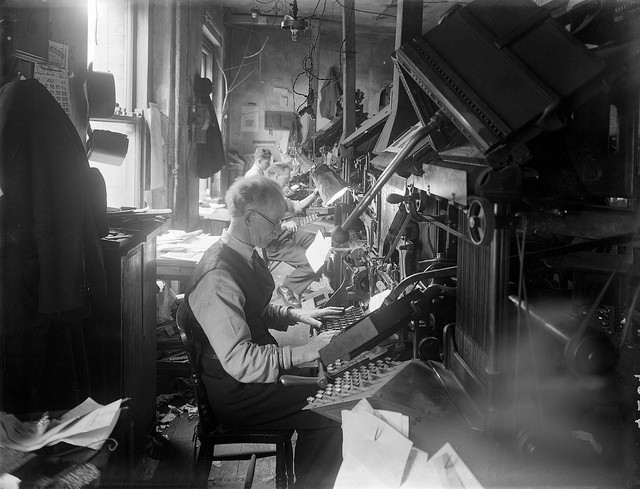
Typesetters working  linotype machines Waterford NewsOver the next few classes we will devote time to editing / formatting our DBQs for iTunes publication of a class DBQ collection. Peter will provide instruction in using iBooks Author. Students will use  material from their DBQ Design project as the foundation for their contribution to one chapter of the class iBook. Peter will arrange for publication on iTunes with all student work credited. DBQ assignment here.

Project Reflection at Ed Methods
Students willing write a reflection on their DBQ design project. That will be done in the form of a blog post to Ed Methods – due by class time 11/25. Students should be sure to go back and quote their original DBQ post and note how their project evolved over time by answering three questions:

  1. What were the learning goals of this DBQ – what skills or content did you want students to master?
  2. To what extent did your final project achieve those goals?
  3. What did you learn about the DBQ lesson design process? (Note: do not discuss the merits of Learnist. It’s about the teaching not the technology.)

The DBQ design blog post should include an image from their DBQ and a link back to their DBQ on Learnist. This post will introduce their DBQ to the world. Peter will also re-publish their post as a guest blogger at Copy / Paste to broaden the audience for their work.

Class DBQ iBook
As a group, the class will review each other’s work before inclusion in the iBook collection of DBQs. Each student (or team) will contribute one DBQ in the form of a book chapter. It will include the project reflection as a way of introducing the DBQ. Students will collaborate on book design decisions and Peter will include a sample chapter and an introduction to the book.

Technical aspects
The iBooks will be designed using iBooks Author in the Mac lab. Students will bring digital versions of their DBQs to the lab – including all image and sound files, text files, citations and URLs. Note: YouTube videos will be inserted into the iBooks using ibooksgenerator.

For more see:

Image credit: Typesetters working on linotype machines at the Waterford News. Date: Friday, 29 July 1938.
This newspaper was set up in 1848, and is still going strong as the Waterford News and Star in print and online.
National Library of Ireland Ref.: P_WP_4269

Class 10: Role-Playing – Beyond Manifest Destiny: America Enters the Age of Imperialism

second Virginia VolunteersStudents took part in a role play developed by the Choices Program. The program’s curriculum units draw upon multiple primary source documents and culminate in a rigorous student-centered role-playing activity. Students took part in a Choices lesson entitled: Beyond Manifest Destiny: America Enters the Age of Imperialism. Working cooperatively, students will advocate for one of the three options the United States considered toward Spain’s former colonies. Students draw upon primary sources and take into consideration the views of fictional townspeople to recreate this critical moment in history.

The goal of this class is to experience the role-play as teaching method. Students will be introduced to (and receive) a hands-on curriculum that uses primary sources, case studies, videos, and role-play simulations to engage students in an exploration of the concept of human rights and the challenges of international enforcement. The curriculum also introduces students to various human rights actors, and examines the current debate on U.S. human rights policy. Emphasis is placed on helping students develop the skills and habits needed for active citizenship.

The lesson was delivered by guest teacher  – Tim Graham. Tim is currently a teacher at Cleveland High School in Portland, OR. He has taught social studies for 11 years in the Portland Public Schools district, working at Roosevelt, Benson, and Franklin high schools in addition to his current placement at Cleveland. He has attended teaching seminars with the Gilder Lehrman Institute of American History, National Endowment for the Humanities, and Watson Institute for International Studies at Brown University. He is currently a Choices Teaching Fellow. Tim maintains two class blogs – Modern World History and  IB HOTA.

Image credit: 2nd Virginia Volunteers  playing with a rattlesnake. Volunteers were poised for war with Spain and stationed in Pablo Beach, Florida prior to assault on Cuba. 1898
State Library and Archives of Florida call number: N041287