Students will present their historical thinking lesson to the class for feedback via large group discussion. Students will have class time to collaborate with peers and teacher to implement the suggestions.
Our goal will be to assist each other in designing a great lesson that supports student mastery in skills of Sourcing, Contextualizing or Corroborating. Lessons will be modeled after History Assessments of Thinking developed by SHEG. For more on the assignment click here.
Assignment for Class 7
Students will write a post that introduces their lesson to the world. The lesson should be embedded into their blog post. More on how to embed Google Docs and Google Forms into WordPress
They should also write a reflection about what they learned from the development process – that reflection could include: working with SHEG model, insights from peer feedback, and/or the workflow used in this course to produce the lesson (how it was assigned, use of Google tools, peer feedback before final posting).
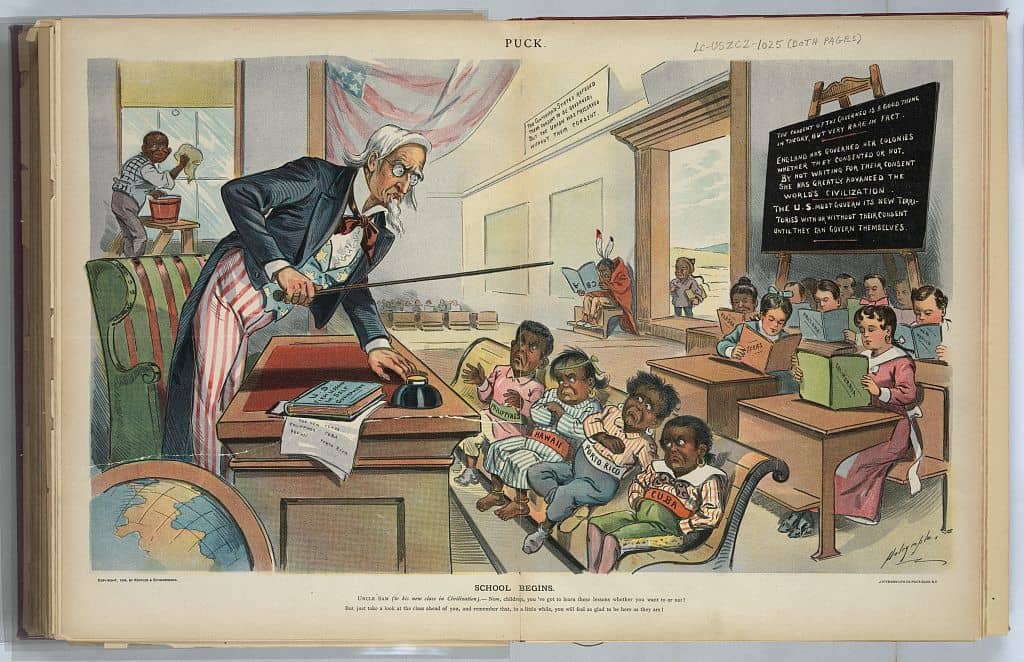
Date Created/Published: N.Y. : Published by Keppler & Schwarzmann, 1899 January 25.
Summary: Print shows Uncle Sam as a teacher, standing behind a desk in front of his new students who are labeled “Cuba, Porto Rico, Hawaii, [and] Philippines”; they do not look happy to be there. At the rear of the classroom are students holding books labeled “California, Texas, New Mexico, Arizona, [and] Alaska”. At the far left, an African American boy cleans the windows, and in the background, a Native boy sits by himself, reading an upside-down book labeled “ABC”, an a Chinese boy stands just outside the door. A book on Uncle Sam’s desk is titled “U.S. First Lessons in Self-Government”.
Our class begins with a review of the Sam Wineburg reading and TEDEd flipped lesson Who is the historian in your classroom? That will also provide a chance to discuss the efficacy of flipping content. What are the challenges and opportunities for that approach?
Today we begin our study of historical thinking skills based on the work of Sam Wineburg and the Stanford History Education Group (SHEG). We will focus on three key skills – Sourcing, Contextualizing and Corroborating. See historical thinking chart (pdf at SHEG).
It will give us a chance to compare both formats for delivering a lesson. (Note: While we could have done either as a hard copy worksheet, this activity gives us a chance to work with a two Google tools.)
Assignment for Class 5
You will each design a historical thinking mini-lesson based on the two sample lessons we did today. Both demonstrate Beyond the Bubble assessment model. All mini lessons should constructed as either a Google Doc or Google Form. (Note: a source video can only inserted into a Google Form).
It features thirteen engaging questions and historic documents that empower students to be the historian in the classroom. The units draw from a fascinating collection of text and multimedia content – documents, posters, photographs, audio, video, letter and other ephemera. “Stop-and-think” prompts based on CCSS skills guide students through analysis of the primary and secondary sources. Essential questions foster critical thinking. All documents include links back to the original source material so readers can remix the content into their own curated collections.
All of our students assignments had a public audience on this class blog and were designed to meet our three class goals:
Learn to think like a historian.
Become a skillful Instructional designer
Develop technical skills for production, reflection, growth and professional networking.
The lesson design process began early in the semester when students designed lessons in historical thinking skills based on the work of Sam Wineburg and the Stanford History Education Group (SHEG). They focussed on three key skills – Sourcing, Contextualizing and Corroborating. Then students identified essential questions worth answering and gathered documents to explore the question in an extended lesson design process.
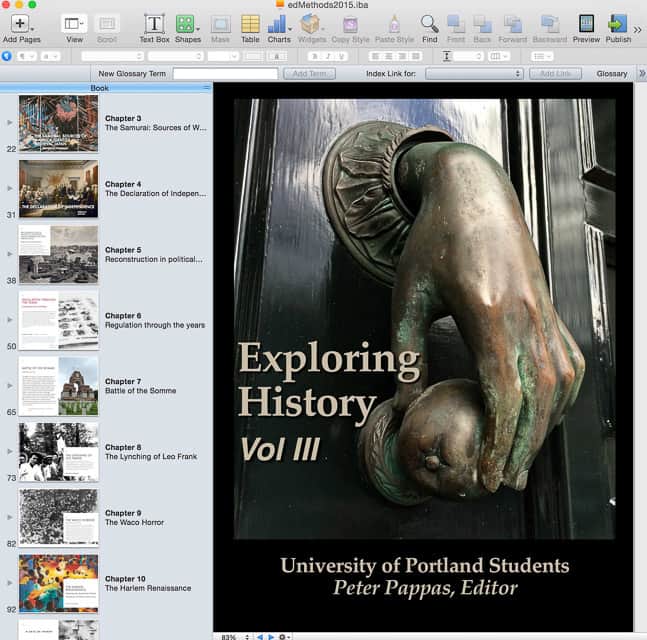
Exploring History: Vol III was our PBL capstone and is available on iTunes in 51 countries around the world. Here’s a post (from fall 13 class) that describes our project workflow (including how we utilized iBooks Author).
This lesson will be imbedded into a unit on World War II. Therefore, students should already know about the devastation that Germany faced in the post-WWI era. They will know that they endured a dramatic economic recession resulting from the Versailles Treaty and the Great Depression. They will understand the helpless aura of the nation at that time. As a review, we will highlight elements that led to Hitler’s rise to power.
Students will be asked to consider why Hitler was able to gain so much power and support so quickly.
Examples for students to consider: Hitler promised the downtrodden citizens a new and better life, as well as a new Germany. The Nazis attracted the unemployed, the young, and the lower middle classes.
Students will be asked to write down their own definition of Nationalism and then share it with their neighbors. Then a few will share them with the class. Specific elements of nationalism will be emphasized as a class: a feeling of superiority over other countries and the feeling that nations should act independently of each other.
Students will be asked to consider nationalism in Germany and the background knowledge that they know of that time when watching the propaganda video.
The Power of Propaganda:
Then the class will briefly go over the definition of propaganda and how students think it could have been employed in WWII Germany.
Students will then watch the propaganda film: Triumph des Willens (1935). By Leni Riefenstahl
Before they begin watching, each student will be divided into “element groups” and asked to consider one of the following key aspects of the film: the soundtrack, the tone and noise of crowds and speakers, and the visual elements.
The class will watch the opening scene of Hitler flying into Nuremberg and then Hitler’s speech at minute 55:00.
Starter thought provoking question: What do you think Hitler’s entrance from the sky symbolizes? ——- Students will write down their own answers and then share with each other, hopefully noticing that his descent from the sky alludes to his representation as a “savior”.
Activity:
As a class, students will look at a timeline of events in pre-war Germany. The teacher will guide them into noticing the events in the year 1924, the year before the propaganda was filmed. Students will therefore notice that on August 2nd, Hitler became president in addition to chancellor. Furthermore, on August 19th, a plebiscite was held to determine Hitler’s support. 90% said that they approved of his powers. For a timeline: http://www.historylearningsite.co.uk/nazi-germany/nazi-germany-timeline/
Students will then meet with the other members of their “element groups” and share their findings about the significance of the elements they noticed. Then they will split into groups of three with those of different “element groups” and share their new ideas. They will be asked to consider their answers in answering the future questions.
Students will be asked to answer these following questions in small groups:
Sourcing Question: Who was the intended audience of this propaganda film?
Contextualizing Questions:
What is significant about the date that the film was released? (March 28, 1935)
How does the video reflect the overall mood of the country during that time?
How does our background information support what is seen in the video?
How can we see nationalism at play in this video?
Their answers will be shared to the whole class and we will write down answers on the board to show connections. Then students in the different element groups will contribute significant features they noticed that help support these answers.
Then students will be asked the essential question in a quick write:
Why did so many ordinary German citizens rally behind Hitler and join the Nazi Party?
We will go over this as a class after they have completed writing their individual answers.
Reflection:
I think that this mini lesson may need some work in its structuring. When I teach this, I want to ask these same questions and ask students to perform these tasks, but I hope to find better methods in doing so. It definitely needs to fit within an overall unit of WWII, hopefully in a world history class so that students also understand the significant after-effects that WWI caused for Germany. The main purpose of this lesson is to approach learning about Germany in WWII from a unique angle. I want students to see what led up to not simply a war, but how a desperate country rallied behind a man who promised change and a brighter future. Therefore, ordinary citizens joined a political party that we could hardly fathom ever joining. I want students to put themselves in the shoes of German citizens of the time and realize just why Hitler was able to gain so many supporters. This lesson will build upon previous lessons towards lessons on the beginning of WWII. Students will also learn about the power of nationalism and propaganda through this lesson.