Black and “Wanted”: Enslaved Black Runaways

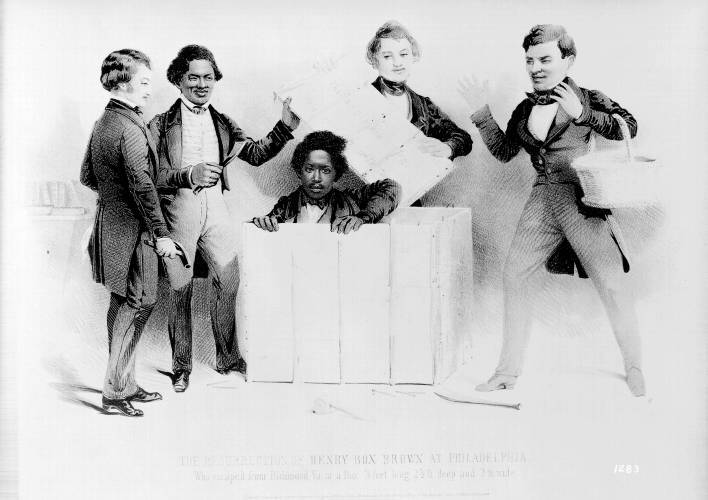
Henry Brown's Box

Mini-Lesson Created by: Alekzandr Wray

Target Students: 10th Grade

SHEG Skills: Close Reading, Sourcing, Contextualizing

Learning Topic: Runaway Slaves

Essential Question: What were the narratives being told about/by enslaved runaways during the 1850s?

Description: Students will discuss three documents which illustrate the perspectives of historic stakeholders in the issue of enslaved runaways. The first document, an excerpt from Frederick Douglass’ “Narrative of the Life of Frederick Douglass, an American Slave”, recounts his experience at the slave breakers’, Mr. Covey, property. The second document is about Drapetomania, a mental illness attributed to enslaved runaways by Samuel A. Cartwright. Finally, the third document is a reward poster published in Washington, D.C. by a local enslaver. Each document plays off of each other to paint different perspectives on the issue. Students will be asked to work in partners or in small groups to discuss scaffolding questions after each segment to further understanding.
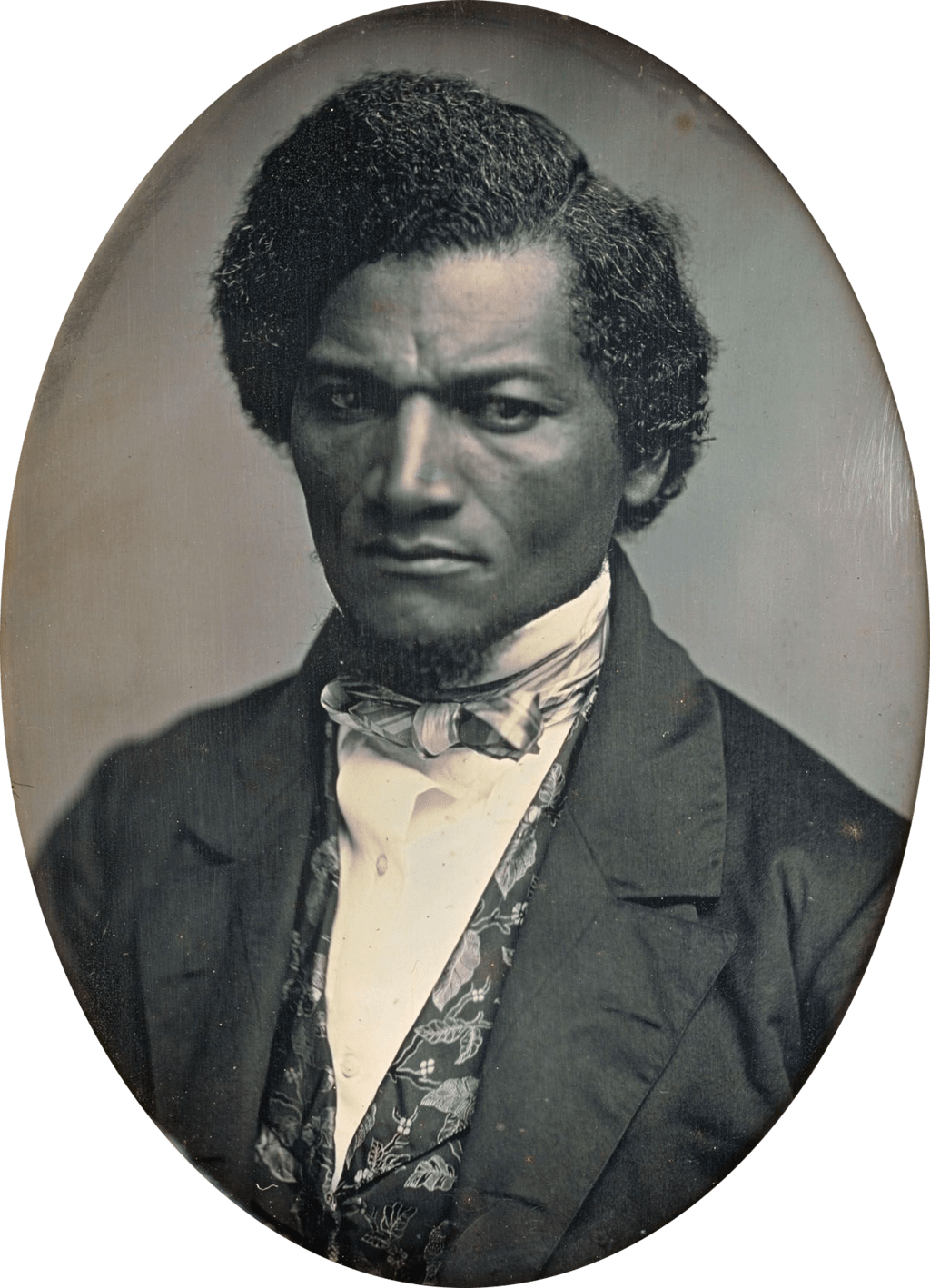


Frederick Douglass


Part I: Frederick Douglass & Mr. Covey

Students work in pairs to read the article, discuss it, respond to the prompts and take notes on their conversation.

Fredrick Douglass recalls being sent to Mr. Covey, a slave breaker (1833, Maryland)

“Master Thomas at length said he would stand it no longer. I had lived with him nine months, during which time he had given me a number of severe whippings, all to no good purpose. He resolved to put me out, as he said, to be broken; and, for this purpose, he let me for one year to a man named Edward Covey. Mr. Covey was a poor man, a farm-renter. He rented the place upon which he lived, as also the hands with which he tilled it. Mr. Covey had acquired a very high reputation for breaking young slaves, and this reputation was of immense value to him. It enabled him to get his farm tilled, with much less expense to himself than he could have had it done without such a reputation. Some slaveholders thought it not much loss to allow Mr. Covey to have their slaves one year, for the sake of the training to which they were subjected, without any other compensation. …

If at any one time of my life more than another, I was made to drink the bitterest dregs of slavery, that time was during the first six months of my stay with Mr. Covey. We were worked in all weathers. It was never too hot or too cold; it could never rain, blow, hail, or snow, too hard for us to work in the field. Work, work, work, was scarcely more the order of the day than of the night. The longest days were too short for him, and the shortest nights too long for him. I was somewhat unmanageable when I first went there, but a few months of this discipline tamed me. Mr. Covey succeeded in breaking me. I was broken in body, soul, and spirit. My natural elasticity was crushed, my intellect languished, the disposition to read departed, the cheerful spark that lingered about my eye died; the dark night of slavery closed in upon me; and behold a man transformed into a brute!”

Scaffolding Questions: 

  1. Who was Frederick Douglass and from what perspective was he writing?
  2. What was Douglass’ experience like with the slave breaker?
  3. Who do you think was Douglass’ intended audience when reflecting on his experience?
  4. Why did experiences like Douglass’ lead many slaves to runaway? Why did they cause many to stay?
  5. What parts of the passage stand out the most to you and why?
  6. How does the concept of “breaking” a slave land for you? What do you think that means?
  7. Can we trust him as a source for how slavery was? Why?
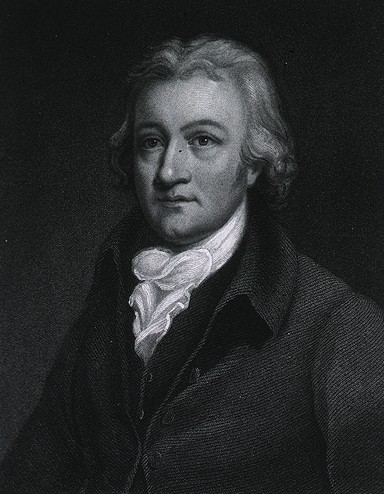
Samuel CartwrightPart II: Drapetomania & Samuel A. Cartwright

Students will each have a copy of Cartwright’s description of Drapetomania and will work in a group to discuss the article, while a scribe takes notes, and review the scaffolding questions.

Scaffolding Questions:

  1. Who was the author of the article, what did he do and what role did he serve?
  2. What was he writing about? What was his perspective? Who was his audience? What/who could he have been influenced by?
  3. Where in the United States was this article written and when?
  4. Why was “science” used to connect enslaved runaways to a mental “malady”? What purpose did it serve?
  5. What two types of treatment by enslavers did Cartwright claim were the chief primary causes of drapetomania?
  6. Is Cartwright a reliable source to consider when discussing enslaved runaways?
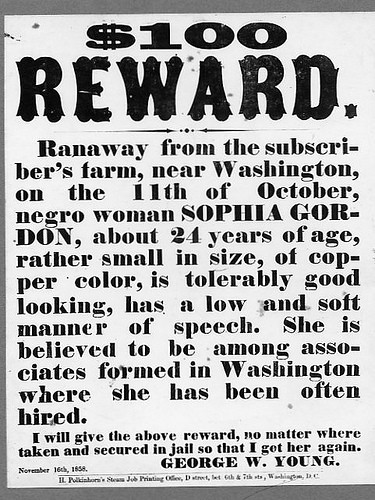
$100 Reward PosterPart III: $100 Reward, “… so that I get her again.”

Again, students will work in a small group to analyze the document, start a conversation using the scaffolding questions, and take notes to turn in.

  1. Who wrote this poster?
  2. Who are the beneficiaries of this poster? Who loses?
  3. What is the article’s purpose?
  4. Where and when was it written?
  5. How much is $100 in 1858 worth in today’s money?
  6. What gave enslavers the right to offer rewards for the capture/return of a human being?
  7. Why were posters like this common during this era?
  8. Does this poster give a reliable description of Sophia? Why? If not, what are the costs of its unreliability?
  9. What were some of the impacts of posters like this?
  10. Have you seen posters like this today? If so, where and who/what was the poster about?


Reflection: I believe what I put together is more of a series of mini-lessons that all connect rather than one mini-lesson that stands by itself: I’d likely have to dedicate a few class periods to teach this activity in order to do it justice. In the future, I’ll likely add an additional section to the presentation that covers the abolitionist viewpoint on the issue and then ask students questions that delve into corroboration territory; doing so would allow students the opportunity to tie each of the different sources together in order to create a larger view of the issue.

An aspect of the mini-lessons that I appreciate is that, at each step of the process, students are allowed to utilize community to further their own understanding and because each group will have a scribe to take notes on their conversation, the teacher can gain some really revealing information into her/his students’ thought process when they’re not being hovered over. That information can help determine where the large group conversation should lead and could be useful in deciding what future activities, if any, need to be planned for this topic.

Sources:

Henry Brown’s Box

$100 Reward Poster

Frederick Douglass’ Photo

Drapetomania

Samuel A Cartwright

Narrative of the Life of Frederick Douglass:

Narrative of the Life of Frederick Douglass (Boston: Anti-Slavery Office, 1845).

Reprinted in Eyewitness to America, David Colbert (Pantheon Books,  NY) 1997  p 143-146

One Minute to Midnight: Decision-Making During the Cuban Missile Crisis


Target Students:
11th and 12th grade

Historical thinking skills: This lesson develops students’ sourcing and contextualization skills.

Essential question: On what bases did the US and USSR make decisions leading up to and during the Cuban Missile Crisis?

Context within Curriculum: To participate in this lesson students must be familiar with the broad contours of post-WWII global politics. In particular, students should be able to describe key differences between the US and USSR, be aware of the existence of NATO and the Warsaw Pact, and have basic knowledge of nuclear weapons.

Primary documents:

  1. CIA Special National Intelligence Estimate, “Major Consequences of Certain U.S. Courses of Action on Cuba,” October 20, 1962.
  2. Prime Minister Fidel Castro’s letter to Premier Khrushchev, October 26, 1962.
  3. USSR, Cable, TOP SECRET, Dobrynin Report of Meeting with Robert Kennedy on Worsening Threat, October 27, 1962.

All sources via The Harvard Kennedy School of Government’s Belfer Center at

Key Documents

Scaffolding questions:

  • Who (or what) wrote/produced these documents?
    • How does the identity of the author change the way we interpret the documents?
    • What were the author’s goals or purposes?
  • These documents are very different from one another. How does their form affect the way we interact with them as historians?
  • Who would have read these documents and what kind of information would they have wanted from them? How might that information have been used?
  • What can we infer about the relationship between Cuba and the USSR from Castro’s letter? Further, what do we know about US-Cuba relations at this time?

Goals: Students will synthesize what they know about Cold War history (context), international relations, and that which they can infer using these documents to develop an explanation of the Cuban Missile Crisis:

  • The US, USSR, and Cuba all sought security
    • The documents support this (compromise re: NATO missiles in Turkey; Cuba’s fear of invasion by the US; US worries that its actions could provoke retaliation by the USSR)
  • Governments make decisions, predictions, with limited information
    • Implication: Decisions cannot be perfectly rational; based on predictions about others’ behavior

Students produce:

Students will be divided into four smaller groups, two groups assuming the role of the US and two becoming the Soviet Union. The individuals within each of these small groups will work collaboratively to analyzing all three documents included in the lesson. These groups are then asked to develop a cohesive “policy proposal” to the entire class. These proposals can take a wide range of forms, although it is essential that students identify 1) a “policy priority” that is rooted in a group’s reading of the primary material (e.g. removal of US missiles in Turkey) and 2) a rationale that details the group’s reasoning for making the specific recommendation that they have chosen (e.g. “we recommend invading Cuba because the CIA report indicates…”).

Reflection:

With this activity I set out to use an exciting, high-profile incident to guide students to a broader understanding of the machinations of international politics. The process of developing the lesson and, the helpful feedback I have received from peers in particular, has helped me to identify major shortcomings that have both improved this lesson and will help me produce stronger lessons in the future. To fully realize the potential of learning through primary documents, I have found that it is essential that lessons be appropriately sequenced and scaffolded. Striking the balance between frustrating students by presenting them with materials they are ill-equipped to understand and over-scaffolding to the point of boredom will be a focus of mine as I grow as a teacher.

Title Image: EXCOMM meeting at the White House Cabinet Room during the Cuban Missile Crisis on October 29, 1962


Literacy DBL Design Project

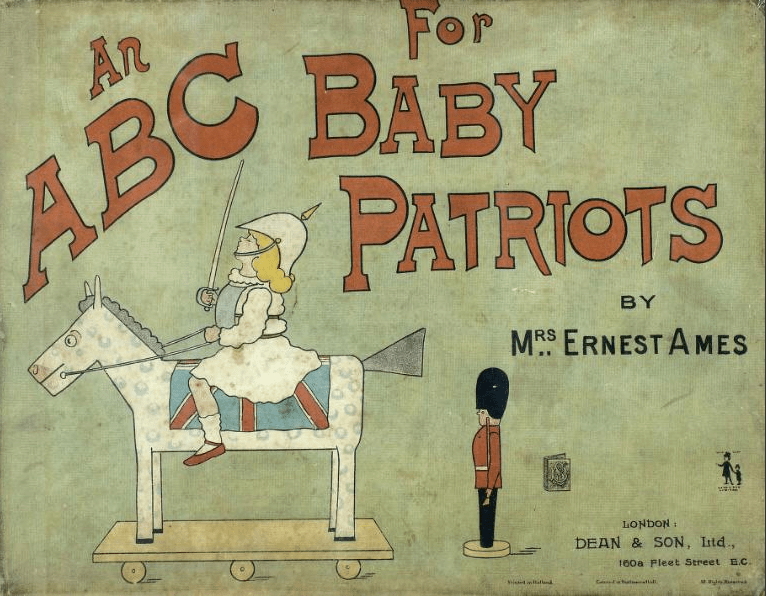
An A B C, for baby patriotsWorking as individuals or in 2 person teams, students will design a document-based lesson (DBL) question suitable for inclusion in our iBook (available at iTunes).

See Class  6 for recommendations for DBLs and Teaching with Documents. Your DBL will include:

  1. Introduction of the DBL with brief historic context as needed.
  2. Generative / essential question
  3. About 5 – 8 related documents (image, text, video, audio) that will assist the students in answering the generative question
  4. Clear statement of what students will be asked to do
  5. Close reading scaffolding question for each document to assist the student in examining the document

A good example of a DBL is Progress and Poverty in Industrial America  This is a pdf version of one of my iBooks. (note: you will not have full function of all the gallery and video widgets). It uses 11 documents, which is a bit more than I expect for your DBL.

The DBL Design Assignment will be accomplished in steps:

Step 1: Develop a proposal which will be submitted for peer review. You should be prepared to deliver a 2 min pitch to class. (not a written assignment to be turned in)
Due date:  10/12.

We’ll do a bit of “speed dating” of our ideas for the DBL Assignment. Students will form two lines and have 2 minutes to pitch their DBL design idea to each other and share some feedback. Then one line will shift and we repeated the pitch exchange. In all students will pitch their idea three times.

The goal of this phase is to gather feedback from peers regarding the following:

  1. You have an interesting generative / essential question worth answering.
  2. Your initial appraisal indicates there are suitable documents available.
  3. You have an idea for how students will be asked interpret your documents.

Step 2: Submit a preliminary idea for your DBL design project for Peter’s feedback by 10/19. It should be posted to a shared Google folder.

Here’s a short video on using shared Google folder

It can be in the form of a Google doc that addresses:

  1. Where will you use it?  Grade, course, etc
  2. An interesting generative / essential question worth answering.
  3. 3 -5 suitable documents (include links).
  4. A brief explanation of “what are the kids going to do?”

Note: This is not intended to be a fully developed lesson. Just an idea of where you intend to go.

Step 3: Prepare content for iBooks Author lab session on 11/23

Workflow? See this guide Getting Ready for iBooks Author 57KB pdf

Step 4: iBooks Author design session 11/23

Step 5: Peer review of draft iBook 11/30

Step 6: Write a reflection on your DBL design process and post to our blog (your final post). It will also be added to your iBook chapter – due 12/6.

Step 7: Final design session in Digital lab 12/7


Title: “An A B C, for baby patriots”
Creator: Ames, Mary Frances
Publisher: Dean & Son
Place of Publication: London (160a Fleet Street E.C.)
Publication Date: [1899]
Archive: University of Florida UF00086056:00001

Class 5: Sharing Our Lessons

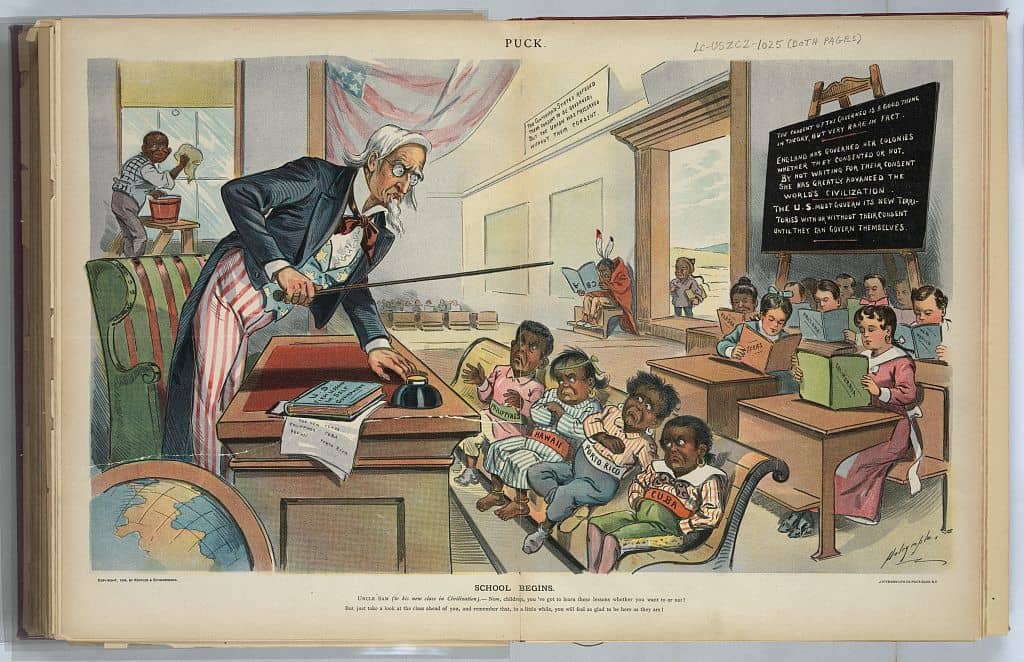
School Begins - 1899
School Begins – 1899

Students will present their historical thinking lesson to the class for feedback via large group discussion and using Google comment feature. Students will have class time to collaborate with peers and teacher to implement the suggestions.

Our goal will be to assist each other in designing a great lesson that supports student mastery in skills of  Sourcing, Contextualizing or Corroborating. Lessons will be modeled after History Assessments of Thinking developed by SHEG. For more on the assignment click here. We are using the shared Google presentation below to collect and curate our lessons.

Assignment for Class 6

Goal: Publish a great historical thinking skills lesson that others can use. Students will post a finished version of their lesson as a blog post. (Due Oct 4) It should be in a form that could be easily used by another teacher.

The post should conclude with a reflection – which could discuss the SHEG lesson model,  the lesson design process, the challenges  opportunities of teaching historical thinking skills, etc.

All historic and lesson plan content should be included in the post or available via linked documents, pdfs, etc. (Specific layout concerns can be worked out as needed.) All historical content should be in the public domain and  must include active URL hyperlinks back to source archive.


Image Credit: Library of Congress

  • Title: School begins / Dalrymple.
  • Creator(s): Dalrymple, Louis, 1866-1905, artist
  • Date Created/Published: N.Y. : Published by Keppler & Schwarzmann, 1899 January 25.
  • Summary: Print shows Uncle Sam as a teacher, standing behind a desk in front of his new students who are labeled “Cuba, Porto Rico, Hawaii, [and] Philippines”; they do not look happy to be there. At the rear of the classroom are students holding books labeled “California, Texas, New Mexico, Arizona, [and] Alaska”. At the far left, an African American boy cleans the windows, and in the background, a Native boy sits by himself, reading an upside-down book labeled “ABC”, an a Chinese boy stands just outside the door. A book on Uncle Sam’s desk is titled “U.S. First Lessons in Self-Government”.
  • Reproduction Number: LC-DIG-ppmsca-28668