After spending a few weeks exploring the different avenues available to me for my DBQ, I am finally on a focused track to the finish. After switching my topic from the more obscure food history topic to the much more document rich Marshall Plan, my issue was not where to find documents, but just the opposite.
There were so many great documents, I found myself following lead after lead on possible directions to take the assignment. While I learned a tremendous amount about the Marshall Plan, the state of Europe after WWII, and the different opinions throughout U.S. and Europe about the plan, I didn’t feel like I was getting any closer to completing the assignment. But I was finding photos, documents, and getting more information. Through this research I was able to narrow my focus and choose an angle on which to focus: the differing views on the Marshall Plan from Europe, Russia, and at home in the U.S.. My next challenge was to step away from the history and just look at the documents. What was I trying to say? What were the documents telling me? I finally focused on assembling documents that could tell a story. Once I had a clear narrative of what I wanted the students to see, the guiding questions practically wrote themselves.
Next up for me is to add the last few pages into iBook Author and begin to fine tune the look and feel. I will have my classmates review the work to ensure the documents and questions create a clear narrative that will guide the students to address the enduring questions of the unit.
This assignment has been exciting for me on two main levels. First learning how to write this type of assignment for my students will be something I will continue to work on throughout my career. I am a big believer in having students think like historians. The other facet is just how much I enjoyed researching the history surrounding the Marshall Plan. Reading all the documents and seeing all the photos was like a DBQ itself. I will continue to practice, learn, and hopefully inspire my students to do the same.
A mini-lesson on WWII cartoons by Kristi Anne McKenzie Historical Content: World War II (home front) Historical Skills: Contextualization, sourcing Intended Grades: 9-12
Directions:
Use the source information, your knowledge of history, and the video and political cartoons to answer the questions below.
Sources:
Document A is an animated short film written by Theodor Geisel (Dr. Seuss) and P.D. Eastman and produced by Warner Bros. for the War Department as part of the U.S. Army Air Force First Motion Picture Unit. Documents B, C and D are political cartoons created by Dr. Seuss for PM, a New York City daily newspaper.
Document A: Private SNAFU in Rumors
Question 1: When was the film produced?
Question 2: Which two of the facts below might help explain why the author wrote this screenplay?
After the attack on Pearl Harbor, Dr. Seuss, like many Americans, developed a concern for national security and a fear of foreign enemies.
Private SNAFU cartoons were only shown on military bases; they were not allowed to be shown to the general public. As they were a product for the use of the War Department, the films did not have to comply with standard censorship regulations in regards to decency or colorful language.
In order to keep the animation studios open during the war, companies like Warner Bros. had to produce military training films.
The goal of the Private SNAFU films was to teach lessons on secrecy, military protocols, and disease prevention to soldiers with poor reading skills.
Question 3. Now compare the film “Rumors” with the three political cartoons. How is the intended audience similar and different? How is the intended message similar and different?
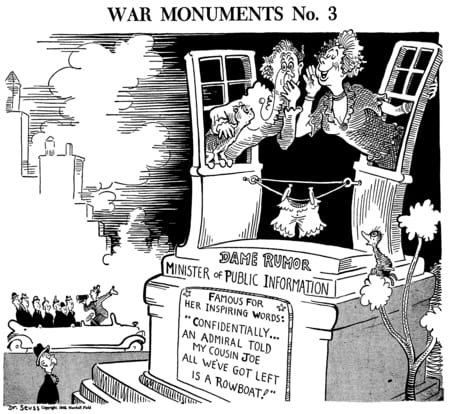
Document B: War Monuments No. 3, published January 8, 1942
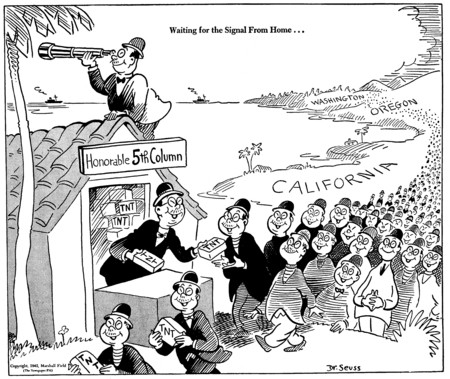
Document C: Waiting for the Signal from Home, published February 13, 1942
Document D: Funny… Some People Never Learn to Keep Their Barn Doors Locked, published February 16, 1942
Lesson Goals: Students should be able to situate the film and the political cartoons on a timeline of World War II events, primarily around the bombing of Pearl Harbor (December 7, 1941) and President Roosevelt’s issuance of Executive Order 9066 (February 19, 1942). Students should recognize the difference between making an animated film for enlisted men in the military and drawing political cartoons for the general public. They should also note that the message of the cartoons and the film are quite similar, but the difference in the intended audience has an effect on the context.
Possible extension activity: Compare and contrast Carlos Mencia’s 2002 stand-up routine for Comedy Central Presents with Dr. Seuss’ cartoon “Waiting for the Signal From Home.” What themes emerge?
Reflection: This was a fun project. It seemed to me that it should have been a more difficult task to assemble a lesson on primary sources using a medium that was new to me (Google Presentation), but the Stanford History Education Group’s assessment model was so clear that this lesson came to together almost effortlessly. In fact, it came together so well I thought I must have done it incorrectly, or left something out. My thanks to Sam for thoroughly examining my first draft and offering his insight and support. This is the kind of lesson that makes me feel like I am doing what I am meant to be doing, and moving in the right direction.
Document D: Funny… Some people never learn to keep their barn doors locked., published by PM Magazine on February 16, 1942, Dr. Seuss Collection, MSS 230. Special Collections & Archives, UC San Diego Library. http://libraries.ucsd.edu/speccoll/dswenttowar/#ark:bb5700525j
When I began this project, I expected that choosing documents for a DBQ would be easy, while writing the text and questions to accompany them would require the greater effort.
As it turns out, the effort came in keeping myself terse. The fundamental question in this project was “what do you want the reader to do?” Once I decided that the reader would examine propaganda posters and analyze what emotional impact they had, it became clear that my main task would be curating the posters themselves. Too much text would only distract from the real focus of the DBQ. Thus, I tried to limit myself to minimal introductions to set the frame, and one or two open-ended questions.
It seems to me that simplicity is at the heart of the DBQ format. As long as the reader is oriented, the documents, visual or textual, should speak for themselves. I’ll keep this principle in mind not only when designing formal DBQs in the future, but when presenting primary documents to students in a classroom context.
I’m satisfied with the final project: its narrow focus has allowed it to stake out its own niche. There are many DBQs out there relating to World War II propaganda, but few ask the reader to look across cultures for parallel concerns. Still, this project only scratches the surface: the five propaganda themes I included are hardly the only possible points of comparison. I hope readers find this to be a source of ideas and inspiration for other projects.
For use with the Nikkei Center Suitcase, I wanted to create a lesson that could be used in upper elementary. This is the age range that most often checks out the suitcases. However, one has to be discerning of what one can discuss with students at that age, and for the most part, I left that up to the person teaching the lesson. Therefore, this lesson focuses more on the changes in physical features. It is a compare and contrast lesson on the past and future. There are elements of history, current day features, discussion and writing. This is a lesson that focuses on Japan town before Japanese Incarceration during World War II. Students will gain an understanding of change over a long period of time as well as some of the causes for that change. Students will also gain some writing practice.
It was very interesting learning about a part of this city’s history. I feel that this lesson can be used and modified across the elementary grades and that it will give a foundation of deeper learning about the situation in the future. Having written several lessons at the third grade level at this point, I believe that this is both appropriate and useful at that grade.This lesson is merely a guide to a deeper lesson. Teachers may chose to modify it as they see fit for their classroom or grade level.
Teacher: Location:
Class/Topic: Social Studies
Time: approx. 35 minutes for discussion and some writing time. Might be a good supplement for regular writing lesson.
Grade Level: 3-5 Date:
Overview:
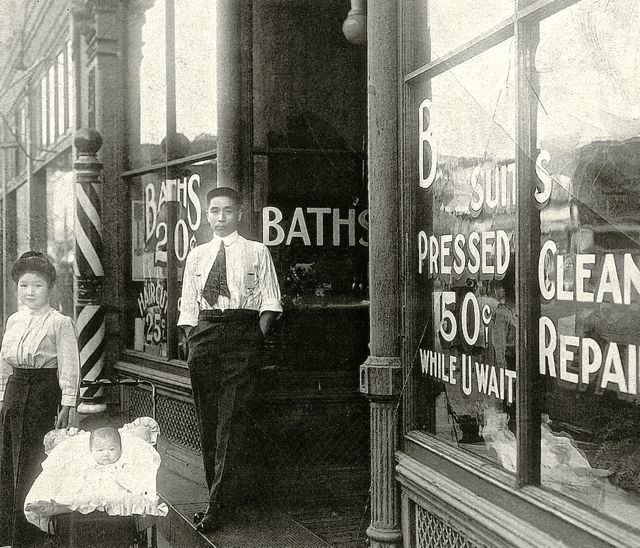
This lesson would be a basic overview of how things have changed in what used to be Japantown (and is now partly Chinatown) and what might have caused physical features as well as themes and ideas to change. To do this, students will look at old images; find similarities and differences to their own experiences and time. Then students will discuss and write about these themes. This is a lesson on the general Japanese-American experience before Japanese Incarceration occurred during WWII.
Goal:
Students will gain a familiarity with how and why things change over time.
Students will be able to discuss things stay the same across time and how things change.
Rationale:
Students will be gaining knowledge of how to work with images and documents as well as gaining familiarity over their own community as it was in the past and how it is now. This will also give them experience in finding similarities and differences as well as some writing skills.

 After spending a few weeks exploring the different avenues available to me for my DBQ, I am finally on a focused track to the finish. After switching my topic from the more obscure food history topic to the much more document rich Marshall Plan, my issue was not where to find documents, but just the opposite.