
Reflection: Federal Govt Revenue and the Deficit

The U.S. Department of the Treasury Source

Last week, I presented a lesson: Federal Government Revenue and the Deficit. I presented a PowerPoint with graphics, and background information, to give context to the featured Robert Reich video and text. For the most part, I believe I accomplished my goal. I felt at ease during the presentation and was able to cover the intended material. I did accidentally overlook the Reich biographical background commentary, however. In the future, I would perhaps make a note in the PowerPoint, so this is not overlooked. 

The teaching tools, e.g. the close reading guiding questions, were well received. I heard great feedback on the content of the lesson. It was new and interesting information for the class. I also heard some constructive criticism on the graphics. For example, it was suggested that my graphic on the rate history of the top income taxpayers could have been an entire slide. It could have not only been more prominently featured in the presentation, I could have spent more time pointing out the details of the graphic. I agreed. I was slightly concerned about time, so I would also suggest that I could have spent more time engaging the students on the close reading questions for the first Robert Reich video.  

Overall, I learned about putting together a lesson, finding thematic ties for the narrative, and recognizing the constraints of presentation without review. It is great to have this opportunity to hear from my fellow students and receive feedback.

Lesson 2: Federal Govt Revenue and the Deficit

The U.S. Department of the Treasury Source

The purpose of this lesson is to look at federal taxes as the main government revenue source and the implications of federal tax cuts. We will also consider the current national deficit and who is profiting from the deficit.

I will walk students through a brief review of federal tax revenue and the deficit to give context. I will be presenting a video and sharing text by Robert Reich, as well. I will provide students with close reading prompts for the video presentation. I will also include a reading log to accompany the article text.

Prior to the review, students will have an opportunity to recall and share a few pieces of previous knowledge regarding federal tax revenue and/or the deficit.The students will be watching a Robert Reich video “The Yuge Republican Lie About The Deficit” (3:00), and will consider some close reading prompt regarding Reich’s claims, reasoning and evidence. We will discuss. Students will then read “The Big Economic Switcheroo” by Robert Reich. They will note in a log: important ideas and information. Another column offers space for thoughts, feelings, and questions about the text. Students will then pair-share their insights and apply a close-reading lens to their discussion.


The resources for the lesson include my powerpoint presentation, Robert Reich’s video: “The Yuge Republican Lie About The Deficit” (https://robertreich.org/post/183414097535), and the text of his video: “The Big Economic Switcheroo” (https://robertreich.org/post/181848967520).

Social Security Lesson Reflection

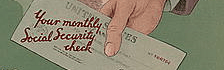
A Monthly check to you for the rest of your life, beginning when you are 65… (Source)

I did accomplish my goals in presenting the historical thinking skills Social Security lesson adopted from Historical Thinking Matters. We were able to explore two historical thinking skills: close reading and corroboration while exploring some of the history around the development and evolution of Social Security. Two positive outcomes were: (1) I was able to comfortably present the lesson in the allotted time, and (2) my peers were able to share with me, during closure, one or two things they learned from the lesson. 

 I received feedback that spending more time talking about the Social Security Board poster prior to asking students to sketch the poster would be helpful. In retrospect, I wish I had asked the students to come up to the front of the room to explore the poster as there was a lot of text that may not have been legible. I also received feedback regarding the flow and the variety of materials presented. I understood that the variety of materials (poster, video, congressional testimony excerpt) is appealing. I received a positive response regarding the flow of the lesson, as well.  

I learned that there are a lot of very well-crafted materials available that can be adopted to one’s needs or to an allotted time frame and that it is okay to reshape materials in a way that works for you. I also learned that I was more capable than I thought in terms of presenting the lesson and that running ideas by peers is an excellent way to improve my future lessons.  

Social Security Lesson Study

For my lesson study presentation, I will be introducing a portion of a Social Security lesson from Historical Thinking Matters (http://historicalthinkingmatters.org/ ). Students will do an icebreaker in the form of a drawing analysis, and subsequent pair share, on a publication poster which was distributed in 1936 and 1937 by the Social Security Board. (loc.gov/pictures/resource/ppmsca.07216/ ) The lesson allows social studies students to experience close reading of both the poster, and an excerpt from a NAACP representative’s speech at a 1935 Congressional committee hearing. From these documents, students consider those initially left out as beneficiaries of the Social Security framework. Students will also watch a brief video and listen to a historical analysis. We will conclude with a brief take-away exit ticket.

Source: historicalthinkingmatters.org/socialsecurity/