Test your knowledge on both Paleolithic and Neolithic history
The attached quiz is intended to be taken by sixth graders in a social studies course attached to an ancient civilizations unit. This focuses on important concepts linked to both the Paleolithic and Neolithic eras and define important cultural facts that are important for longer analysis. Answer the questions on the attached google form as best you can.
Context: An Air Force RF-101 Voodoo captures images of Soviet personnel and six missile transporters loading onto ship transport at Casilda port in Cuba, in this Nov. 6, 1962. Fidel Castro of the then communist Cuban regime and the USSR wanted to instill a deterrent against American invasions since the ICBM’s of the Soviets did not compare in abundance or performance to that of the missile silos of the United States. Storing nuclear missiles in Cuba was carried out to protect Cuban interests. The spy planes also wouldn’t find out until later that the Cubans had over a hundred missiles already on site that the Americans knew nothing about.
Context: The U.S. Navy destroyer USS The Sullivans was one of many ships in the United States navy sent to “quarantine” the Cubans since a “blockade” was an act of war that president John F. Kennedy wanted to avoid. This was intended to prevent the USSR from coming to Cuba’s aid, and would eventually result in a tense stand off between both navies before both sides stood down. For the Cubans, actions such as this increased fears that the United States would try to invade the island and depose the Cuban government.
Context: When JFK announced the existence of the missile sites and his response of quarantining Cuba, protests such as this erupted across the country. Those opposed to Kennedy thought this was a personal grudge against Castro after the failed “Bay of Pigs” invasion and was sacrificing peace for war. While many of these protesters were unaware of the true extent of what was occurring between the US and the USSR in secret, they knew that if the situation escalated further a terrifying nuclear war would erupt between the two superpowers that would kill millions of Americans.
Context: JFK met with the National Security Council Executive Committee (EXCOMM) and deliberated with them as to what course of action needed to be taken to handle the crisis. Though some, including his brother Robert Kennedy, advocated for an invasion of Cuba and the removal of Castro JFK decided to de-escalate the crisis instead of allowing for this crisis to spiral out of control. Ultimately, the Soviets removed the missile sites from Cuba (while the USA quietly negotiated to remove missile sites from Italy and Turkey) and nuclear war was averted.
Questions for Students
Question 1: What is revealed in the aerial photos of the missiles being loaded onto Cuba? What might this reflect about the state of Cuba at this time? How might this relate to the second image of USS The Sullivans.
Question 2: What are some themes found within posters and demonstrations of the anti-nuclear protesters? Why might protests such as this erupted across the country?
Question 3: What details are revealed in the picture featuring EXCOMM? What subtext might exist during these negotiations? Do you think that EXCOMM made the right decision when it came to handling the crisis? Could it have been handled better?
Instructional Goals and Model Answers
Response 1: The photo reveals that the Cubans are not necessarily ready to launch a nuclear attack on the United States. These are missiles that have to be transported and stored before they can be armed. However, what is revealed is that the Cubans clearly have loading sites from which to carry out this process of arming Cuba for war. The presence of a Soviet tanker suggests a clear alliance between this macro and micro power that is finally highlighted openly. This relates to the second photo of the USS The Sullivans in that the US is taking direct action to start isolating Cuba while seemingly preventing the situation from worsening. If we are aware with hindsight that there were far more missiles on the island than believed by the Americans at the time, we can see that both sides are interpreting this crisis in different ways. To the Americans, they are stopping Cuba from becoming a dangerous threat to stability. Furthermore, these protestors likely learned about the failed “Bay of Pigs” invasion and saw this as a political gamble that was needlessly dangerous. To the Soviets, the Americans are threatening to invade a communist ally and spark World War III. It would only be in the next few hours when the full extent of the crisis was made evident.
Response 2: The posters have phrases such as “Be Careful” and “Peace of Perish” which highlights how these protestors recognize that if Cuba gets “hot” then the world basically ends in nuclear war where millions die across the world. They advocate for peace with rigid dogma because they believe that a war between the USA and the USSR cannot possibly end favorably. For those that did not align with the “hawk” attitude of the time that called for continued resistance to the communist Soviets and any supporters of them, this crisis was not something that could be allowed to happen. They could not fathom an outcome where only a few powerful people could determine if the world would end or not and would do anything they could to prevent this from happening. Shifting cultural attitudes were just starting to take effect and protests such as this were becoming more and more common.
Response 3: This picture featuring EXCOMM might not reveal the chaos and disorder experienced among these leaders. While one group advocated against nuclear war and the risk of World War III, the other wanted to avenge the failure of the “Bay of Pigs” and score some military gains against Castro. The photo suggests that the negotiations were calm and collected which seems unlikely given the fact that the crisis seemed to worsen with each hour before cooler heads finally prevailed. The debate that might have occurred here could have consisted on whether or not the US would demonstrate it’s military capabilities or not with this crisis being the chance to do so. It seems that the best options were taken when it came to not allowing for an invasion and instead just calling for the demilitarization of Cuba by removing the missile sites. I do think that this crisis couldn’t have been handled any better since any escalation, whether that be an invasion, air raids or strikes against the USSR would have resulted in a nuclear war that would have ended civilization as we know it. Any attempt to make this a pure military operation would have ended the world and killed millions, if not billions, of people.
Context: A “retiarius,” a Roman gladiator who fought with a trident and net, is being crushed in the paws of a bear and has already lost consciousness. Gladiators were a source of entertainment for the Roman Empire and the function of these spectacles in society was comparable to that of sporting events carried out today albeit far less violent. This statue reflects a perception of how the fights are seen as great contests of valor and strength. Bears are of great importance in Roman myth, which is grounded in the existence of the Atlas Bear that used to exist within North Africa, one of the more prominent regions of the Roman Empire.
Icebreaker: What is missing from this picture of the statue? What details seem to be emphasized and what is left out?
Response: For one, this statue was likely decorated with colored paints that have faded away over time. They likely would have reflected the type of Roman emphasized as a “retiarius” or gladiator and perhaps their muscularity and bulk. Art expresses aspects of not only the human condition but wider context to the culture it belongs to. Physicality and strength seems to be emphasized as an exemplary traits, as seen in that the figure wrestling the bear is nude. A gladiator would likely be wearing armor or wielding weapons instead of nothing but his bare hands. The absence of these elements reflect a warrior culture as seen with these statues.
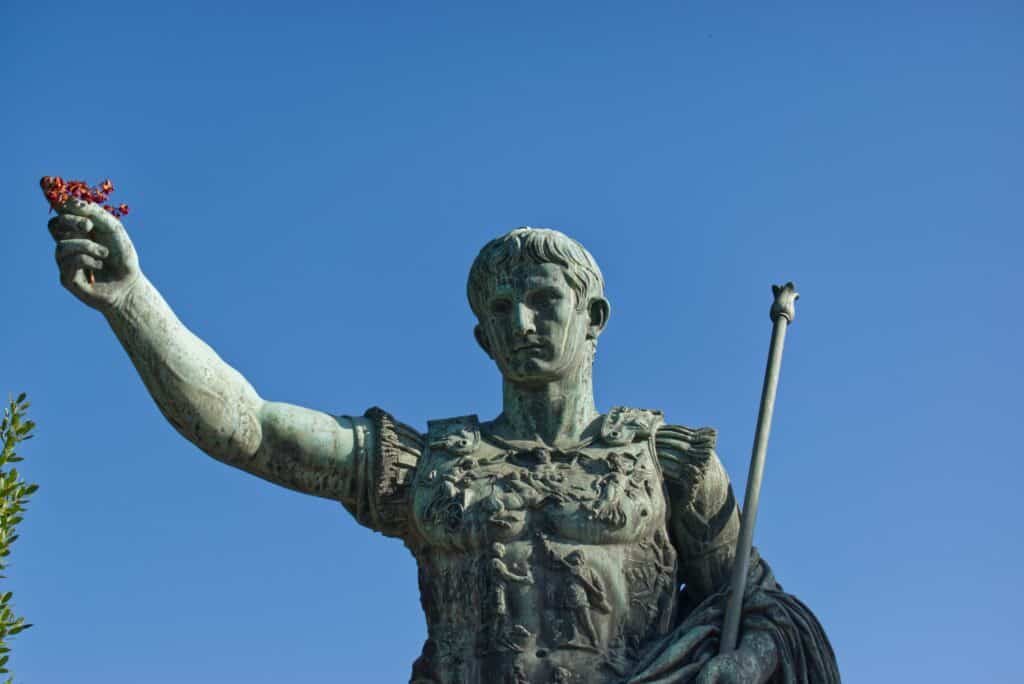
Context: This is a statue of Julius Caesar Augustus, often referred to as Caesar Augustus, the first Roman Emperor from 27 BCE to 14 CE. This statue reflects that of a military commander, an “Imperator” of the Empire that has set out to conquer lands in the name of Rome. The style of the statue reflects that of a great orator speaking to the people with a hand extended to offer deliverance. The armor adorned would be that of detailed regalia characterized by the finest cloth and most ornate armor. The chest plate has Roman gods decorated from top to bottom which connects well with the idea believed by the Roman populace: that the Emperor’s place was determined by divine origin.
Icebreaker: Analyze the figure in the image. Provide a caption.
Response: Augustus Caesar: “Hear thee, Italians. I realize you may not speak Latin anymore but you can hear my emotions surely. I stand here strong! I stand here brave! I stand in victory is what I would say if you were here….where is everybody? What are those chariots? They have no horses.”
Image 3: Persecution of Christians
Painting of Persecuted Christian Martyrs in a Roman Colosseum. See Source from PICRYL
Context: The Roman Empire was a pagan society that worshipped the Roman gods. Those within the Empire had to pay tribute to the Emperor and renounce any religion that caused them to be separate from Roman society or else face execution. Early Christians refused to offer tribute and renounce their religion which led to public executions such as the one pictured here in this painting, exile was also the punishment for particularly esteemed individuals. Romans indeed used animals such as captive lions and tigers that have been starved as a particularly brutal means of execution, though this form of execution became more popular within the second century CE. The means of punishing dissent was particularly brutal during this time but it reflects a culture that did not respect differences in religion, especially a monotheistic one such as Christianity.
Icebreaker: What symbols are in this picture? What context do they relate to? Do these symbols work today?
Response: The first symbol that stands out is that of the lion and how it reflects a ruler. It has two simultaneous symbols depending on the viewer. One way you can interpret the lion is that of Rome itself. Rome is the regal and powerful figure that is going to kill the Christians for their disobedience to obey its rule. In this regard, the Lion being a king of the “Roman Jungle” makes this scene one of the state oppressing a religious minority. Another way to see this is the idea that the lion is a substitute for the Christian God. This way the lion’s symbolism of ruling king is retained, but shifted to being a deity instead of a ruler. In this case, the lion will rescue the Christians from this arena of suffering and deliver them into a swift death. According to Christian beliefs, this allows them to reach heaven and therefore refuge from the Romans.
French Prisoners standing and singing outside of a German camp, likely Zossen prisoner of war camp, Wünsdorf, Zossen, Germany, during the year 1914 of the Great War.
Bain News Service, Publisher. Germany — French prisoners singing. , ca. 1915. [Between 1914 and] Photograph. https://www.loc.gov/item/2014699433/. See source.
The prisoners are holding books as they sing, likely French translations of a particular German song. Perhaps the German anthem?
The red armband on this man suggests that this could be a field medic. If so, the darker coats of the surrounding officers could signify additional medics. Are these Germans or French?
Presumably the German officers watching this event unfold.
Image 2: Wounded Russian Soldiers in 1915
Photograph shows wounded Russian prisoners being carried in a horse-drawn cart through a street during World War I.
Bain News Service, Publisher. Wounded Russian prisoners. , ca. 1915. [Between and Ca. 1918] Photograph. https://www.loc.gov/item/2014703155/. See source.
This seems to be a prisoner so wounded he has to be carried. Notice that we can’t see the injuries. This man might have lost his legs in combat which is shielded from the camera.
We see an empty carriage lying listlessly. Russia was once very agricultural and very poor. A sample of Pre-Soviet Russia before the October Revolution.
We see two Russian soldiers trudging through mud alongside the one driving the carriage. Their faces are stoic while that of the carriage driver is fierce. High discipline is expected in the Russian army.
Image 3: German prisoners, Messines Ridge 1917
Photograph shows German prisoners of war captured by British forces at the Battle of Messines in West Flanders, Belgium during World War I.
Bain News Service, Publisher. German prisoners, Messines Ridge. , 1917. [June 8] Photograph. https://www.loc.gov/item/2014704996/. See source.
This soldier’s helmet has a clear dent from a bullet. He seems older, and by this point could have served in the armed forces for several years.
The men on the right are wearing forced grins while the man on the left has a tired and unhappy frown. This photograph was likely staged.
The soles on these soldiers’ feet are exactly the same. Soldiers would have to use standardized equipment. The soles are worn down likely because the German Empire was running out of funds to quickly replenish equipment, unlike the allies.