Propaganda Used Throughout History

For my generative question, I want students thinking about how the state uses resources in order to aggrandize themselves.  This can be applied to ancient empires, the United States (Particularly in WWII, Cold War, etc), Nazi Germany, the Soviet Union, etc.  I like this question because it’s applicable in World and US History and can be applied today.

This will involve fining documents and allowing students to think about why the state (whoever they may be learning about) would produce such a document.  Why would this benefit them?  Of course with the historical context hopefully provided by the class, the students will be able to hypothesize why the state would produce these documents.

Hopefully this allows the students to have a better understanding of how the people of a certain age or nation were thinking throughout history and also the decision process that state/government was making at the time.  Furthermore, students will also be able to understand how and why propaganda may be used today throughout the world.

Views of Freedom

I have actually been struggling deciding where I want to take my DBQ project. This biggest issue for me is that I want to connect it to the historical fiction novel, Chains, which we will be reading for my work sample, and I just can’t narrow my thoughts. I am not sure if I have refined it or gone backwards a bit, but I would really enjoy any thoughts or comments on what I have so far.

So, basically I want to focus on freedom. The novel takes place during the American Revolutionary War and talks about the events during that time through the lens of a young slave girl. That being said, a generative question that I would like to explore would be: How do understandings of freedom in Chains compare to other historic sources?

declaration_of_independence_630

The Declaration of Independence

http://www.archives.gov/exhibits/charters/declaration.html

Obviously, one of the main documents I would use would be the Declaration of Independence. But through other sources, I want the students to explore and compare different visions and realities of freedom – Loyalist versus Patriots, officers versus infantrymen, freed blacks versus slaves, etc. I realize that many of these sources will be text based – letters, pamphlets, declarations, notices – so I will need to do a good job uncovering other mediums to explore this question.

As for the Common Core, besides analyzing primary sources, the students would be required to determine the central ideas of the texts, cite their evidence to support their analysis, and identify aspects of the text that reveal’s the author’s point of view. Hopefully I’ll be able to make little historians out of these students in the end.

Women’s Suffrage

Suffrage is one of the most important rights that an individual can obtain in a democratic society. Despite the importance of this right, the right to vote has been withheld from a vast majority of the population. This DBQ will focus on the the Women’s Suffrage Movement in the United States from 1900-1920.

Our generative questions are:
– What is the role of image media in the suffrage movement?
– How are pro-and anti-suffrage movements depicted in media?
– What are the biases that are found in image media?
– How are political, social, and economic factors portrayed in image media?
These generative questions are worth answering due to the facts that they will give students a better understand not just of the struggles females (and to a lesser extent minorities) had to overcome in order to receive the ability to vote. These questions will also give students a look at certain aspects of American life and culture in the 20th century.
There is a massive amount of media devoted to either defending or defeating the women’ suffrage movement, and as a result finding pictures that both support or attack the movement will be no trouble. Some of the photos that we will use are below:
handicapped_vintage_suffrage_propaganda_print-r6cf18d8cbe5f4edf99e42d6105edb7a1_wvg_8byvr_512 Suffragette1

Students will use this DBQ to compare and contrast pictures from both pro-woman suffrage and anti- women suffrage, as well as understanding who the targeted audience was, and what argument each piece was making. This in depth analysis will allow students to better understand the media in their current lives as well as how that media affects them

The Evolution of Revolution in the 20th Century

Image

Courtesy of Wikimedia Commons.

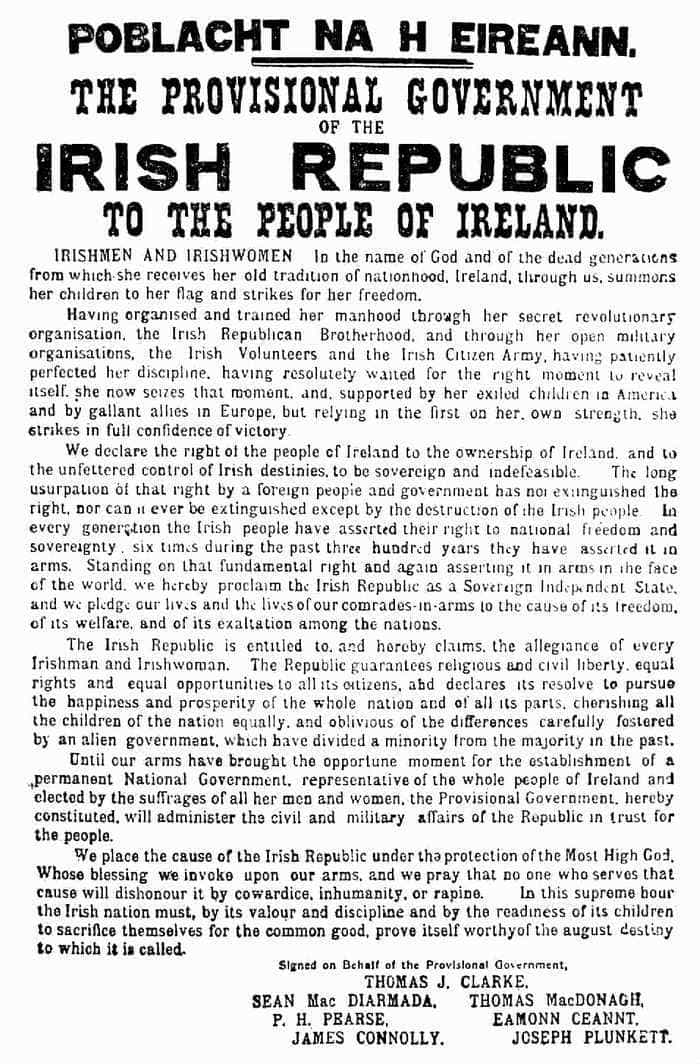
My DBQ assignment will revolve around various revolutionary movements in the 20th century. Students will examine primary documents, such as the image above, and attempt to draw conclusions about the factors that contribute to what I will consider “revolutionary moments,” or the boiling over of revolutionary sentiments in a national context. To begin, I will introduce the Proclamation of the Irish Republic. Beginning on Easter 1916, the Irish revolution proved to be the initial unraveling of the British Empire, as they waged war against the central powers in World War I. Unpopular both at home and abroad, the Irish revolution gained momentum over the course of five years, until the signing of a cease fire in 1921 between the government of the United Kingdom and the newly formed Republic of Ireland. War then broke out between Pro-Treaty and Anti-Treaty forces, once they were forced to confront the reality of a divided nation, as outlined by the treaty signed with the British government.

The Irish revolutionary period raises many interesting questions regarding revolution in the 20th century. As most revolutions pitted an independence movement against a larger, imperial force, one must ask who controls the revolution? In the case of Ireland, a revolution did not unite the country, but in fact divided it along lines that persist to this day.

I would ask students to compare the Irish revolution to Mexico’s in later units. Though I have yet to delve deeply into the history of the Mexican revolution, the parallel timelines should elicit some interesting comparisons. Fortunately, both revolutionary periods produced a surfeit of sources that capture the sentiments of the time.

Image

Courtesy of the Library of Congress.

Questions:
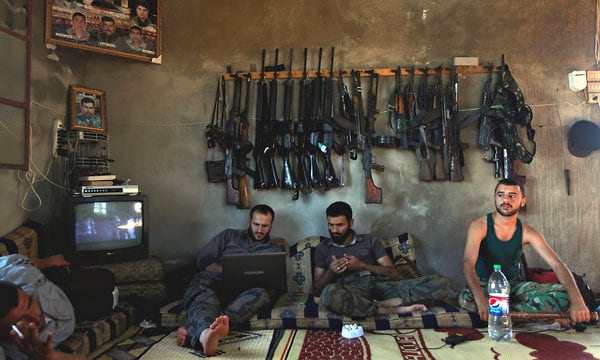
Who controls a revolution? The revolutionaries, or their opposition? When and why do revolutions begin? How does the Proclamation of Irish Republic compare to other documents of independence, namely the US Declaration of Independence? Does a revolution necessarily need an enemy? How have revolutions changed in the 21st century?
Image

Courtesy of The New York Times.