We Found a Lot of Naked People

Central Historical Question: What were the European perceptions of the natives in the New World?

Historical Skills: Corroborating

Topic: Colonization of the New World

Grade Level: 8th

Directions:

Have students read the two diary entries from Christopher Columbus and decide whether they think it is enough evidence for for historians to understand European perceptions of natives. Then, have them read the two additional documents from Amerigo Vespucci and the London Company and decide whether they corroborate Columbus and why.

Sources:

Question A: Explain why a historian might or might not believe that the excerpts from Columbus’ diary provide enough evidence to understand European perceptions of Native Americans.

Diary of Christopher Columbus. 1492

Thursday, 11 October.

Here follow the precise words of the Admiral: “As I saw that they were very friendly to us, and perceived that they could be much more easily converted to our holy faith by gentle means than by force, I presented them with some red caps, and strings of beads to wear upon the neck, and many other trifles of small value, wherewith they were much delighted, and became wonderfully attached to us. Afterwards they came swimming to the boats, bringing parrots, balls of cotton thread, javelins, and many other things which they exchanged for articles we gave them, such as glass beads, and hawk’s bells; which trade was carried on with the utmost good will. But they seemed on the whole to me, to be a very poor people. They all go completely naked, even the women, though I saw but one girl. All whom I saw were young, not above thirty years of age, well made, with fine shapes and faces; their hair short, and coarse like that of a horse’s tail, combed toward the forehead, except a small portion which they suffer to hang down behind, and never cut. Some paint themselves with black, which makes them appear like those of the Canaries, neither black nor white; others with white, others with red, and others with such colors as they can find. Some paint the face, and some the whole body; others only the eyes, and others the nose. Weapons they have none, nor are acquainted with them, for I showed them swords which they grasped by the blades, and cut themselves through ignorance. They have no iron, their javelins being without it, and nothing more than sticks, though some have fish-bones or other things at the ends. They are all of a good size and stature, and handsomely formed. I saw some with scars of wounds upon their bodies, and demanded by signs the of them; they answered me in the same way, that there came people from the other islands in the neighborhood who endeavored to make prisoners of them, and they defended themselves. I thought then, and still believe, that these were from the continent. It appears to me, that the people are ingenious, and would be good servants and I am of opinion that they would very readily become Christians, as they appear to have no religion. They very quickly learn such words as are spoken to them. If it please our Lord, I intend at my return to carry home six of them to your Highnesses, that they may learn our language. I saw no beasts in the island, nor any sort of animals except parrots.” These are the words of the Admiral.

Saturday, October 13

This is a large and level island, with trees extremely flourishing, and streams of water; there is a large lake in the middle of the island, but no mountains: the whole is completely covered with verdure and delightful to behold. The natives are an inoffensive people, and so desirous to possess any thing they saw with us, that they kept swimming off to the ships with whatever they could find, and readily bartered for any article we saw fit to give them in return, even such as broken platters and fragments of glass.

Source: Fordham University

Question B: Read the additional documents from Amerigo Vespucci and Virginia Company. Does each document support the diary excerpts from Columbus? If they cannot be used to support Columbus’ claims, explain why not.

Letter by Amerigo Vespucci, 1503

We found a lot of naked people. they have no laws, and no religion. They just live by nature. They own nothing, and share every thing. They have no country, borders or king. It seems that everyone is his own master.

They live together in huts, built without any metal. What a surprise, I have seen houses 220 feet long, and 30 feet wide that can hold 500 people. They sleep in hammocks of cotton; they sit on the ground and eat the roots of herbs, or fruits and fish.

They are cruel people, but I don’t understand why they go to war. They don’t fight for power or to take things from their enemies. When we asked them about this, they said they fought as payback for the murder of their families.

Source: Peter Pappas

Virginia Company of London, 1622

It will be easier to conquer them, than civilize them. They are a rude, barbarous, naked people, scattered in small villages. This would help us to defeat them. It would also make it tough to civilize them. We can conquer them all at once. Civilizing them is slow and will take much more effort.

We can have victory over them many ways– by force, surprise, and famine.We can burn their corn, boats, canoes, houses and fishing equipment. We can disrupt their hunting. That’s how they get most of their winter food. We can chase them with our horses and bloodhounds, and our big mastiff dogs will tear them apart.

Source: Peter Pappas

About the Assessment:

Students should be able to use the sources to figure out whether or not the sources are enough to make a judgement and whether or not they support one another and why.

Question A:

Students should note that while the source is very detailed, it is the account of only one man who was also known for bending the truth to achieve his aims. The account is, on the other hand, reliable in that it is written in the time period it describes by someone who experienced it first hand before anyone else, so his response is not marred by the bias of others before him. Regardless, what Columbus say may not be representative of all Europeans.

Question B:

Student should see that the two additional accounts support European perceptions of natives as backward and savage peoples though they are written years apart. They should also be able to cite specific similarities in the accounts, such as seemingly simple lifestyles and modest housing.

Reflection:

What I really enjoyed about creating this lesson using the SHEG model was how it genuinely encouraged students to think like historians through emphasis on sourcing, contextualizing, and corroborating. Students are given concrete ways to look at the sources and practice these skills in a way that is not intimidating, but that still allows them to use primary sources. It’s fantastic to see so many lessons that get students to engage with the material directly and make their own arguments instead of being told what to think from a textbook. I look forward to implementing some of these lesson plans and seeing how students feel about them as well.
The Only Thing We Have to Fear is Not Being Able to Correctly Identify These Speeches (and Fear Itself)

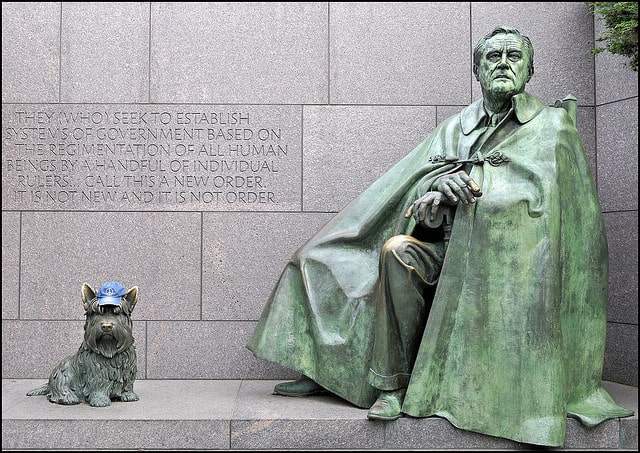
2862070585_c31d8ac957_z

Photo Credit: Tony Fischer

Target: 8th or 11th grade (caliber of questions can be tailored based upon grade)

Historic Skills: Contextualization

For Students: The following two excerpts are both from inaugural speeches given by FDR. Based upon what you know about the time during which FDR served as president, respond to the following prompts:

  1. Which speech do you think came first? Why?
  2. Out of the four inaugural addresses that FDR gave, which do you think these two are? Explain your rationale.
  3. What common themes do you see in these speeches?

For Teachers: Students should have enough knowledge about FDR’s presidency that they will be able to identify what issues he was addressing in each speech, and be able to put them into context. They will be able to pick up on the fact that he was far more verbose in the first speech given than the second, indicating that this was his first, or at least an earlier speech. By the time he gave the second, he was used to doing this, and the people were used to hearing from him, thus he felt less of a need to be so wordy. They will also notice the repeated calls to be courageous during this time.

Note: The dates attached to the speeches would not be provided, but are included for the reader’s knowledge.


 Speech #1

“I am certain that my fellow Americans expect that on my induction into the Presidency I will address them with a candor and a decision which the present situation of our Nation impels. This is preeminently the time to speak the truth, the whole truth, frankly and boldly. Nor need we shrink from honestly facing conditions in our country today. This great Nation will endure as it has endured, will revive and will prosper. So, first of all, let me assert my firm belief that the only thing we have to fear is fear itself—nameless, unreasoning, unjustified terror which paralyzes needed efforts to convert retreat into advance. In every dark hour of our national life a leadership of frankness and vigor has met with that understanding and support of the people themselves which is essential to victory. I am convinced that you will again give that support to leadership in these critical days.”

–FDR’s First Inaugural Address. March 4, 1933


Speech #2

“Mr. Chief Justice, Mr. Vice President, my friends, you will understand and, I believe, agree with my wish that the form of this inauguration be simple and its words brief.

We Americans of today, together with our allies, are passing through a period of supreme test. It is a test of our courage—of our resolve—of our wisdom—our essential democracy.

If we meet that test—successfully and honorably—we shall perform a service of historic importance which men and women and children will honor throughout all time.

As I stand here today, having taken the solemn oath of office in the presence of my fellow countrymen—in the presence of our God—I know that it is America’s purpose that we shall not fail.”

–FDR’s Fourth Inaugural Address. January 20, 1945.


Reflection: As usual, I felt that the class review process went smoothly. I have used Google Docs to work on projects with people before, so I was already fairly comfortable using the comments option. It was a fun experience being able to incorporate that into a class. While working on these lessons was fun, I still strongly believe that these SHEG inspired activities are still best suited for being used as a warm-up, or part of a review session. An entire lesson could not be taught on this. Perhaps by combining a few slightly different formats of this activity, you could teach an entire lesson on thinking like a historian and examining documents. Beyond that though, this is just a quick exercise.

Who Are We? A Mini-Lesson on Assimilation through Education

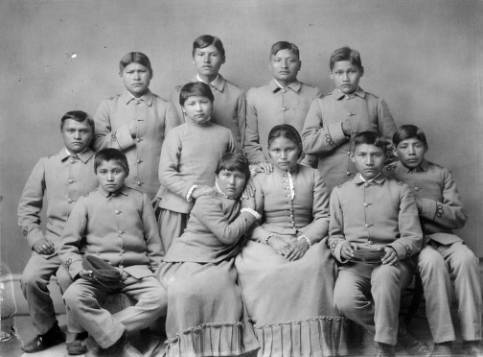
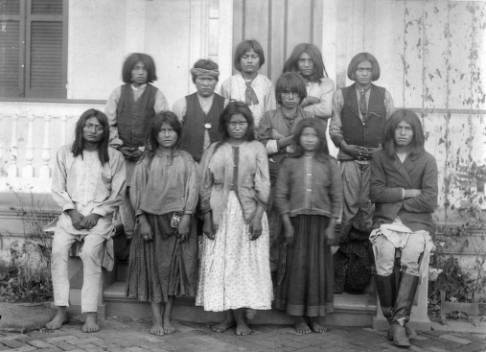
Chiricahua_Apaches_as_they_arrived_at_Carlisle_from_Fort_Marion_Florida(1) Chiricahua_Apaches_four_months_after_arriving_at_Carlisle(1)

 A lesson in corroboration for 8th grade students

by Christy Thomas

In this lesson, students compare two John Choate photographs from 1886, Chiricahua Apaches as they arrive at Carlisle from Fort Marion, Florida & Chiricahua Apaches four months after arriving at Carlisle. Using the quotations from Sitting Bull and Henry Ward Beecher, students are asked to examine two contrasting pieces of information to learn how Native Americans and the Euro-Americans disagreed on assimilation through education.

“If the Great Spirit had desired me to be a white man he would have made me so in the first place. He put in your heart certain wishes and plans; in my heart he put other and different desires. Each man is good in the sight of the Great Spirit. It is not necessary, that eagles should be crows.”

–Sitting Bull (Teton Sioux)

“The common schools are the stomachs of the country in which all people that come to us are assimilated within a generation. When a lion eats an ox, the lion does not become an ox but the ox becomes a lion.”

–Henry Ward Beecher

Background Information: From the 1879 to 1918, the Carlisle School trained Native American children in academics and trade skills. The school operated on a deserted military base in Central Pennsylvania.

Question 1: As you compare the children in these photographs, what are some of the major changes that took place?

Question 2:  Do you believe Sitting Bull and Henry Ward Beecher felt similarly about assimilation? What factors would have caused Sitting Bull and Henry Ward Beecher to view assimilation differently? How do the two messages differ?

Creating a mini-lesson based on historical thinking skills was a great exercise in thinking outside the box. I found it challenging to adjust my thinking from simple recall to more analytical questions. In this lesson, I hope to step outside of a lecture mode and let students take ownership of their learning process. I see emphasizing historical thinking skills as a great way to help students connect the past to the present lives.

I enjoyed working with my classmates to fine tune the mini-lessons. It was nice to work together to improve our final products and discuss the best way to engage students.

Sources:

Images from the Library of Congress Primary Source sets: http://1.usa.gov/1msgsaM

Quotations taken from the Carlisle Indian Industrial School history: http://bit.ly/1msheVi

Dr. Seuss on Domestic Security

A mini-lesson on WWII cartoons by
Kristi Anne McKenzie
Historical Content: World War II (home front)
Historical Skills: Contextualization, sourcing
Intended Grades: 9-12

Directions:   

Use the source information, your knowledge of history, and the video and political cartoons to answer the questions below.

Sources:

Document A is an animated short film written by Theodor Geisel (Dr. Seuss) and P.D. Eastman and produced by Warner Bros. for the War Department as part of the U.S. Army Air Force First Motion Picture Unit. Documents B, C and D are political cartoons created by Dr. Seuss for PM, a New York City daily newspaper.


Document A:  Private SNAFU in Rumors


Question 1: When was the film produced?

Question 2: Which two of the facts below might help explain why the author wrote this screenplay?


  1. After the attack on Pearl Harbor, Dr. Seuss, like many Americans, developed a concern for national security and a fear of foreign enemies.
  2. Private SNAFU cartoons were only shown on military bases; they were not allowed to be shown to the general public. As they were a product for the use of the War Department, the films did not have to comply with standard censorship regulations in regards to decency or colorful language.
  3. In order to keep the animation studios open during the war, companies like Warner Bros. had to produce military training films.
  4. The goal of the Private SNAFU films was to teach lessons on secrecy, military protocols, and disease prevention to soldiers with poor reading skills.


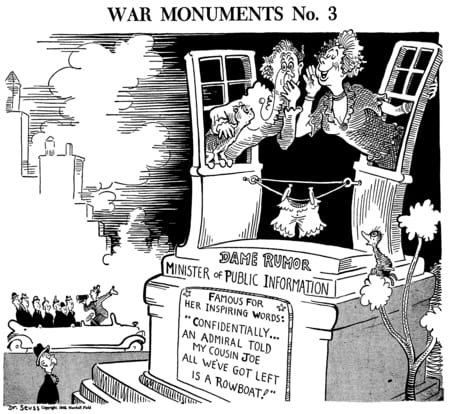
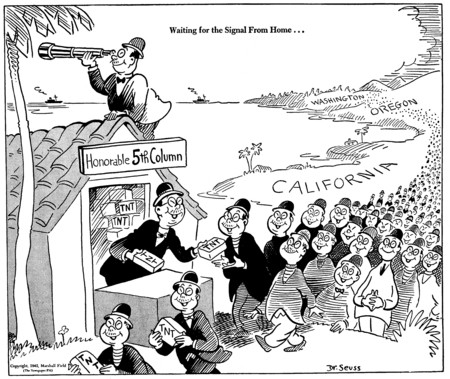
Question 3. Now compare the film “Rumors” with the three political cartoons. How is the intended audience similar and different? How is the intended message similar and different?

damsAccess-2

Document B: War Monuments No. 3, published January 8, 1942


damsAccess

Document C:  Waiting for the Signal from Home, published February 13, 1942


damsAccess-3

Document D:  Funny… Some People Never Learn to Keep Their Barn Doors Locked, published February 16, 1942


Lesson Goals: Students should be able to situate the film and the political cartoons on a timeline of World War II events, primarily around the bombing of Pearl Harbor (December 7, 1941) and President Roosevelt’s issuance of Executive Order 9066 (February 19, 1942). Students should recognize the difference between making an animated film for enlisted men in the military and drawing political cartoons for the general public. They should also note that the message of the cartoons and the film are quite similar, but the difference in the intended audience has an effect on the context.


Possible extension activity: Compare and contrast Carlos Mencia’s 2002 stand-up routine for Comedy Central Presents with Dr. Seuss’ cartoon “Waiting for the Signal From Home.” What themes emerge?


Reflection:  This was a fun project. It seemed to me that it should have been a more difficult task to assemble a lesson on primary sources using a medium that was new to me (Google Presentation), but the Stanford History Education Group’s assessment model was so clear that this lesson came to together almost effortlessly. In fact, it came together so well I thought I must have done it incorrectly, or left something out. My thanks to Sam for thoroughly examining my first draft and offering his insight and support. This is the kind of lesson that makes me feel like I am doing what I am meant to be doing, and moving in the right direction.


Sources:

Document A, Private SNAFU in “Rumors,” is now in the public domain. http://www.youtube.com/watch?v=ZGP7GebzO_E

Document B: War Monuments No. 3, published by PM Magazine on January 8, 1942, Dr. Seuss Collection, MSS 230. Special Collections & Archives, UC San Diego Library. http://libraries.ucsd.edu/speccoll/dswenttowar/#ark:bb76459366

Document C: Waiting for the signal from home…, published by PM Magazine on February 13, 1942, Dr. Seuss Collection, MSS 230. Special Collections & Archives, UC San Diego Library. http://libraries.ucsd.edu/speccoll/dswenttowar/#ark:bb5222708w

Document D: Funny… Some people never learn to keep their barn doors locked., published by PM Magazine on February 16, 1942, Dr. Seuss Collection, MSS 230. Special Collections & Archives, UC San Diego Library. http://libraries.ucsd.edu/speccoll/dswenttowar/#ark:bb5700525j