DBL Reflection: Cleopatra’s Needles

Egyptian_obelisk,_Central_Park,_from_Robert_N._Dennis_collection_of_stereoscopic_viewsThe process of designing a document based lesson was quite lengthy and involved. It required finding not only relevant documents and primary sources but ones that were both rich enough yet easily accessible for students to engage with on a deep level. In my case I found this objective fairly challenging as I was looking to create a lesson to fit within a unit about ancient Egypt.

Given that the subject for my lesson was from such antiquity I found it fairly difficult to find primary sources and other documents that would fit the aforementioned stipulations. However once I was able to identify my documents the actual designing of the lesson was pretty fun! Throughout this process I had to continually put myself in the shoes of my students and ask the question: what should students be doing and learning from each document? With this important question in mind I was able to critically think about how each document and primary source fit into the larger fabric of my lesson. Even though this type of lesson carries a fairly heavy workload in terms of planning I think that this would be a fantastic method to use in my instruction. Certainly not every lesson can be document based but I think that such lessons could be very powerful in terms of both increasing student content mastery as well as providing an opportunity for students to act as historians (which should always be our goal as teachers of social studies)!

Image credit:  Robert N. Dennis collection of stereoscopic views. / United States. / States / New York / New York City / Stereoscopic views of structures in Central Park, New York City. (Approx. 72,000 stereoscopic views : 10 x 18 cm. or smaller.) Link
Reflection on the Creation of a iBook

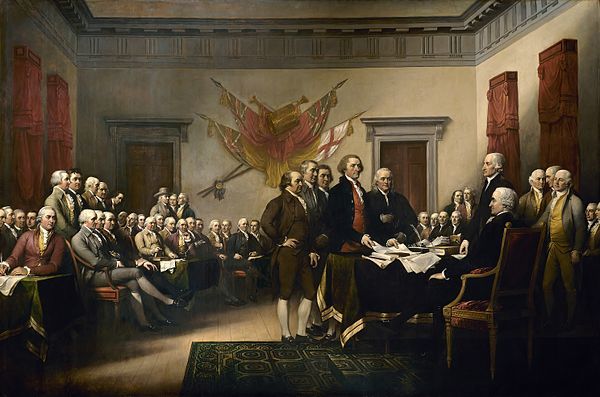
Painting by John Trumbull

The creation of a DBL (Document Based Lesson) has been an interesting one.  Originally, I looked at the task as if I was creating a DBQ (Document Based Question) such as one that would be found on the AP US History test.  However, I soon realized that this is only one aspect of a DBL.  For a DBL to work, the students must answer a general question through the use of very specific source material.  This hindered my generation of ideas with which to create a DBL.  I eventually did decide on a solid topic: The effects that a singular event can have on another event that occurs many decades later.

To answer this question, I am having students examine the Declaration of Independence as compared to the Declaration of Sentiments.  For this I have having the students read sections of each work as well as images depicting the events in question.  The compare and contrast elements of the assignment are meant to help he students come to a deeper understanding that little in history happens in a vacuum.  Almost everything has had some sort of influence acted upon it.

I greatly enjoyed the creating of the iBook because it allows for a degree of creativity.  The use of the iBook medium allows for a more interactive version of a lesson.  The use of scrolling texts widgets allows the writer/teacher to place large snippets of text  in a condensed area.  This allows for the reading to become less daunting than a solid block of static text and it allows the creator to add in additional material—such as images—onto the page.  This makes it so the students don’t have to use only text but can use the text in context/conjunction with the images.

Image credit:  The Declaration of Independence
By John Trumbull  Source

Flipped Lesson: Ancient Egyptian Hieroglyphics

Image of Hieroglyphics

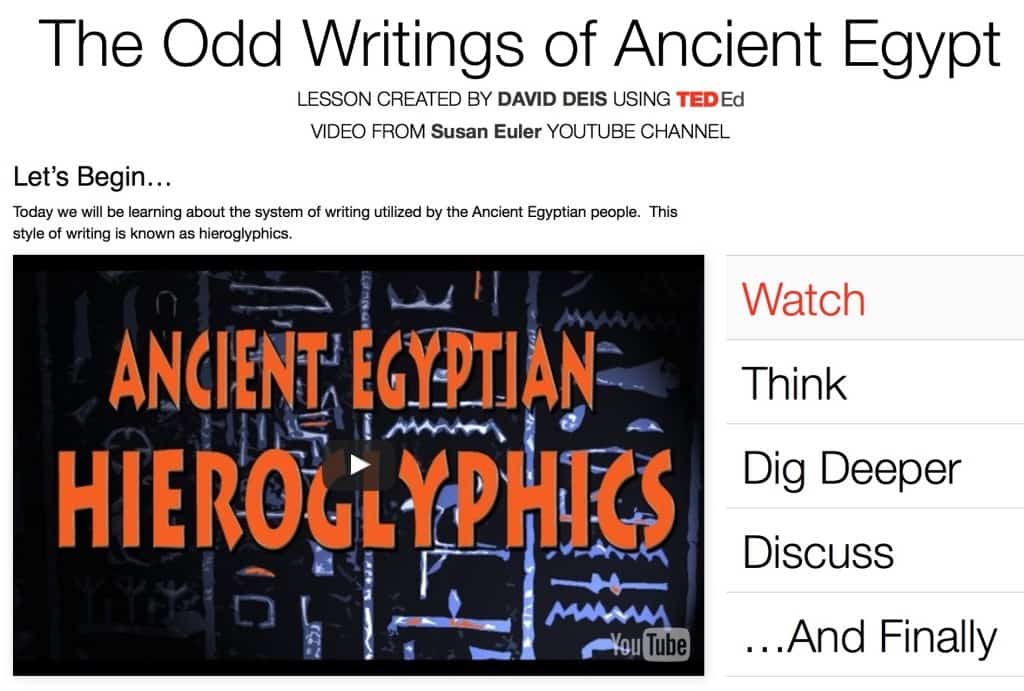
           The flipped lesson that I have created is on the ancient system of writing known as Hieroglyphics.  This lesson was created using the TedEd software.  A link to the lesson is provided below.

The Odd Writings of Ancient Egypt

TEDed-Egypt

            This is has not been the first time I have designed a flipped lesson using the TedEd format.  I had previously used the format for one of my education courses.  I have found that the TedEd format for the flipped lesson is a simple tool for teachers to create lessons for students using already established videos.  This makes it easier for the teacher to gather the appropriate content for the lesson.  TedEd also has a streamline format for the inclusion of questions and discussions that the students can use to begin to dig deeper into a topic rather than just parrot back information.

If I were to use the flipped lesson format, especially the TedEd format, I would use it in a supplementary role or as a means for students to access the material at home.  For example, if a student is absent for an extended period of time, the flipped lesson allows the students catch up with the material that they had missed during that time.  Also, if a student is not grasping lecture material, the use of the video medium can supplement their learning, buttressing what they have learned.


A Different Perspective of The Harlem Renaissance

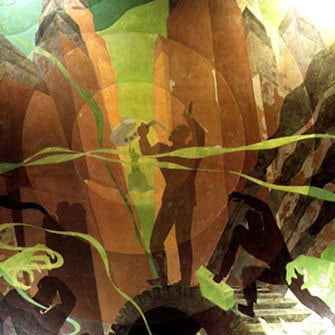
douglas-song-of-the-towers_9890debb55

For this assignment I chose to focus on the Harlem Renaissance and have my students explore the work of various African American musicians, artists, and writers, in order to identify the purpose of their work, and what it represented. This past semester I did a similar lesson to this DBL with my 11th grade history class for a 1920s unit. For that lesson I introduced similar sources to the ones in this assignment in order to guide my students to a deeper understanding of the Harlem Renaissance, and open a small discussion of race within America. The DBL I have created here will accomplish a similar goal.

For this lesson I wanted to introduce a more serious side of the Harlem Renaissance, and expose my students to these sources in order to guide them to understand a different perspective of America during this time period. Despite the Harlem Renaissance being a time and place full of spirit, opportunity, and pop-culture, it was also a time of opportunity to captivate audiences, black and white, and explore issues of race in America. For myself, the issues and concerns that are expressed in the documents provided by these artists, are still issues seen today. Following this DBL students can be asked to make connections to more modern day issues, compare and contrast, and reflect on American society today. As an educator I want to create a place where such discussions can be held with respect, because I do believe discussing situations and concerns such as this should be held in a classroom in order to help our students be more open minded, respectful, and well rounded to the world around them.

Artwork by:

Aaron DouglasAspects of Negro Life: Song of the Towers. Oil on canvas, 1934.
The New York Public Library, Schomburg Center for Research in Black Culture, Art and Artifacts Division.

Link: http://exhibitions.nypl.org/treasures/items/show/170#