Document-Based Lessons and Historical Thinking Skills

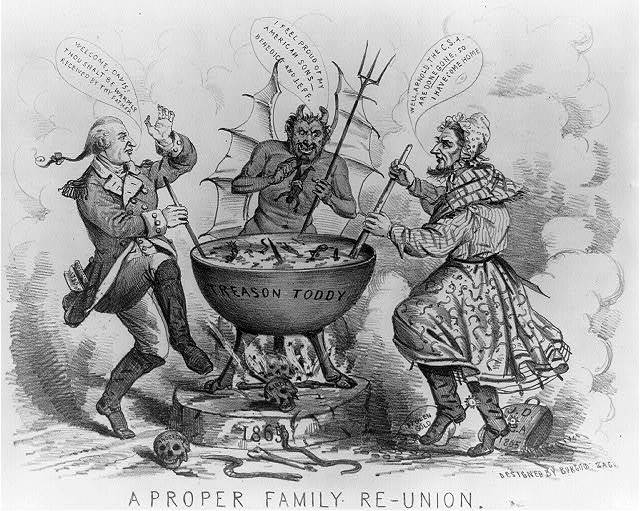
A Proper Family ReunionThe topic of my document-based lesson project was the period of Reconstruction as viewed through political cartoons published in the time period from 1865-1877.  In the lesson, students are asked scaffolding questions which help them engage with the historical thinking skills of contextualization and sourcing. Using the images I chose, students will be able to develop an understanding of how Americans in different parts of the country may have felt about policies enacted during Reconstruction, and about the period as a whole. I intentionally chose certain cartoons that depicted vivid images and which reflected various opinions of Reconstruction.

In the initial stages of developing this lesson, I had the idea that I might want to focus primarily on political cartoons for this lesson. There are so many available from this time period, and so many with such vivid imagery that allow students to engage in analysis with very little background knowledge. As I began to collect documents for this lesson, I was a bit worried that I did not have enough content, and that I might need to include other types of documents. However, because Reconstruction is such a large topic, and because there are so many different lenses through which it can be understood, I found that it was easier to stick with the medium of political cartoons, and engage with them more deeply. In this way, students get the opportunity to engage with the controversy of how to rebuild after a terrible and destructive war that changed multiple aspects of society.

In secondary history classes, topics such as Reconstruction are rarely discussed; if they are, very little time is spent uncovering the controversy and complexity of the time period. However, Reconstruction is a period in America’s history that began the current stream of history. By understanding the period following the Civil War, students can begin to see how America’s history has shaped its present. For instance, certain racial policies enacted during Reconstruction played a major role in Americans’ later perceptions of race and racial constructs. It isn’t an easy time period to untangle, certainly another reason why it rarely is at the secondary level. However, giving students primary sources to discuss and explore give them an effective entry point into the time period and the topics surrounding some difficult issues of Reconstruction.

At the end of this particular lesson, numerous different activities could be assigned. In the creation of this lesson, I wanted to leave the final product/assignment open because there are so many creative ways to assess understanding of the cartoons and the ideas and values they present. When I discussed possible options for closing assignments for this lesson, various suggestions were given. My favorite assignment idea was to have students create their own political cartoon using similar themes and imagery from the cartoons that they explored in the lesson. This could be done either about Reconstruction issues or even current events. This would allow students to make connections across topics and time periods.


Image Credit: Library of Congress

Title: A proper family re-union

Creator: Oscar Henry Harpel

Date Created/Published: 1865.

Summary: A biting cartoon showing Confederate president Jefferson Davis in league with both the devil and Revolutionary War traitor Benedict Arnold. Arnold and Davis stir a cauldron of “Treason Toddy,” a brew into which the devil drops miniature black slaves. The devil holds a pitchfork and gloats, “I feel proud of my American sons–Benedict and Jeff.” Davis, dressed in a bonnet, shawl, and dress (see “The Chas-ed “Old Lady” of the C.S.A.,” no. 1865-11), explains to his fellow traitor, “Well, Arnold, the C.S.A. [Confederate States of America] are “done gone” so I have come home.” Arnold greets him, “Welcome, Davis! Thou shalt be warmly received by thy father.” At the cauldron base, marked “1865,” lie two skulls, marked “Libby” and “Andersonville,”–no doubt intended to represent Union victims of the two notorious Confederate prisons Libby and Andersonville. Copperheads writhe on the ground. Near Davis’s feet are a bag of “Stolen Gold” and a valise marked with his initials and “C.S.A. 1865.”
Class 15: Publish or Perish

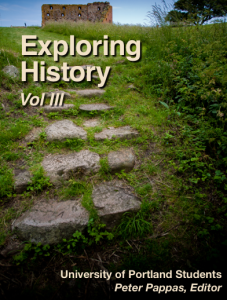
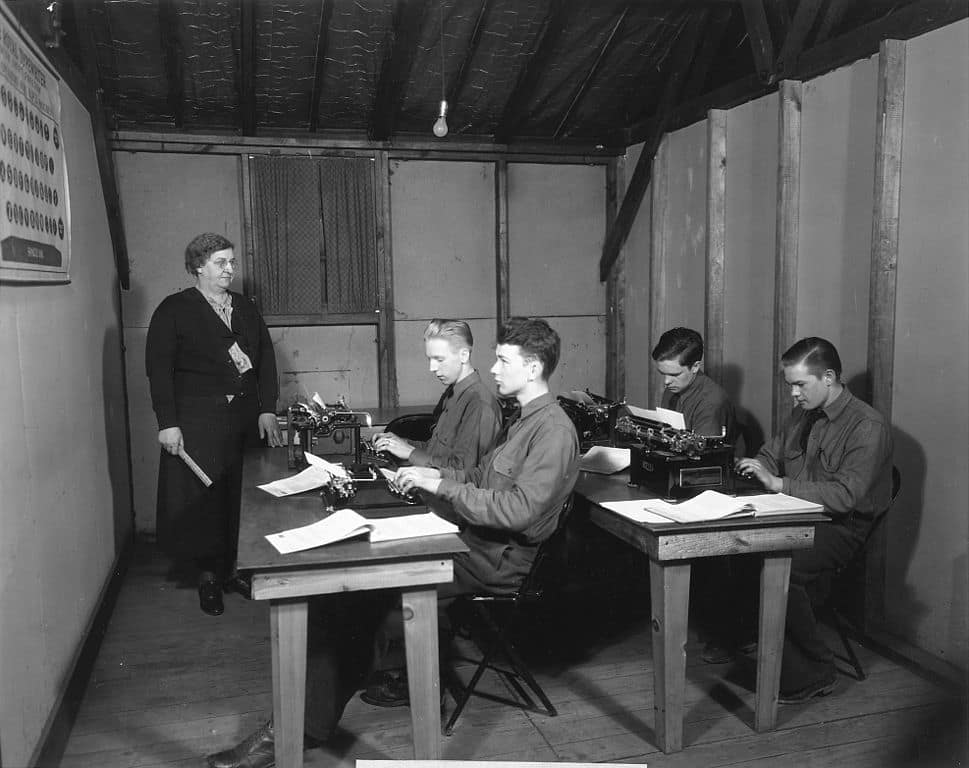
Civilian_Conservation_Corps,_Third_Corps_Area,_typing_class_with_W.P.A._instructor_-_NARA_-_197144We’ll be using iBooks Author to finish our iBooks today (Report to Digital lab / Clark Library). Here’s a  pdf copy of our rough draft “Exploring History Vol III” A collection of student-designed document based lessons.

Note: You will be adding your last blog post (reflection) as a final portion of the lesson. That can be your look back at the of the entire document based lesson process.

We will also take some time to complete our UP Smart Evals

Here’s a  few iBooks Author reminders:

  1. We will use the Inspector/ Document to disable “Hyphenate.”
  2. Your chapters will need your names. If you have a website, Twitter or LinkedIn page, etc – you can link to it so readers can find you.
  3. Some chapters need dates (or eras).
  4. Some have used sections, some not. That is your call. Unless the sections help deliver the content, we should consider eliminating them and going to chapter with pages.
  5. You will need to have links back to documents / content. They should not just link to jpg file, but the entire source as listed in whatever archive you used.
  6. Sources can be adjacent to document or at end of the lesson as Work Cited.
  7. All  links should all be checked to see if they work. To save space consider just using the words source and making it a hyperlink.
  8. Looking for icons to spice it up? Check out The Noun Project. They are free and should be cited in your sources
  9. Some of the images you used are bit fuzzy in resolution. We can look for higher resolution versions.
  10. If you have large images, you can use a setting to make the images pop out to full size. (inspector/ widget/ interaction/ goes to full screen)
  11. Some of you still have placeholder text in widgets “Lorem ipsum dolor sit amet….” That needs to be removed. iTunes will not accept the iBook.
  12. If you want to embed a video, we will use the Bookry site. Here’s a video how to
  13. I’ve created a YouTube channel with some short tutorials – iBooks Author Tips

Image Credit: Civilian Conservation Corps, Third Corps Area, typing class with W.P.A. instructor ca. 1933
National Archives and Records Administration Identifier: 197144


Class 14: Project Based Learning

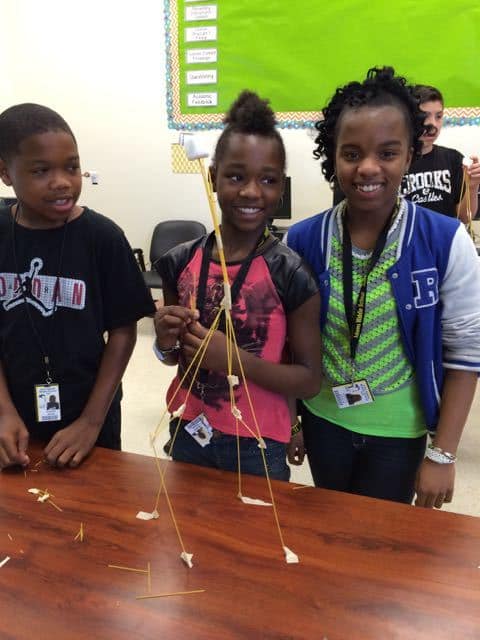
Marshmallow ChallengeProject (or problem) Based Learning is a teaching method in which students gain knowledge and skills by working for an extended period of time to investigate and respond to a complex question, problem, or challenge.  While this course has an ongoing PBL feel to it, today we approach the methodology head on with an activity and discussion.

Students will take part in the Marshmallow Challenge and use the experience to explore the challenges and opportunities of the project based approach to instruction. Plus we’ll see if my UP students can top these middle school “engineers” I worked with in Dallas TX (above).

Students in a traditional classroom spend the majority of their lessons learning basic knowledge from the teacher. Then maybe if there’s time, they may get a chance to apply the basics in an “activity.” (Note: that’s in quotes since the “activity” is so tightly aligned to lesson that it’s about as challenging as putting a round peg in a round whole.) PBL reverses that model. With a project as the goal, students go into action trying to uncover the foundational knowledge that will enable them to succeed. The project isn’t an add-on at the end of a lesson. It is the lesson.

Essential Elements of PBL include
  1. Significant Content – At its core, the project is focused on teaching students important knowledge and skills, derived from standards and key concepts at the heart of academic subjects.
  2. 21st century competencies – Students build competencies valuable for today’s world, such as problem solving, critical thinking, collaboration, communication, and creativity/innovation, which are explicitly taught and assessed.
  3. In-Depth Inquiry – Students are engaged in an extended, rigorous process of asking questions, using resources, and developing answers.
  4. Driving Question – Project work is focused by an open-ended question that students understand and find intriguing, which captures their task or frames their exploration.
  5. Need to Know – Students see the need to gain knowledge, understand concepts, and apply skills in order to answer the Driving Question and create project products, beginning with an Entry Event that generates interest and curiosity.
  6. Voice and Choice – Students are allowed to make some choices about the products to be created, how they work, and how they use their time, guided by the teacher and depending on age level and PBL experience.
  7. Critique and Revision – The project includes processes for students to give and receive feedback on the quality of their work, leading them to make revisions or conduct further inquiry.
  8. Public Audience – Students present their work to other people, beyond their classmates and teacher.

For more on the subject see my PBL-tagged posts.

A great source of PBL resources is the Buck Institute for Education –  register to access their resources.

We will also spend some class time proofing our document-based lesson chapters which have been assembled into a draft iBook. We’ll have them all loaded into the iPad cart.

Assignment: Write a reflection on the document-based lesson project.  It should be turned into your final blog post by 12/6. (Add an image from your lesson). Note: It will also be included in the final version of your iBook chapter.

Class 13: Don’t Hand It In, Publish It

William Caxton showing specimens of his printing to King Edward IV and his Queen. 1877

Digital technologies have put us in charge of the information we access, store, analyze and share.  Creating an iBook harnesses those motivational factors into an engaging learning experience. The ease of distribution across the world (via iTunes) means students can communicate with a broader, and more authentic audience than just their teacher and class peers.

This is the third iBook published by our EdMethods students. Available free at iTunes:

Exploring History Vol I: Fall 2013
Exploring History Vol I: Fall 2014

Note: EdMethods students regularly post to our course blog. See posts here.

This week we will wrap up our first drafts of our DBLs for inclusion into our collaborative iBook. The iBooks will be designed using iBooks Author in the library digital lab. Students will bring digital versions of their DBLs to the lab – including all image and sound files, text files, citations and URLs.

Workflow? See this guide Getting Ready for iBooks Author 57KB pdf

For more see my resource site: Get Started with IBA

I’ve created a YouTube channel with some short tutorials that students may wish to refer to. See iBooks Author Tips


Exploring History IIIAssignment:

Write a reflection on the document-based lesson project.  It should be turned into your final blog post by 12/6. (Add an image from your lesson). Note: It will also be included in the final version of your iBook chapter.

Here’s our first draft Exploring History Vol III 23MB pdf

Image Credit:  Wikipedia The Graphic, June 30, 1877, p617. 

William Caxton showing specimens of his printing to King Edward IV and his Queen. Published in The Graphic in 1877 refering to The Caxton Celebration. The Caxton Celebration, commemorating the 400th anniversary of the first printed book in England, took place in London in the summer of 1877.