What “Flipped” the US Economy on its Head?

“Breadline” by Margaret Bourke-White, 1937

The world continues to be an ever-evolving place, and, as with all things, educational strategies must adapt in parallel.  Today, the most significant change is occurring in the field of technology, and incorporating its use into the classroom is essential to aligning with the evolving needs of students.  Perhaps the most obvious use of this new resource is for delivery of content, and teachers across the world are finding it beneficial to “flip” their classroom, having students watch videos the night before class.  This frees up in-class time for interactive activities and project-based learning.
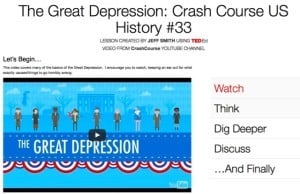
TEDed Lesson DepressionHere’s a link is to a Ted-Ed lesson on the causes of the Great Depression.  Students watch the video, answer a few questions, and are presented with additional materials to explore and space to converse with each other.  The video raises several points of debate and is largely inconclusive as to specific causes, setting the stage for the activity the following day.  In-class, students will be presented with many strips of paper, each with a different factor contributing to the Great Depression.  In groups, they will sort the strips by level of impact, discussing their rationale as they go.  Once completed, results will be collected and analyzed to produce a class-wide list generated from average list position for each cause.  A whole group discussion and debate on the list will conclude the session.

In my professional career, I fully plan to utilize the flipped lesson model quite often.  I am a proponent of project-based learning, and freeing up time for in-class collaboration is at the heart of this approach.  In my own career as a student, I found interactive tasks that generated a product offered opportunities to feel genuinely proud of my schoolwork, something strikingly absent from the traditional endless chain of worksheets.  Flipping content delivery to the night before allows for this type of meaningful exploration of the material.  Kids can learn by doing rather than just listening.

The traditional top-down-lecture model of education has been made essentially irrelevant by technology.  It is simply not practical to ask students to sit and listen to a speech when they can find the same material online with a quick internet search.  Online materials can be paused, re-watched, and used as reference, creating a useful tool where once only a fleeting lecture was available.  The new task of teachers is to teach students how to use these new tools effectively, and how to assess the sources of information they find.  These are distinct skills that must be taught directly and absorbed through repetition.  It’s a good thing there’ll be so much time in class to work on them.

Image credit: link

Class 12: Mock Trials

Mug shot of Hazel McGuinness, Sydney Australia, 1929

I’m a big fan of using mock trials – they embody critical thinking in the classroom. Over the years I wrote a number of cases which proved to be effective tools for improving student analytic skills and Common Core skills. Here’s a few posts from my blog on using them in the classroom and a link to two mock trials and an appeals case that I developed.

CLP-logo_300x300This week we will be visited by Ms. Barbara Rost, program director, Classroom Law Project. She’ll provide resources for law related education. (Be sure to follow that link – loads of lesson plans!)

As a demonstration activity, she will guide us through a mock trial –Vickers v Hearst (443kb PDF) Rules of evidence here.

Barbara graduated with a Bachelor of Science from Portland State University after using the 11-year plan to earn her degree, something she does not advocate for others. Three years later she earned her J.D. from Lewis & Clark Law School. She enjoys combining her interests in law and education in her work at Classroom Law Project. She is married, has two daughters in college and a really cute dog.

Classroom Law Project is a non-profit organization dedicated to bringing civics, government and law to Oregon classrooms K-12. Teachers and students know CLP through programs such as mock trial, con team, Law Day conference (for students), Civics Conference for Teachers, court tours, weekly current events, professional development and more. CLP makes civic education fun. Its mission statement: Classroom Law Project is a non-profit organization of individuals, educators, lawyers, and civic leaders building strong communities by teaching students to become active citizens.


Assignment: Continue research / design for DBL (iBooks Author lab work on 11/23)

Workflow? See this guide Getting Ready for iBooks Author 57KB pdf


Image credit: Mug shot of Hazel McGuinness, Central Police Station, Sydney, 26 July 1929 NSW Police Forensic Photography Archive, Justice and Police Museum, Sydney Living Museums

Digitizing History

Prompt: Write a blog post in response to our class on digital history.

The idea of using digital tools such as Twitter, NY Times Chronicle, or GapMinder have just as many pros as they do cons. From experiencing using tools such as Twitter in the classroom I believe it can be a great leverage for teachers who are engaging with a very technology literate generation. During a recent ED class, my peers and I used Twitter as a device to hold discussions not only with each other, but with other Social Studies teachers across the nation. Due to the limited character count I was forced to paraphrase my thoughts,  which I think is a fun and novel way to get students to really grapple with understanding their own ideas, and how they can convey it in a concise explanation. After experiencing a lesson such as this myself, i witnessed just how focused students could be if guided to use this tool correctly. The cons of using Twitter in a high school or even middle school, in comparison to a college class, is the fact it is a social media, and can easily distract students.

Other tools such as NY Times Chronicle or NGram though are fascinating. Although there is still that fear that students will get distracted and use these tools for whimisical pleasure, it allows students to have a visual and chronological  understanding of a word of phrase, and give rise to new curiosity as why it is displayed on the graphs as so. How I would use these digital tools in my own class I  for a lesson I am still not sure of, but I’m sure something will come to mind later in the future.

Digital History

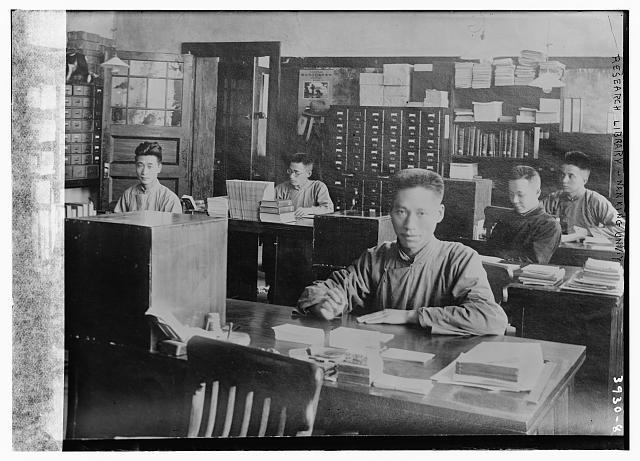
Nanking Uni

Prompt: Write a blog post in response to our class on digital history.

Our Digital History class was definitely a fun experiment. Taking a site like Twitter, which is often one of the social networking sites that get blocked in school, and making it an actual tool to be used for learning was impressive. Thinking about how that would translate into a Middle/High School class is a bit challenging for me though because it was hard to keep a room full of graduate students focused on the single task at hand without getting distracted by Miley Cyrus or The Walking Dead or whatever other nonsense Twitter has the tendency to throw at users. One thing that might have reigned it in a bit is if the class as a whole had a larger, classroom conversation on the #engsschat questions and then, as a class, contributed some of the highlights of what we discussed.

The second highlight of the Digital History class for me was being able to get my hands on really cool data machines… my favorite was the NYT Chronicle website (check out my search here).  Giving us resources to explore our own curiosities led to some serious engagement… obviously there’d be some issues with students looking up problematic/inappropriate information but I think that could be cleared up with clear and concrete guidelines set ahead of time. Ultimately, resources like NYT Chronicle and GapMinder was incredibly engaging and letting kids explore and play discover/historian in a Social Studies class could be a breath of fresh air for students.

In regards to how “historians” can leverage these digital tools for research/instruction/professional growth, I’ll focus primarily on instruction. Going all the way back to our first day of class, when we were asked to work in groups to create an image of what was needed to be a good Social Studies teacher, I think these digital tools could be a really cool opportunity to see what students can create/find/produce. I could see a teacher showing students how to use GapMinder and then telling them, “In a group of three, use GapMinder to find different social/economic/health data that has a strong positive or negative correlation. After your group feels that your data is strongly connected, think of a way to creatively explain how they connect to each other.” Products may be all over the place but students would have to tap into multiple skill sets to complete the task: team work, research, reasoning, etc. I love the idea of using these tools in a classroom!

Image Credit:

Digital Idggbain 22350 http://hdl.loc.gov/loc.pnp/ggbain.22350

Control Numberggb2005022348