Damming the Nation

Image: Albert Bierstadt: "Hetch Hetchy Valley from Road", oil, undated c.1870. Link Here.
Image: Albert Bierstadt: “Hetch Hetchy Valley from Road”, oil, undated c.1870. Link Here.

A Historical Assessment Lesson by Erik Nelson
Adapted from SHEG’s Beyond the Bubble assessments site.

Historical Content: Hetch Hetchy Dam Controversy: 1908-1914
Historical Skills: Corroboration, Sourcing

Image Credit: John Muir. Photographer unknown. Library of Congress. Link Here.

Intended Grades: 9-12
Directions: Use the excerpt to answer the questions that follow.

Source Background: In 1906 a massive earthquake and subsequent fires devastated the city of San Francisco. Debate arose between political and business leaders who called for a dam to be built to supply water to the city and the environmental advocates. In his book The Yosemite (1912), John Muir joined the debate.

Source Text: “These temple destroyers, devotees of ravaging commercialism, seem to have a perfect contempt for Nature, and, instead of lifting their eyes to the God of the mountains, lift them to the Almighty Dollar. Dam Hetch Hetchy! As well dam for water-tanks the people’s cathedrals and churches, for no holier temple has ever been consecrated by the heart of man.”

Question 1: Explain why a historian might not believe that Muir’s view alone provides enough evidence to understand the debate surrounding the dam.

Question 2: Three documents are described below. Explain whether each document could be used to support John Muir’s view, or why the document could not be used to support his position.

Image: pg. 489 of “Review of reviews and world’s work (1890). Link Here.
  1. Testimony before the House Committee on Public Lands by former San Francisco Mayor James Phelan about the utilitarian needs of San Francisco’s citizens.
  2. A letter from Robert Underwood Johnson to the Chairman of the House Committee on the Public Lands explaining the need of the country “to uphold its best ideals and its truest welfare against shortsighted opportunism and purely commercial and local interests.”
  3. A letter from the San Francisco Fire Department Widows and Orphans and Mutual Aid Associations, Inc, asking for the right to use the much needed water that would be supplied by the dam.

About the Assessment: This assessment asks students to source and corroborate a document. Students evaluate an excerpt of a 1912 book arguing against damming the Hetch Hetchy Valley in the Sierra. Question 1 asks students to evaluate whether the excerpt provides enough evidence to draw conclusions about the dam debate as a whole. To answer this question, students must source the document to determine whether the account can be thought of as conclusive evidence. Question 2 asks students to evaluate whether additional documents could be used to corroborate the argument.

Source Credits:

John Muir. The Yosemite. From the Sierra Club Web archive. Link Here.

Phelan Testimony and Johnson Letter: From American Social History Production, Inc. Link Here.

San Francisco Fire Department Letter: From the US National Archives Online. Link Here.

Lesson Reflection: As an aspiring architect of social studies classes that engage students in activities to promote historical thinking, it is often hard to brainstorm lessons or activities that address specific ways of thinking as a historian. I relied heavily (entirely) on the model created by Stanford History Education Group to build this lesson. It was very helpful to reverse engineer their assessment model, and I am grateful for the horizons they have opened for me in terms of assessment possibilities. I am also grateful to my Ed. Methods classmates for their help in editing this lesson. Their guidance again helped me to see that my first draft in crafting questions for high school students is never fully comprehensible. Our group worked collaboratively through Google Slides to build these lessons, which was a first big step in content generation. I also realize that reading my questions aloud, and having them read back to me in person, helped me to consider this lesson from a potential student’s point of view. Heavy revision and redirection was needed for clarity.
Thinking Like A Historian: Lesson Collection

Beginning in Class 4, we began a study of historical thinking skills based on the work of Sam Wineburg and the Stanford History Education Group (SHEG). We focussed on three key skills – Sourcing, Contextualizing and Corroborating. Students were assigned the task of designing their own historic thinking skills lesson based on that model and collecting them in a shared Google presentation. We took time in Class 5 to do some peer evaluation of the work. As a final assignment, students were asked to reflect on the process and use their lesson as the basis for a blog post. See them all here.

Dr. Seuss on Domestic Security

A mini-lesson on WWII cartoons by
Kristi Anne McKenzie
Historical Content: World War II (home front)
Historical Skills: Contextualization, sourcing
Intended Grades: 9-12

Directions:   

Use the source information, your knowledge of history, and the video and political cartoons to answer the questions below.

Sources:

Document A is an animated short film written by Theodor Geisel (Dr. Seuss) and P.D. Eastman and produced by Warner Bros. for the War Department as part of the U.S. Army Air Force First Motion Picture Unit. Documents B, C and D are political cartoons created by Dr. Seuss for PM, a New York City daily newspaper.


Document A:  Private SNAFU in Rumors


Question 1: When was the film produced?

Question 2: Which two of the facts below might help explain why the author wrote this screenplay?


  1. After the attack on Pearl Harbor, Dr. Seuss, like many Americans, developed a concern for national security and a fear of foreign enemies.
  2. Private SNAFU cartoons were only shown on military bases; they were not allowed to be shown to the general public. As they were a product for the use of the War Department, the films did not have to comply with standard censorship regulations in regards to decency or colorful language.
  3. In order to keep the animation studios open during the war, companies like Warner Bros. had to produce military training films.
  4. The goal of the Private SNAFU films was to teach lessons on secrecy, military protocols, and disease prevention to soldiers with poor reading skills.


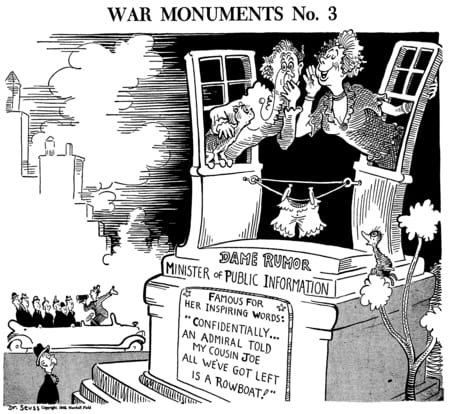
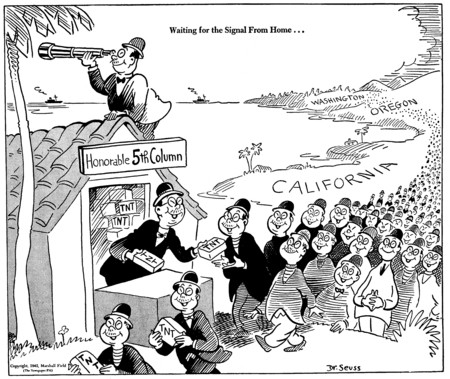
Question 3. Now compare the film “Rumors” with the three political cartoons. How is the intended audience similar and different? How is the intended message similar and different?

damsAccess-2

Document B: War Monuments No. 3, published January 8, 1942


damsAccess

Document C:  Waiting for the Signal from Home, published February 13, 1942


damsAccess-3

Document D:  Funny… Some People Never Learn to Keep Their Barn Doors Locked, published February 16, 1942


Lesson Goals: Students should be able to situate the film and the political cartoons on a timeline of World War II events, primarily around the bombing of Pearl Harbor (December 7, 1941) and President Roosevelt’s issuance of Executive Order 9066 (February 19, 1942). Students should recognize the difference between making an animated film for enlisted men in the military and drawing political cartoons for the general public. They should also note that the message of the cartoons and the film are quite similar, but the difference in the intended audience has an effect on the context.


Possible extension activity: Compare and contrast Carlos Mencia’s 2002 stand-up routine for Comedy Central Presents with Dr. Seuss’ cartoon “Waiting for the Signal From Home.” What themes emerge?


Reflection:  This was a fun project. It seemed to me that it should have been a more difficult task to assemble a lesson on primary sources using a medium that was new to me (Google Presentation), but the Stanford History Education Group’s assessment model was so clear that this lesson came to together almost effortlessly. In fact, it came together so well I thought I must have done it incorrectly, or left something out. My thanks to Sam for thoroughly examining my first draft and offering his insight and support. This is the kind of lesson that makes me feel like I am doing what I am meant to be doing, and moving in the right direction.


Sources:

Document A, Private SNAFU in “Rumors,” is now in the public domain. http://www.youtube.com/watch?v=ZGP7GebzO_E

Document B: War Monuments No. 3, published by PM Magazine on January 8, 1942, Dr. Seuss Collection, MSS 230. Special Collections & Archives, UC San Diego Library. http://libraries.ucsd.edu/speccoll/dswenttowar/#ark:bb76459366

Document C: Waiting for the signal from home…, published by PM Magazine on February 13, 1942, Dr. Seuss Collection, MSS 230. Special Collections & Archives, UC San Diego Library. http://libraries.ucsd.edu/speccoll/dswenttowar/#ark:bb5222708w

Document D: Funny… Some people never learn to keep their barn doors locked., published by PM Magazine on February 16, 1942, Dr. Seuss Collection, MSS 230. Special Collections & Archives, UC San Diego Library. http://libraries.ucsd.edu/speccoll/dswenttowar/#ark:bb5700525j

American Adobo: The Fight for the Philippines

Lesson design by Samuel Kimerling

Eighth grade students will be asked to evaluate the evidence of historical documents as a means of deepening their understanding of the Philippine War. They will use the historical thinking skills of sourcing, corroboration, and contextualization. 

roosevelt-taguinaldo-1philippines

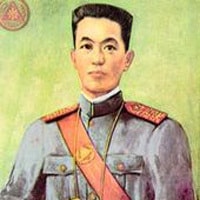
photos credit: US Dept of State Office of the Historian

Directions:

Use the document below and your knowledge of history to answer the questions that follow.

Source:

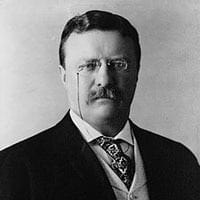
An excerpt from President Theodore Roosevelt’s introduction to a special report by Secretary of War Howard Taft regarding the accomplishments of the U.S. Army in the Philippines from 1898-1908.

roosevelt zoom

photo credit: Library of Congress

Source text (excerpt):

“It is a subject for just national gratification that such a report as this can be made. No great civilized power has ever managed with such wisdom and disinterestedness the affairs of a people committed by the accident of war to its hands. If we had followed the advice of the misguided persons who wished us to turn the islands loose and let them suffer whatever fate might befall them, they would have already passed through a period of complete and bloody chaos, and would now undoubtedly be the possession of some other power which there is every reason to believe would not have done as we have done; that is, would not have striven to teach them how to govern themselves or to have developed them, as we have developed them, primarily in their own interests.”

Question 1: Explain why a historian might question why Roosevelt’s praise for the military outcome in the Philippines may not be a “subject of just national gratification”?

Students will need to understand that there was major debate over imperialism during this time. Students will use the skills of sourcing and contextualization.

Question 2: Three documents are listed below.  Explain whether each document supports or conflicts with the President’s view on the military success of the Philippine War.

Students will see the various facets of the for and anti-imperialist sentiment. Students will use skills of sourcing and corroboration.

a. 1901 Petition to the Senate and House of Representatives from the Philanthropic Committee of the Religious Society of Friends which advocates for making peace with the Filipino insurgents and granting their independence.

Source text (excerpt): “The Filipino people, we feel, have a right to look to this Republic not only as an example of free government, but for effective aid and support in the establishment and maintenance of institutions of their own, freely chosen by them, and adapted, in their judgement, to their circumstances and conditions. This the American people long ago claimed for themselves, and have never heretofore denied to others.”

Quaker_Dove

photo credit: Society of Friends

b. Mark Twain’s essay, “To the Person Sitting in Darkness,” delivered to the New York Anti-Imperialist League in 1901.

Source text (excerpt):“True we have crushed a deceived and confiding people; we have turned against the weak and the friendless who trusted us; we have stamped out a just and intelligent and well-ordered republic; we have stabbed an ally in the back and slapped the face of a guest; we have bought a Shadow from an enemy that hadn’t it to sell; we have robbed a trusting friend of his land and his liberty…”

Philippines

Published May 5, 1902 New York Journal “Kill Everyone Over Ten-Criminals Because They Were Born Ten Years Before We Took The Philippines”

c. Republican Senator Albert Beveridge’s “March of the Flag” campaign speech of September 16,1898.

“The Opposition tells us that we ought not to govern a people without their consent. I answer, The rule of liberty that all just government derives its authority from the consent of the governed, applies only to those who are capable of self-government. We govern the Indians without their consent, we govern our territories without their consent, we govern our children without their consent. How do they know that our government would be without their consent? Would not the people of the Philippines prefer the just, humane, civilizing government of this Republic to the savage, bloody rule of pillage and extortion from which we have rescued them?”

filippino

Minneapolis Tribune 1902

photo credit: Philippines 1900

Self Reflection

self-reflection


This project challenged us to design a lesson that encouraged students to think like a historian. Designing a lesson like this proved challenging to me as I am used to simply conveying information in a lesson.  This model relies less on the transfer of information and more on the thought process. It was helpful to have the SHEG resources as a scaffold to help figure out what a good lesson looked like.  I ended up spending a lot of time searching for primary sources and trying to figure out the best way to make them fit together to make a coherent question set.  By the time I was done searching I had discovered and bookmarked some great sources for original documents.  I would definitely give this type of project a try in the classroom, as I think making the student the historian is key to getting them to understand why history is important, and why we study it in school.  Historical thinking is critical thinking which can be applied across disciplines and prove useful in life outside the classroom.  Moving the classroom experience away from the transfer of information, and towards the acquisition of thinking skills, not only engages the student more, but prepares them better for the future.