Shoutout from Sam Wineburg

We are very pleased that our Ed Methods class is getting recognition on the Twitters from one of our inspirations – Sam Wineburg of the Stanford History Education Group

Click to see how we used SHEGs historical thinking skills approach in Class #4 
This lesson became the foundation for our class-published iBook  –
“Exploring History Vol II.”  Available free at iTunes.

Implications of the First Amendment: “To Bigotry No Sanction, To Persecution No Assistance”

Overview

This pre-assessment will ask 10th grade United States history and government students to corroborate details across three documents: the Virginia Statute for Religious Freedom (1786), George Washington’s Letter to the Hebrew Congregation of Newport, Rhode Island (1790), and the First Amendment to the United States Constitution (1791). The documents will be called Documents a, b, and c, and no background information will be provided. Question 1 will ask students to determine points of agreement in the messages of the three documents. Question 2 will ask students to evaluate what rationale the authors give for their positions. Question 3 will ask students to source the documents.  They will chronologically order the documents and match them to their authors.

Having learned about the historical figures who authored the documents, as well as having some context on the evolution of the bill of rights, students should be able to correctly identify the author, voice, message, and significance of the documents.

Documents

a.  Virginia Statute for Religious Freedom (1786)

“…Be it enacted by General Assembly that no man shall be compelled to frequent or support any religious worship, place, or ministry whatsoever, nor shall be enforced, restrained, molested, or burthened in his body or goods, nor shall otherwise suffer on account of his religious opinions or belief, but that all men shall be free to profess, and by argument to maintain, their opinions in matters of Religion, and that the same shall in no wise diminish, enlarge or affect their civil capacities. And though we well know that this Assembly elected by the people for the ordinary purposes of Legislation only, have no power to restrain the acts of succeeding Assemblies constituted with powers equal to our own, and that therefore to declare this act irrevocable would be of no effect in law; yet we are free to declare, and do declare that the rights hereby asserted, are of the natural rights of mankind, and that if any act shall be hereafter passed to repeal the present or to narrow its operation, such act will be an infringement of natural right.”

b.  George Washington’s Letter to the Hebrew Congregation of Newport, Rhode Island (1790)

“…If we have wisdom to make the best use of the advantages with which we are now favored, we cannot fail, under the just administration of a good government, to become a great and happy people.

“The citizens of the United States of America have a right to applaud themselves for having given to mankind examples of an enlarged and liberal policy—a policy worthy of imitation. All possess alike liberty of conscience and immunities of citizenship.

“It is now no more that toleration is spoken of as if it were the indulgence of one class of people that another enjoyed the exercise of their inherent natural rights, for, happily, the Government of the United States, which gives to bigotry no sanction, to persecution no assistance, requires only that they who live under its protection should demean themselves as good citizens in giving it on all occasions their effectual support…”

c.  First Amendment to the United States Constitution (1791)

“Congress shall make no law respecting an establishment of religion, or prohibiting the free exercise thereof; or abridging the freedom of speech, or of the press; or the right of the people peaceably to assemble, and to petition the Government for a redress of grievances.”

The Questions

  1. On what topics do the authors of these documents agree?
  1. What reasoning provided in documents a. and b. support the conclusions of document c.?
  1. Match the documents with their author and date of composition/enactment:

Thomas Jefferson; George Washington; The Constitutional Convention

1786; 1790; 1791

Document a.  Author______________________________________ Date___________________

Document b.  Author______________________________________ Date___________________

Document c.  Author______________________________________ Date___________________

Reflection

When I use this lesson in the classroom, I will use it as a pre-assessment before I begin a unit on the Constitutional Convention.  One of the major hurdles that the Federalists had to clear in order to sell the model of a constitutional republic was to ensure the preservation of civil rights.  An examination of the evolution of church/state separation is germane to the topic.  An assessment that will ask my students to give a close reading to these primary sources should “hook” them into listening to a lecture that will use the sources as a jumping-off point for examining the Anti-Federalist concerns that prompted the writing of the Bill of Rights.

My Big Symbolic Colonial Wedding

The Wedding of Pocahontas and John Rolfe

Target Students: 8th Grade

Historical Skills: Sourcing

Guiding Source Questions:

• Who painted this?

• What is the painter’s perspective?

• When was it painted?

• Where was it painted?

• Why was it painted?

• Is it reliable? Why or why not?

Description: This mini-lesson gives students a chance to source a document. Sourcing a document is an opportunity to identify the painter’s positions on the historical event. Identify and evaluate the author’s purpose in producing the document. Hypothesize what the painter will produce before looking at the painting. Evaluate the source’s reliability by considering genre, audience, and purpose. This lesson helps students understand an important aspect of sourcing, which is, the time elapsed between when a document was produced and the events that it depicts.

Title: The Wedding of Pocahontas with John Rolfe

Artist: Anton Hohenstein, 1823

Published: Joseph Hoover, c1867, Philadelphia

Summary: Large gathering of Natives and Englishmen for an outdoor wedding ceremony between Pocahontas and John Rolfe

Source: Library of Congress

Directions: Use the image to the right to answer the question

Question: The painting, “The Wedding of Pocahontas with John Rolfe,” is a useful resource for historians who wish to understand the wedding of Pocahontas and John Rolfe. Do you agree or Disagree? Support your answer.

Reflection: After working on my mini-lesson for two weeks, I fully understand what it means for students to engage in historical thinking. It is essential for lessons to employ historical thinking skills such as sourcing, contextualizing, and corroborating. The historical thinking chart created by Stanford History Education Group (SHEG), is a great resource for teachers who are developing lessons. Within my lesson I focused on the historical thinking skill of sourcing. I was able to use the SHEG website as a resource to help build and guide my lesson. The peer review process also gave me a chance to expand my lesson. Overall, I thoroughly enjoyed the process of producing a mini-lesson using Google presentation. The lessons produced by our class will give students a chance to develop in historical thinking skills and engage with primary sources.

Arriving in the Land of Plenty

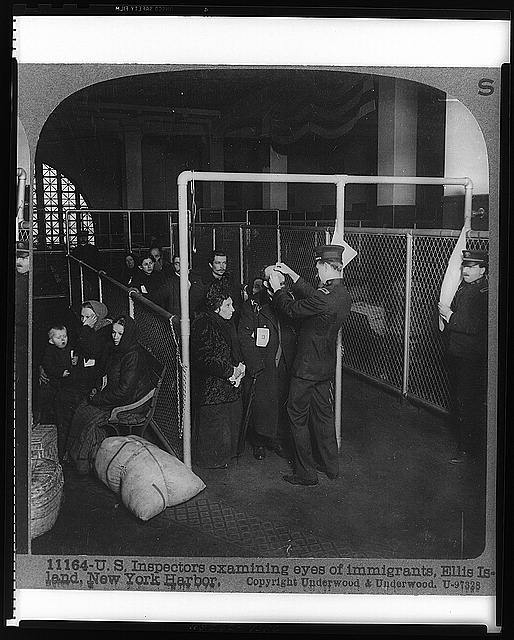
ellis island
Title: U.S. inspectors examining eyes of immigrants, Ellis Island, New York Harbor Date Created/Published: New York : Underwood & Underwood, c1913.

Accessed: Library of Congress Prints and Photographs Division Washington, D.C. 20540 USA

Target Students: 9th through 12th grade (Questions can be revised to reflect grade level and content studied)

Historic Skills: Sourcing and Corroboration

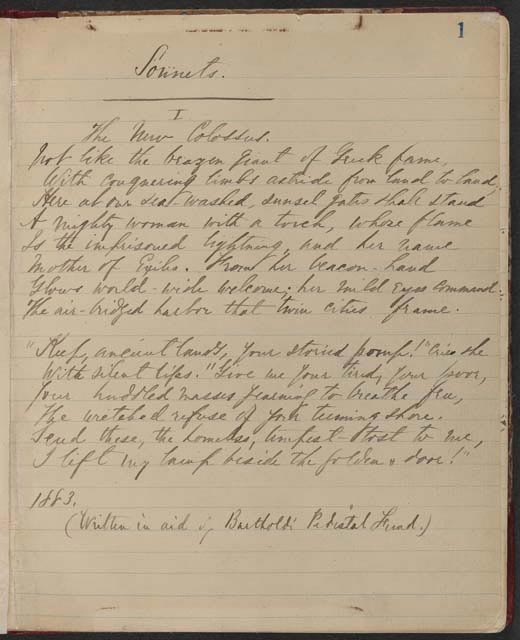
Primary Source: This is an excerpt from the Poem “The New Colossus” by Emma Lazarus, 1883. An inscription of the poem was later added to the Statue of Liberty at Liberty Island in 1903.

new colossus
Title: The New Colossus Author: Emma Lazarus, 1883.

“Give me your tired, your poor,

Your huddled masses yearning to breathe free,

The wretched refuse of your teeming shore.

Send these, the homeless, tempest-tost to me,

I lift my lamp beside the golden door!”

Accessed: Library of Congress 

Questions Pertaining to Sourcing:

Sourcing Question: The excerpt from Emma Lazarus’ poem, “The New Colossus” is indicative of the millions of immigrants that emigrated through Ellis Island and is useful in understanding the experiences of and attitudes towards immigrants . Do you agree or disagree? Use evidence from the source to support your answer.

Guiding Questions: Who wrote this? What is the author’s perspective? When was it written? Where was it written? Why was it written? Is it reliable? Why? Why not?

Immigrants
Title: Our Immigrants at Ellis Island; An exercise prepared for young people and descriptive of the reception, inspection, and experiences of our immigrants in the detention room and railway offices Author: Mrs. Francis E. Clark, 1912.

The following are a few excerpts from a book called “ Our Immigrants at Ellis Island” by Mrs. Francis E. Clark, a member of the United Society of Christian Endeavour, 1912. The book was meant to educate young Americans on the hardships and experiences associated with immigration during the late 19th and early 20th century by using real immigrant examples.

Accessed: The Library of Congress

Primary Sources: 

  1. T.D. : Temporarily Detained
  2. E: Excluded
  3. O.K. : All right

Capture

423

Questions Pertaining to Corroboration:

Question #1:Explain why a historian may or may not agree with the way in which Emma Lazarus’ poem, “The New Colossus” describes the experiences of and attitudes towards all immigrants who came through Ellis Island.

Question #2: Using the examples of immigrants from the book “Our Immigrants from Ellis Island” decide whether or not these sources can support Emma Lazarus’ take on immigration in “The New Colossus.” If the sources are not supportive, explain why not.

Description of the Lesson:

This mini-lesson allows students to source a primary document and then find supportive evidence from other primary documents to support or challenge the information being presented in the first primary source. Students are essentially being asked to compare and contrast the differences between a fictionalized account of immigration and actual accounts of immigration while remaining critical of the sources’ origins. The students will be able to interact with the primary sources and ask questions of the primary sources.

Reflection:

Creating a lesson comprised entirely of primary sources leaves the history geek inside of me very content. The SHEG model really allows students to interact with primary source material and engage with material that is often neglected in a more teacher-centered classroom. By giving students an opportunity to analyze the sources directly, they not only take responsibility for their own learning, but are able to make prior connections to what they may already know. A primary source is like a window into another time and another place. In order to understand these windows, it’s essential to learn how to think and analyze like a historian. By teaching students to practice essential historian skills like sourcing, corroboration, and context, one can ensure that the students see the whole picture. I’m very excited to be using primary source material in a way that gives students a chance to grapple with their own opinions and interpretations of history.