Class 2: The Lesson

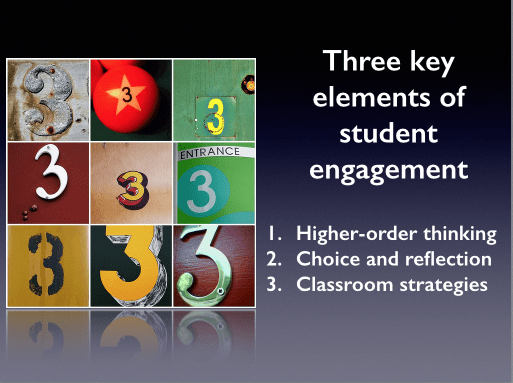
Three key elements of student engagement
This week we take our first look at instructional design. The class begins by addressing key elements of lesson design :

  1. Higher-order thinking
  2. Student choice and reflection
  3. Effective classroom strategies

This  portion of the class lesson includes three major elements:

  • Practical examples of Bloom’s taxonomy in the form of sample exercises and questions. They are used to anchor a conversation on Bloom in action.
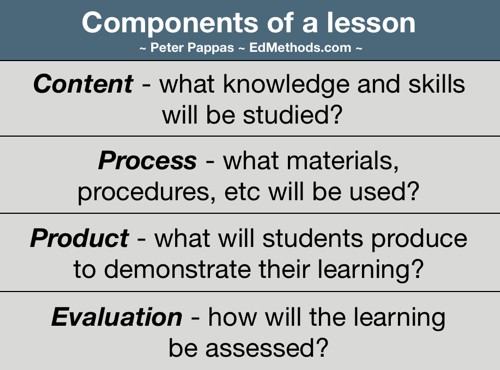
  • How student choice can impact key lesson elements – content, process, product, evaluation.
  • Demonstrate a student-centered approach to a teacher presentation as a way to foster reflection (instead of listening to a straight lecture on the subject)

The lesson is driven by a Keynote presentation Week 2-15 Handout 2.5MB pdf.

We will use an audience response system to gather student input. The lesson includes multiple activities that illustrate the content. Student will be led through discussing their reactions to the activities to connect them to the content. This lesson will serve as a kick off to their first assignment to write and share a Lesson Study.
key lesson components


Later in the class we will share the learner selfie assigned in class 1.

Written assignment for Class 3:

Lesson Study I is due next week.

The goal of this assignment is two-fold. First, to offer supportive feedback on your lesson development through a peer review process. Second, to offer some “lenses to look through” that help you easily see the essentials of a lesson. This perspective should be useful when you later craft your edTPA commentary.

This is not some exercise for the benefit of your instructor. This should be a process that works for you. So feel free to modify to meet your particulars. Use a scale that works for you – focus on just a small segment of a larger unit, or look at the entire unit. Don’t like Bloom? Use another schema to discuss the kinds of thinking that your students will need to successfully complete the assignment

Lesson Study assignment  47kb pdf
Lesson Study Sample 51kb pdf

Class 1: Teachers

Timken Roller Bearing Co., calendar, September 1950, teacher at desk

Class 1 Overview

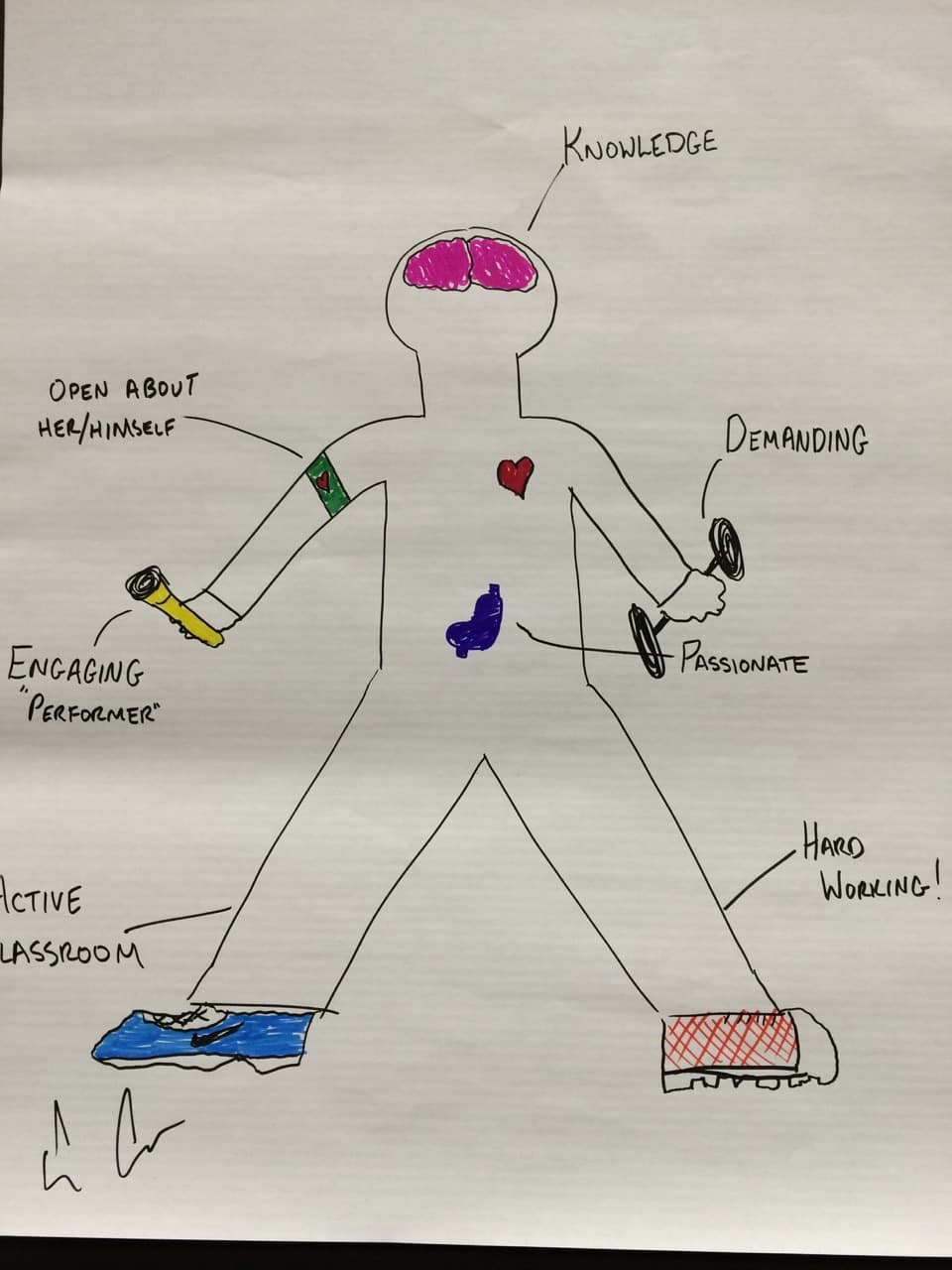
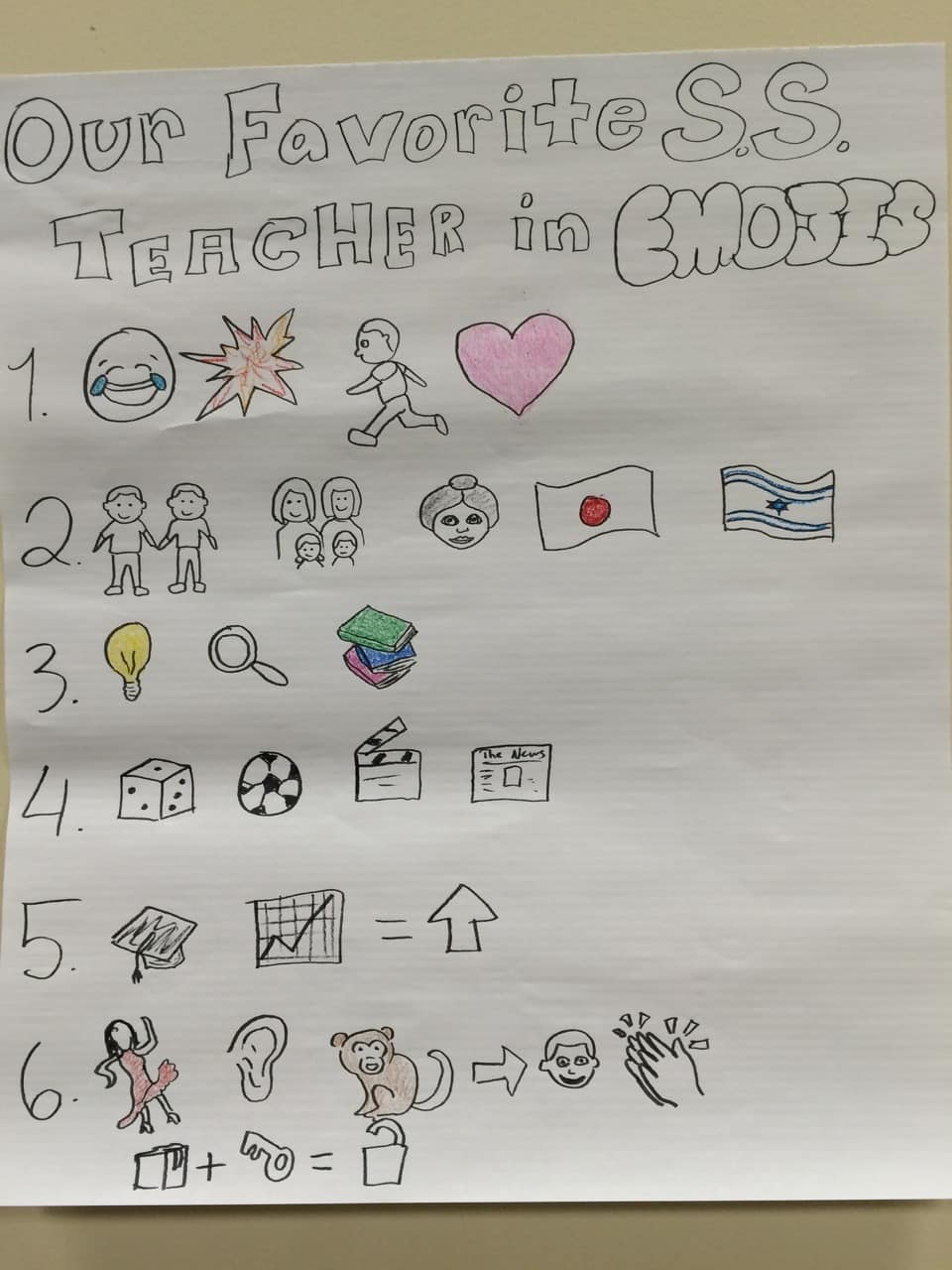
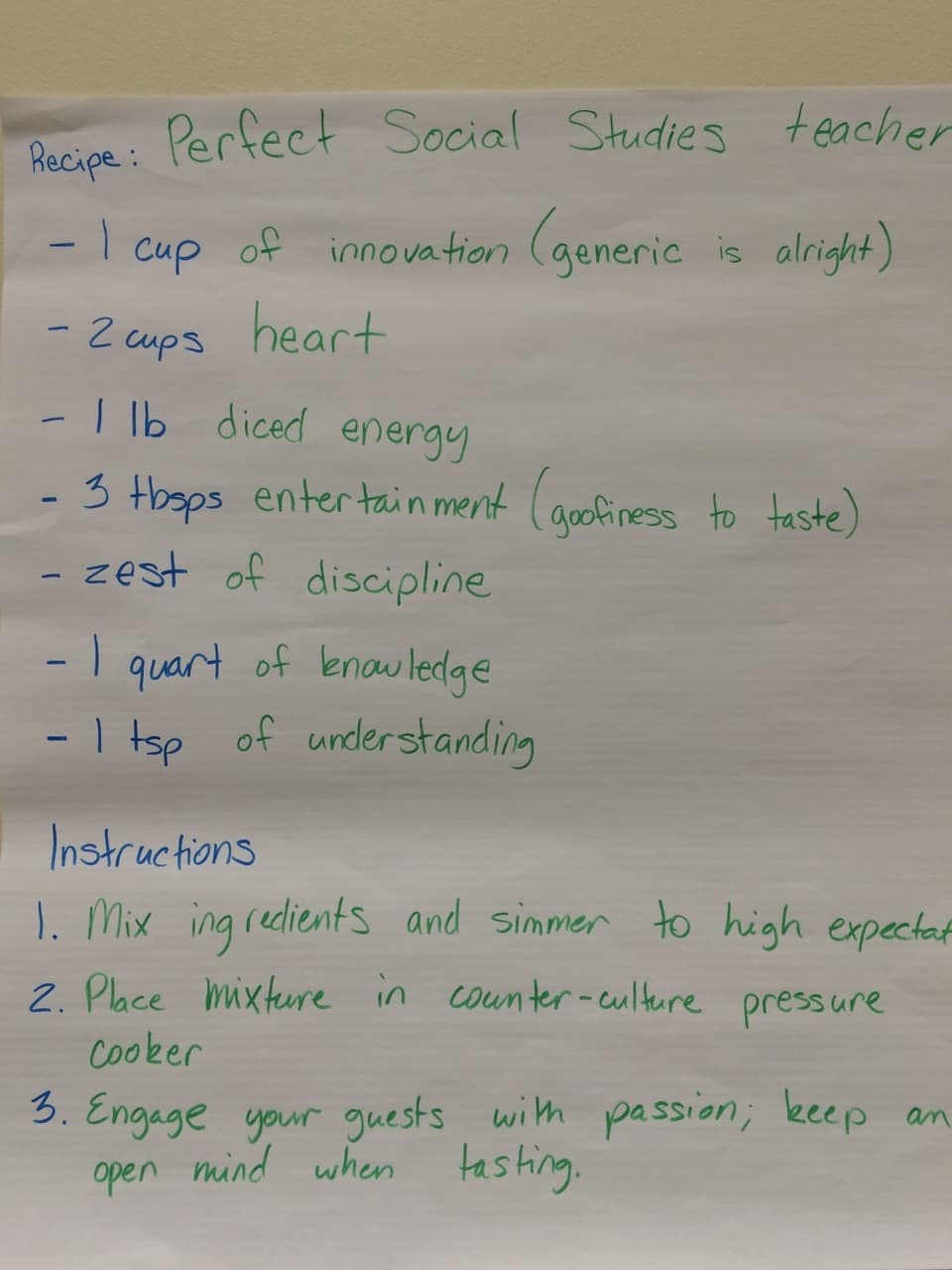
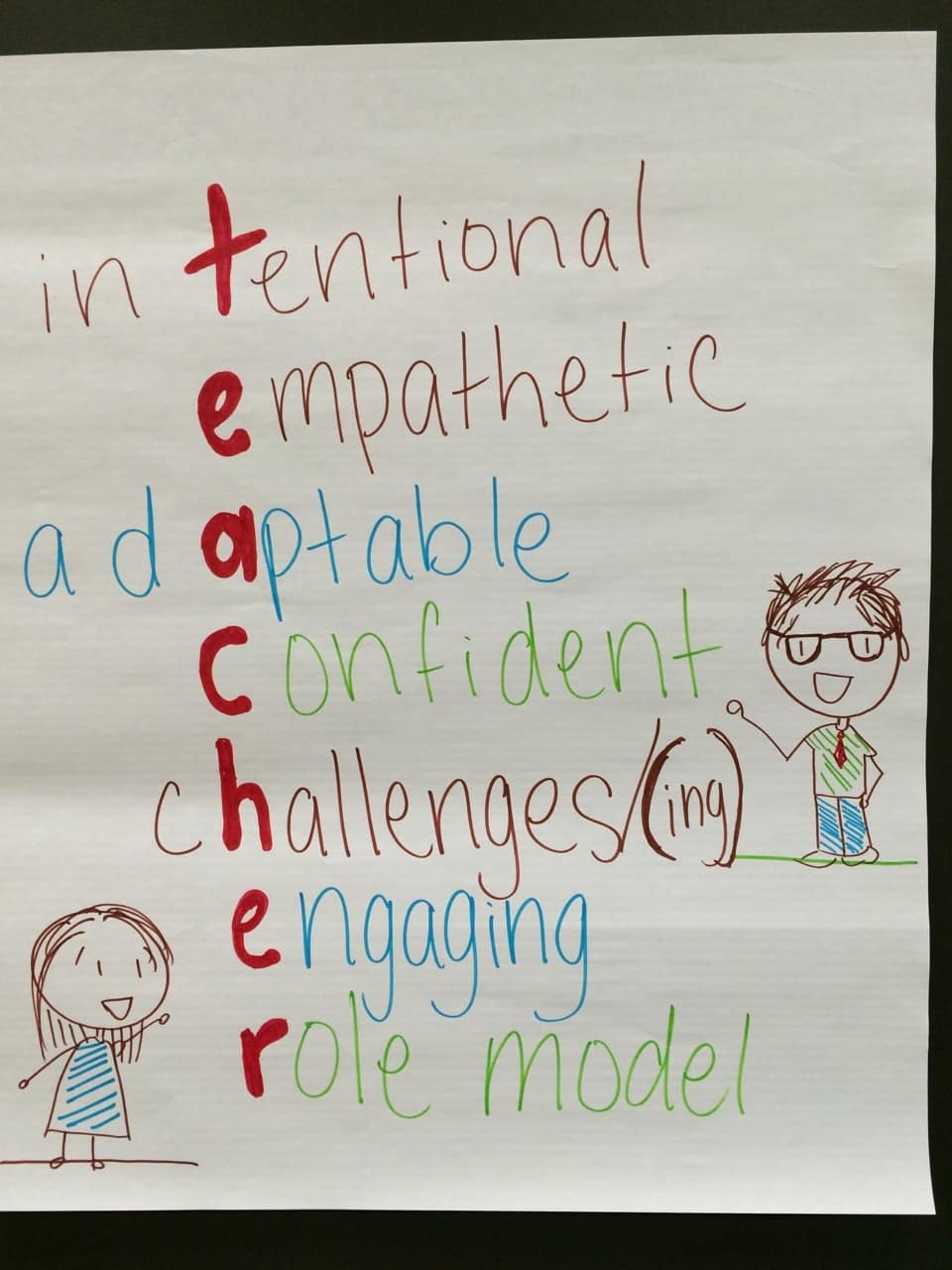
As an ice breaker, I’ll give students an activity to design a great history teacher-  a variation of “Tool 13: Brainstorm, Group, Label” from my Literacy Strategies Tool Kit (free PDF)

  • Ask them to brainstorm all the words or phrases they can associate with “a great history teacher.”
  • Give them Post-Its and asked them to write one associated word or phrase on each sheet.
  • Put them in groups and ask them to share their Post-its and thinking. Then design an illustration that captured their collective thinking. And be prepared to share that with the class.
  • Working in fours synthesize their individual brainstorming into a collective vision on large paper, then take turns sharing and responding to questions. Click to enlarge posters.

diagramEmoji

recipespell teacher

I’m giving my students a copy of my 1971 student teaching evaluation (2 page pdf) Quite a relic – Why did I save it?  We’ll examine it as an historic document with a critical eye for answering a number of questions: Who created it and why? Historic context? Point-of-view? What could we learn from it? What other sources might we need to collaborate?

We will explore what it tells us about NYS teacher preparation programs in 1971.

We will take a tech survey using LearningCatalytics

Assigned Readings for Class 2:

  1. Snapshot of a Modern Learner Mike Fisher in SmartBlog on Education
  2. How to Motivate Students: Researched-Based Strategies Peter Pappas in Copy / Paste
  3. A Taxonomy of Reflection: Critical Thinking For Students, Teachers, Principals Peter Pappas in Copy / Paste

Assignment for Class 2:

Think about “Santos” from Snapshot of a Modern Learner 

  1. What do you know about him? 
  2. How does he  best learn?
  3. How should he be taught?

Think about yourself as a learner. Use the same 3 prompts we used with Santos. Create a brief “selfie” of yourself as a learner that you can share with a classmate in our next session.

  1. It does not need to use an edtech perspective (as Santos’s snapshot did), unless that’s how you learn.
  2. It’s not actually a selfie. But, like Santos – it’s a Snapshot of a Learner – You
  3. It can take any form you choose – written narrative, cartoon, diagram, Powerpoint, Webcam video, Pinterest. (it doesn’t have to be digital). Think about “Reading 2” above. That’s why I’m letting you choose the product format.  
  4. It  should be something you can share with a classmate at our next class. Key point to consider – Will make sense to someone else without you having to explain it?

In class 2 you will share your “selfie” snapshot and we’ll take it from there. 

Based on edTPA

HSS2: How does the candidate use knowledge of his/her students to target support for students to develop understandings of facts, concepts, and interpretations or analyses to build arguments about historical events, a topic/theme, or social studies phenomenon?

HSS3: How does the candidate use knowledge of his/her students to justify instructional plans?


Image credit: George Eastman House
Timken Roller Bearing Co., calendar, September 1950, teacher at desk
Accession Number: 1976:0240:0019
Maker: Victor Keppler (1904-1987)
Date: Dec-1948

Fall 2015 Preview

Click image for a visual course intro

Just a quick post to welcome my students to another semester of Social Studies Methods.  We will continue with our practical, hands-on, project-based approach to to the art and science of teaching secondary social studies. This year we will explore ways to integrate edTPA skills and concepts into the course to assist students with that process.

Click here for a visual intro to the course

Our course goals:

  1. Learn to think like a historian (or other social scientist).
  2. Become a skillful instructional designer.
  3. Develop skills for reflection, growth and professional networking.

Shoutout from Sam Wineburg

We are very pleased that our Ed Methods class is getting recognition on the Twitters from one of our inspirations – Sam Wineburg of the Stanford History Education Group

Click to see how we used SHEGs historical thinking skills approach in Class #4 
This lesson became the foundation for our class-published iBook  –
“Exploring History Vol II.”  Available free at iTunes.