The target student group for this activity can be a 9th grade world history class or a 10 grade US history class. The witch craze that happened in the US and throughout Europe is an interesting period that can be used to get students thinking about some overarching historical topics. This period can be an example of how laws are changed/influenced by “current” events or when looking at the power religion has over law making. These quizzes can be given when students are learning how to examine primary sources for their main ideas as well as an introduction to the US witch craze.
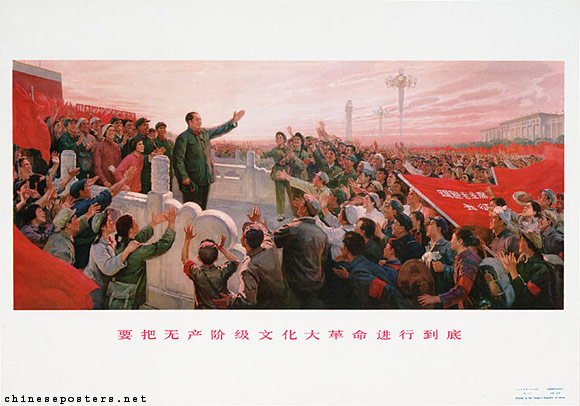
The Great Proletarian Cultural Revolution must be waged to the end Source
Context: This poster is from 1973 of Mao Zedong, greeting the Red Guard during the Cultural Revolution. It was created by artists that had come back from labor camps. The caption, “Chairman Mao’s heart beats as one with the hearts of the revolutionary masses.”
Bias Ice Breaker: Do you think this picture has a bias? Is it intentional or unintentional? What do you think was the artists intentions? Why do you think an artist would create an image glorifying Mao and the Red Guard after returning from a labor camp?
Student Response: I think this poster has a bias because maybe the artists were trying to prove that they weren’t anti-Mao, so they created art that showed Mao in a positive light.
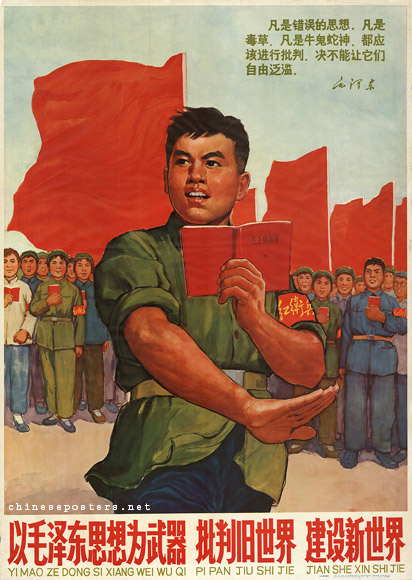
Image Two: A Good Red Guard
Criticize the old world and build a new world with Mao Zedong Thought as a weapon Source
Context: This poster is propaganda promoting Mao’s Little Red Book that contained quotes from Chairman Mao. The idea of this poster was “It is small and bound in a red plastic cover so you can always carry it with you. A good Red Guard knows the book by heart and rarely reads anything else.”
Questioning Ice Breaker: What questions do you have? What does the context contribute to this poster? What is going on in this poster? Is the person in the poster young or old? Does it matter?
Student Response: I wonder why this poster wants people to carry the book everywhere with them. It looks like it’s a young person, but he has that arm band which kind of reminds me of the Nazi’s so I think it shows that there is some group thing going on.
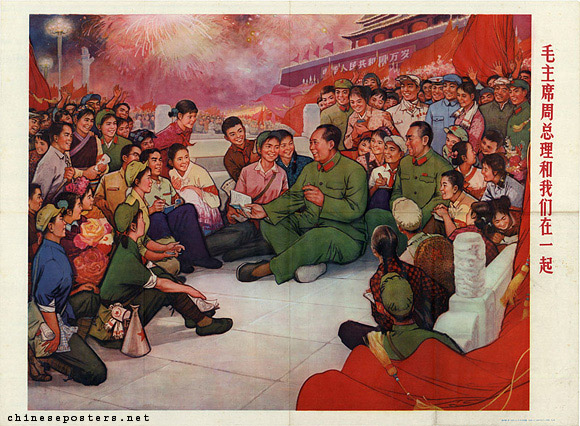
Image Three
Chairman Mao and Premier Zhou together with us Source
Context: This poster is of an imaginary scene of Mao Zedong and Zhou Enlai sitting in Tiananmen Square talking with Red Guards. It was created in 1977 which is after the end of the Cultural Revolution. The caption going down the side says that Mao and Zhou are together with us.
Anomalies Ice Breaker: What do you notice is weird/off about this poster? What surprises you?
Student Response: I noticed that this was created in 1977 which is just after the Cultural Revolution ended. I thought it was a horrible time period where a lot of people were hurt so I think it’s weird that this poster shows everyone all happy after something so bad had happened. There’s also fireworks going on in the background which makes it seem like they are celebrating something, maybe the end of the Cultural Revolution?
Lest Liberty Perish from the Face of the Earth – Buy Bonds Source Propaganda is meant to send a message to the people viewing it, typically its meant to motivate them to think a certain way or do something. What is going on in this image? What statue is that? Who is being attacked?What is the message of this picture? What is at stake? What does this poster want people to do? Do you think the picture as a whole is conveying its message successfully? How would you feel if you saw this?
Propaganda Poster 2
Let’s Take Care of the Poultry. I am a Fine War Hen. I Eat Little and Produce a Lot SourceWhat is going on in this picture? “Soignons la Basse-cour” translates to “lets take care of the poultry.” This was created by a 16 year-old girl. Why do you think she created this?This translates to “I am a fine war hen. I eat little and produce a lot” When paired with “lets take care of the poultry” what does this poster want people to do? If this was created by a 16 year old, what does this poster say about the French war effort during WWI?Give Your Money for Victory: Victory Means Peace Source What is going on in this picture? What is it implying? What does it say about the Italian war effort? “Banca Italiana di Sconto” translates to “Italian Discount Bank” who are sponsoring this poster. What does the bank want people to do?This translates to “Give Your Money for Victory: Victory Means Peace.” Based on these propaganda posters, what do you think people were most concerned about during WWI? Do you think these posters were effective ways of achieving people’s participation in the war effort? What are modern forms of propaganda and how do we spot them?