
Visions of Freedom: A Reflection

Image

The Liberty Song. Article from page 346 of The Boston Chronicle, Volume 1, Number 38, 29 August – 5 September 1768. Retrieved from http://learni.st/learnings/353016-the-liberty-song?board_id=44562

This DBQ explored slavery and the American Revolutionary War through various visions of freedom that existed during the mid- to late-1700s. The idea for this project came from the understanding that oftentimes only one voice is heard in history. That approach, however, does not take into account the full narrative of the time and provides a false reality of important historical events. As a result, the purpose of this project was to provide readers an opportunity to look at central documents in a different light, while at the same time offering a chance to explore documents that may not take a dominant role in many studies of the American Revolution. By the end of the DBQ, readers would have investigated views of freedom between the colonists and the British government, military officers and laymen, and slaves and freemen, building content depth and providing the means to explore many unfamiliar corners of this important event in American history.

Even though the main essential question revolved around what influences visions of freedom, there were many other generative questions that were incorporated into my project.

  • How does individual identity change during times of revolution?
  • How does the political atmosphere of a time change social understandings?
  • What are the motivating factors that lead one to revolt against authority?
  • How do people express their distrust and discontent towards authority?

Because these questions permit the reader to investigate multiple horizons of possibilities, this project fits perfectly into many course and state standard requirements.

In the end, I feel like this DBQ completed my goals to introduce different visions of freedom to the American Revolution story. What I really enjoyed about this process is that it forced me to think deeply about every document that I wanted to add to the project. In order for readers to successfully complete the DBQ, the documents and order needed to be coherent and accessible. This thinking exercise now can be easily translated into the classroom, which I foresee as a priceless skill when I begin to introduce students to primary documents.

This DBQ is part of our class-produced, multi-touch iBook. Available free at iTunes
Class 9: DBQ Project Showcase / Sites for Social Studies / Fishbowl Continues

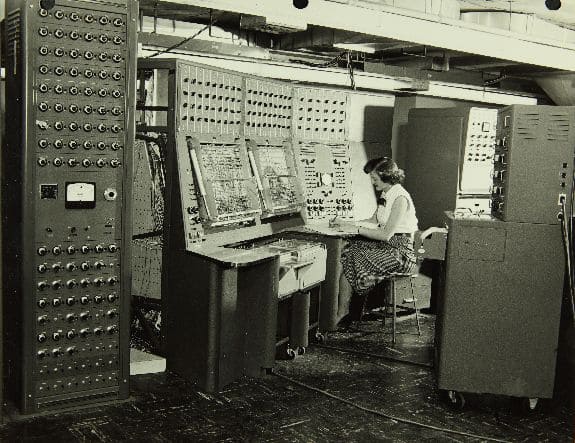
1950s analog computer

This class continued in our 3rd session of Lesson Studies Fishbowls, but added a tech focus.

The class showcased and offered feedback on our student-designed DBQs at Learnist>
More on DBQ Design assignment

  1. Red Scare DBQ by Christina Steiner & Kristi Convissor
  2. The Vietnam War by Samuel TS Kelley
  3. Visions of Freedom: The American Revolution by CRSoderberg
  4. Media and War: An Analysis of Vietnam War Propaganda by Damian Wierzbicki
  5. Cross-Cultural Contact Between Native American Residents and European Conquerors by Tom Malone
  6. Propaganda of the American Suffrage Movement c. 1910-1920 by Heather Treanor and Cory Cassanova
  7. Anne Frank: A Timeless Story by Erin Deatherage
  8. Images and Emotion – WWII Propaganda Posters by Aram Glick
  9. The Irish Revolutionary Period by Peter Gallagher
  10. The Power of Propaganda by Kyle Stephens

Peter shared a few of his favorite websites for students applying analytic thinking to history and social studies. They included:

Sources for historic content:

Image Credit:
1950s Analog Computer : Consolidated/Convair Aircraft Factory San Diego
San Diego Air and Space Museum Archive Archives No.: 10-000861

Views of Freedom

I have actually been struggling deciding where I want to take my DBQ project. This biggest issue for me is that I want to connect it to the historical fiction novel, Chains, which we will be reading for my work sample, and I just can’t narrow my thoughts. I am not sure if I have refined it or gone backwards a bit, but I would really enjoy any thoughts or comments on what I have so far.

So, basically I want to focus on freedom. The novel takes place during the American Revolutionary War and talks about the events during that time through the lens of a young slave girl. That being said, a generative question that I would like to explore would be: How do understandings of freedom in Chains compare to other historic sources?

declaration_of_independence_630

The Declaration of Independence

http://www.archives.gov/exhibits/charters/declaration.html

Obviously, one of the main documents I would use would be the Declaration of Independence. But through other sources, I want the students to explore and compare different visions and realities of freedom – Loyalist versus Patriots, officers versus infantrymen, freed blacks versus slaves, etc. I realize that many of these sources will be text based – letters, pamphlets, declarations, notices – so I will need to do a good job uncovering other mediums to explore this question.

As for the Common Core, besides analyzing primary sources, the students would be required to determine the central ideas of the texts, cite their evidence to support their analysis, and identify aspects of the text that reveal’s the author’s point of view. Hopefully I’ll be able to make little historians out of these students in the end.