Keeping Focus: a Reflection on Writing DBQs

Image

(Link to DBQ: Images and Emotion – World War II Propaganda.)

When I began this project, I expected that choosing documents for a DBQ would be easy, while writing the text and questions to accompany them would require the greater effort.

As it turns out, the effort came in keeping myself terse. The fundamental question in this project was “what do you want the reader to do?” Once I decided that the reader would examine propaganda posters and analyze what emotional impact they had, it became clear that my main task would be curating the posters themselves. Too much text would only distract from the real focus of the DBQ. Thus, I tried to limit myself to minimal introductions to set the frame, and one or two open-ended questions.

It seems to me that simplicity is at the heart of the DBQ format. As long as the reader is oriented, the documents, visual or textual, should speak for themselves. I’ll keep this principle in mind not only when designing formal DBQs in the future, but when presenting primary documents to students in a classroom context.

I’m satisfied with the final project: its narrow focus has allowed it to stake out its own niche. There are many DBQs out there relating to World War II propaganda, but few ask the reader to look across cultures for parallel concerns. Still, this project only scratches the surface: the five propaganda themes I included are hardly the only possible points of comparison. I hope readers find this to be a source of ideas and inspiration for other projects.

This DBQ is part of our class-produced, multi-touch iBook. Available free at iTunes

Image Source: Miami University Libraries

Visions of Freedom: A Reflection

Image

The Liberty Song. Article from page 346 of The Boston Chronicle, Volume 1, Number 38, 29 August – 5 September 1768. Retrieved from http://learni.st/learnings/353016-the-liberty-song?board_id=44562

This DBQ explored slavery and the American Revolutionary War through various visions of freedom that existed during the mid- to late-1700s. The idea for this project came from the understanding that oftentimes only one voice is heard in history. That approach, however, does not take into account the full narrative of the time and provides a false reality of important historical events. As a result, the purpose of this project was to provide readers an opportunity to look at central documents in a different light, while at the same time offering a chance to explore documents that may not take a dominant role in many studies of the American Revolution. By the end of the DBQ, readers would have investigated views of freedom between the colonists and the British government, military officers and laymen, and slaves and freemen, building content depth and providing the means to explore many unfamiliar corners of this important event in American history.

Even though the main essential question revolved around what influences visions of freedom, there were many other generative questions that were incorporated into my project.

  • How does individual identity change during times of revolution?
  • How does the political atmosphere of a time change social understandings?
  • What are the motivating factors that lead one to revolt against authority?
  • How do people express their distrust and discontent towards authority?

Because these questions permit the reader to investigate multiple horizons of possibilities, this project fits perfectly into many course and state standard requirements.

In the end, I feel like this DBQ completed my goals to introduce different visions of freedom to the American Revolution story. What I really enjoyed about this process is that it forced me to think deeply about every document that I wanted to add to the project. In order for readers to successfully complete the DBQ, the documents and order needed to be coherent and accessible. This thinking exercise now can be easily translated into the classroom, which I foresee as a priceless skill when I begin to introduce students to primary documents.

This DBQ is part of our class-produced, multi-touch iBook. Available free at iTunes

Reflecting on the DBQ Assignment

Image

The goal of my DBQ project was for students to gain an appreciation for how one’s perceptions of an event can be manipulated through media. The idea was for students to examine a variety of items, identify the techniques employed in conveying the message, and evaluate whether or not the techniques were effective. After investigating the media content within the lesson, students would apply what they learned by curating a series of media items that depict a certain perspective in a contemporary conflict.

Reading my original proposal for the project, I feel the final product achieves the goals I initially set forth. The lesson contains a variety of media types (print, posters, photos) and each example is accompanied by a set of questions that challenge students to do more than just identify what they see. I’m pleased with what I created because it approaches the study of history through a different lens. I can see this being more enjoyable than reading a history text or listening to lecture on a more traditional topic.

Though I am pleased with what I created, reservations do exist. This product has yet to be used. I don’t know how students or educators will react. Will they learn or appreciate the material I put forth? Will they find it engaging? It’s hard to say; especially since this was the first DBQ project I created. Teachers must always reflect and adapt. The project I created feels like a solid first step, but I want it to be used so I know how to make it better.

Once I decided upon a topic, the process was straightforward. However, I did run into one hurdle: curating the media. Selecting relevant pieces was challenging and time consuming. There is so much iconic media from the Vietnam era, but not all it was applicable to my objective. Using the wrong piece could lead to confusion and undermine what students are supposed to take away from the lesson.

A link to the final product on Learnist: Media & War

Image Credit: Louisiana State University Library 

LSU student Luana Henderson participated in a peaceful protest against the Vietnam War held in 1970 on the LSU campus. The poster behind her refers to the killing of four students by National Guardsmen during a protest that turned violent at Kent State University in Ohio. University Archives, LSU Public Relations.

This DBQ is part of our class-produced, multi-touch iBook. Available free at iTunes

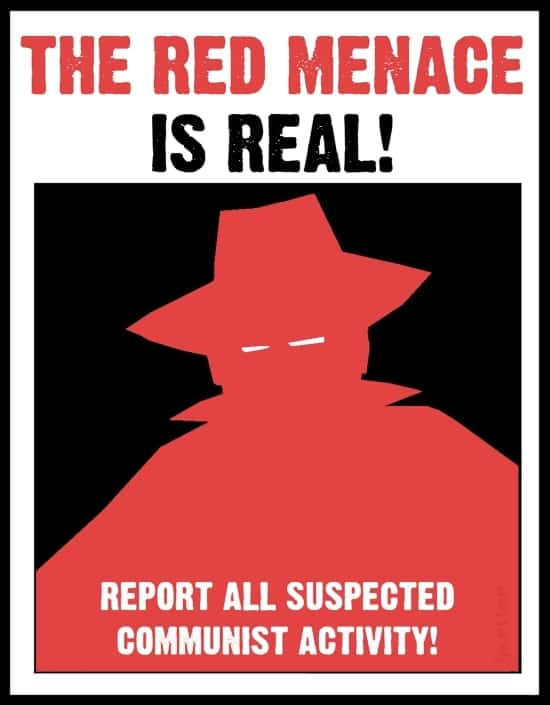
DBQ “The Red Scare” Reflection

Image

Christina Steiner and I have been working on this project for several weeks. We started out with the idea that propaganda is meant to stir feelings in a certain direction, bad or good. Then we decided that we wanted students to recognize the use of propaganda throughout history. Our general question was “What do we want students to learn from the DBQ overall?” The generative question that we formed out of this starting idea was: “How does a nation develop such an intense fear of an enemy, creating mass hysteria?”

We thought that a good starting point to understand such hysteria would be the Red Scare in 1950’s America. We wanted students to learn about the paralyzing fear of communism that existed among Americans at that time. We wanted students to understand what caused such terror to develop. We wanted students to think about what words, images, actions, and depictions might cause fear and what is needed to cause mass hysteria. Student will then be able to understand the driving force of the Red Scare in 1950’s America. The DBQ slowly leads students to think in an investigative manner.

Christina and I chose documents that would help answer the generative question. We found A LOT of interesting documents and images, but we tried to stick to those that would answer that generative question. This kept us focused on the task at hand. We also ended each document or image with follow-up questions, to scaffold student understanding of propaganda. We wanted each document or image to provide a great deal of information that could lead to greater student discovery and interaction with each piece.

The final project can be found here on Learnist and will soon be part of a larger iBook. Through this project, students will come to see and learn how America held such great fear of communism though images, books, comics, films, and posters. We looked specifically at media, examining the creation of enemies based on common perceptions rather than true events or facts.

This DBQ is part of our class-produced, multi-touch iBook. Available free at iTunes